October 6, 2026
Resell AI Agent Builder in Under a Week: Australian Privacy, Pilot KPIs
Launch white label AI agents in under a week with a reseller first plan. Includes Australian privacy checks, pilot KPIs and $497/month.

Resell AI Agent Builder in Under a Week: Australian Privacy, Pilot KPIs
A white-label AI agent builder lets marketing agencies and resellers launch branded conversational agents across messaging channels without building infrastructure, often within a week when the platform supports rapid onboarding. Agent Release AI is a resell-focused example of this model, built around fast setup and enterprise-grade controls. For agencies, the benefit is simple: you get a revenue-generating product to sell without an engineering team.
TL;DR:
- Deploying a white-label AI agent can be completed within a week when using prebuilt templates and a ready configurator, reducing traditional rollout timeframes.
- Key channels to verify before reselling include WhatsApp, SMS, web chat, and email, with branding controls like custom domains, logos, and editable templates essential for client expectations.
- Compliance obligations in Australia require clear AI disclosure, updated privacy policies, data minimization, and oversight on escalations, regardless of the third-party platform used.
- Revenue models vary from flat subscription and add-ons to per-client tiers, with server-side tracking critical for transparent billing and attribution.
- Conduct thorough measurement during pilots with KPIs like resolution rate and lead conversion, and start small to build a scalable, trust-based AI agent deployment.
Table of Contents
- What a white-label AI agent builder is and who should use it
- Quick deployment checklist and realistic timeline
- Channels, customisation and brand controls to verify before you resell
- Security, privacy and Australian regulatory checklist
- Commercial model: how agencies package, bill and attribute revenue
- Pilot, measure and scale: KPIs, governance and rollout plan
- Step-by-step guide to building and deploying an AI agent
- Best practices for training and optimising AI agents
- Common challenges and troubleshooting tips when using AI agent builders
- Case studies or examples of successful AI agent builder implementations
- Author perspective: practical advice from a reseller platform
- How Agent Release AI supports agencies and resellers
- FAQ
- Sources
What a white-label AI agent builder is and who should use it
A white-label AI agent builder is a platform that lets you deploy conversational agents under your own brand, on your own domain, and sell them to your own clients. It’s different from a developer SDK: you’re not writing code or training models from scratch. You’re configuring a ready-made system with your logo, your pricing, and your client’s business details.
This model suits agencies that already manage client relationships but don’t want to run a software team. Typical reseller use cases include:
- Lead capture for service businesses that miss calls after hours.
- After-hours support that qualifies enquiries before a human follows up.
- Sales qualification that filters leads by budget, timeline, or intent.
- Automated follow-up sequences that re-engage cold leads without manual outreach.
A platform worth reselling should give you a Brand-Kit Generator for fast visual setup and genuine multi-channel support, not just a single chat widget with a different logo slapped on it. Those two features are what separate a sellable product from a demo.
Quick deployment checklist and realistic timeline
Agencies need a repeatable process, not a one-off build. A staged rollout keeps client expectations aligned with what’s actually achievable.
- Discovery: scope the client’s intent, compliance constraints, and which channels they actually need (don’t default to all of them).
- Branding and content prep: apply the brand kit, set tone of voice, and draft canned flows for the five or six most common enquiries.
- Provisioning and testing: verify each channel connection, run a security review, and work through a live pilot checklist before going public.
- Launch: go live on one or two priority channels first, then expand once performance holds steady.
When you use a ready white-label configurator with prebuilt templates, this entire sequence can run in under a week rather than the months a custom build would take.
Pro Tip: Run your first pilot on a single channel with a client who has high enquiry volume. A fast, visible win builds the case for expanding to the rest of their channels.
Channels, customisation and brand controls to verify before you resell
Before you put your name on an agent, confirm the platform actually delivers what your client is paying for. Mismatched expectations here cost renewals.
Channels to verify:
- iMessage, WhatsApp, Messenger, and Instagram DMs for consumer-facing businesses.
- SMS and email for service businesses and follow-up sequences.
- Web chat and voice for inbound enquiries that need an immediate response.
Branding features to check: a custom domain, logo and colour controls, a genuine Brand-Kit Generator rather than a basic theme picker, editable message templates, and tenant isolation so one client’s data never touches another’s.
Operational features matter just as much: a multi-channel inbox so your team isn’t juggling five logins, admin roles for client-level access control, and analytics with revenue attribution so you can show clients what the agent is actually worth. Unlimited tenant creation is worth confirming too, since it’s what lets you scale across clients without renegotiating your platform contract each time.
Security, privacy and Australian regulatory checklist
Reselling AI agents means taking on compliance obligations, not just a product. The OAIC’s guidance on commercially available AI products makes clear that deploying a third-party platform doesn’t remove your legal responsibility: you and your client remain accountable under the Australian Privacy Principles for how personal information is collected, used, and disclosed.
AI adoption among Australian businesses rose to 12% in 2024-25, reaching 19% among innovation-active small businesses, according to the Australian Bureau of Statistics. That growth means more clients are asking about AI, and more scrutiny on how it’s deployed responsibly.
Build these into every client rollout:
- Clearly identify the agent as AI to end users, and update the client’s privacy policy to reflect it.
- Apply data minimisation: collect only what the conversation actually needs.
- Keep human oversight on escalations, access controls on the admin panel, and audit logs for every tenant.
- Run accuracy testing before launch and set a remediation process for when the agent gets something wrong.
The National AI Centre’s guidance on AI-generated content recommends visible disclosure wherever AI output could influence a customer’s decision. On the consumer-law side, the Treasury’s review of AI and the Australian Consumer Law finds the ACL broadly capable of handling AI-related risks already, though it flags uncertainty that makes clear, accurate client-facing claims worth getting right from day one.
Commercial model: how agencies package, bill and attribute revenue
Most agencies land on one of three structures: a flat subscription plus a white-label add-on; per-client tiering based on volume or channel count; or a flat fee with an optional onboarding charge for setup work.
Whichever model you choose, revenue attribution is what makes it defensible. Server-side revenue tracking shows exactly which conversations converted, so your billing and client reporting are based on real numbers rather than estimates.
Keep the operational side simple:
- Structure tenants by client, not by channel, so permissions and billing stay clean.
- Set clear SLAs for response time and escalation handling before launch.
- Define renewal terms up front so clients aren’t surprised at month three.
- Price in a way a client can explain back to you in one sentence. If they can’t, it’s too complicated.
Pilot, measure and scale: KPIs, governance and rollout plan
A pilot only proves the case if you’re measuring the right things from day one.
- Set KPIs before launch: resolution rate, lead conversion, handover accuracy, and client satisfaction.
- Run accuracy audits weekly for the first month, then monthly once performance stabilises.
- Document governance: human-in-the-loop rules for escalations, an AI use register, and a privacy register, following the documentation approach recommended by Business.
- Train staff on what the agent can and can’t handle before it goes live.
- Scale channel by channel, watching capacity and monitoring dashboards rather than switching everything on at once.
Pro Tip: Treat the first 30 days as an audit period, not a victory lap. Accuracy issues show up in week two far more often than week one.
Step-by-step guide to building and deploying an AI agent
Once you’ve picked a platform, the build itself follows a consistent sequence regardless of client or industry.
Start by defining the agent’s job: one clear use case, like after-hours lead capture, rather than a general-purpose assistant trying to do everything. Vague scope is the most common reason pilots stall.
Next, configure the brand layer: logo, colours, domain, and tone of voice, so the agent sounds like the client, not like generic software. Then build the conversation flows for your top five or six enquiry types, feeding in the client’s actual offer, pricing, and FAQs rather than placeholder text.
Connect the channels one at a time, verifying each integration works before adding the next. Run internal testing with real sample questions, including edge cases the agent should hand off to a human rather than guess at. Review the escalation path: what happens when the agent can’t answer, and who picks it up.
Finally, launch to a limited audience first, a single location, a single channel, or a capped number of conversations, before opening it up fully. This staged approach catches issues while the stakes are still low, and it gives you a clean before-and-after story to show the client once results come in.

Best practices for training and optimising AI agents
The agents that perform well aren’t the ones with the most features switched on. They’re the ones fed the right information and reviewed consistently.
Feed the agent your client’s actual content: real pricing, real service descriptions, real policies, not generic industry text. Mismatched information is the fastest way to lose a client’s trust in the product.
Review conversation logs weekly in the early stages. Patterns show up fast: the same question phrased three different ways, a topic the agent keeps deflecting, a handover trigger that’s firing too often or not enough. Adjust the flows based on what’s actually happening, not what you assumed would happen at setup.
Keep flows narrow and specific rather than broad and generic. An agent built to handle one business’s booking enquiries well outperforms one built to vaguely handle “customer service” for everyone. Specificity is what makes the output feel accurate rather than templated.
Set a cadence for accuracy checks, not just a one-off test before launch. Client offers change, pricing updates, and seasonal promotions shift, and the agent needs to reflect that or it starts giving outdated answers with full confidence.
Common challenges and troubleshooting tips when using AI agent builders
Most problems agencies hit aren’t platform failures. They’re scope, content, or expectation issues that show up once real customers start talking to the agent.
Vague answers: usually means the content fed into the flows was too generic. Fix it by adding specific, client-approved detail rather than tweaking the flow structure itself.
Too many escalations to a human: often a sign the agent’s scope is too narrow for the volume of questions coming in. Widen the flows covering the most common topics before adding new channels.
Client pushback on tone: happens when the brand kit wasn’t reviewed closely enough before launch. A quick tone pass with the client before go-live avoids a messier fix after customers have already seen it.
Inconsistent results across channels: usually traces back to channel-specific formatting that wasn’t tested. WhatsApp, SMS, and web chat each handle message length and media differently, so test each channel individually rather than assuming one test covers all of them.
Slow adoption internally: agencies sometimes under-invest in showing their own team how the dashboard and reporting work. A short internal walkthrough before the first client pilot saves support headaches later.

Case studies or examples of successful AI agent builder implementations
The clearest wins follow the same shape: a narrow pilot, measurable results, then staged expansion. A service business that starts with after-hours lead capture on a single channel, measures resolution rate and lead conversion for a month, then expands to a second channel once the numbers hold, gives an agency a clean, repeatable story to show the next client.
Agencies pitching this kind of rollout often lean on adoption data to make the case: with AI adoption climbing to 12% of Australian businesses and 19% among innovation-active small businesses, clients are increasingly asking what their competitors are already doing rather than whether AI is worth trying at all. That shift makes the pilot-then-scale pitch easier to land than it would have been a few years ago.
For agencies building a broader go-to-market motion around resold agents, a growth partner like JobsAI can help structure the customer acquisition side, lead generation, retention, and sales process, so the technical rollout and the sales pipeline grow together rather than the product outpacing the pitch.
Author perspective: practical advice from a reseller platform
The agencies that succeed with white-label AI agents start small on purpose. One client, one channel, one clear use case, measured properly before anything scales. The ones that struggle try to launch five channels for three clients in the same week and can’t tell you afterward what actually worked.
The most common mistake isn’t technical. It’s skipping the privacy policy update and the AI disclosure step because the pilot felt low-stakes. It never stays low-stakes once a client’s customers are involved.
Make pricing measurable from day one. If you can’t show a client what the agent did for their revenue, renewal conversations get a lot harder.
— Agent
How Agent Release AI supports agencies and resellers
Everything in this checklist maps directly to what we’ve built. Branded agents can be deployed across iMessage, WhatsApp, Instagram DMs, Messenger, SMS, email, web chat, and voice, often in under a week, with server-side revenue tracking so clients can see what their agent earned.
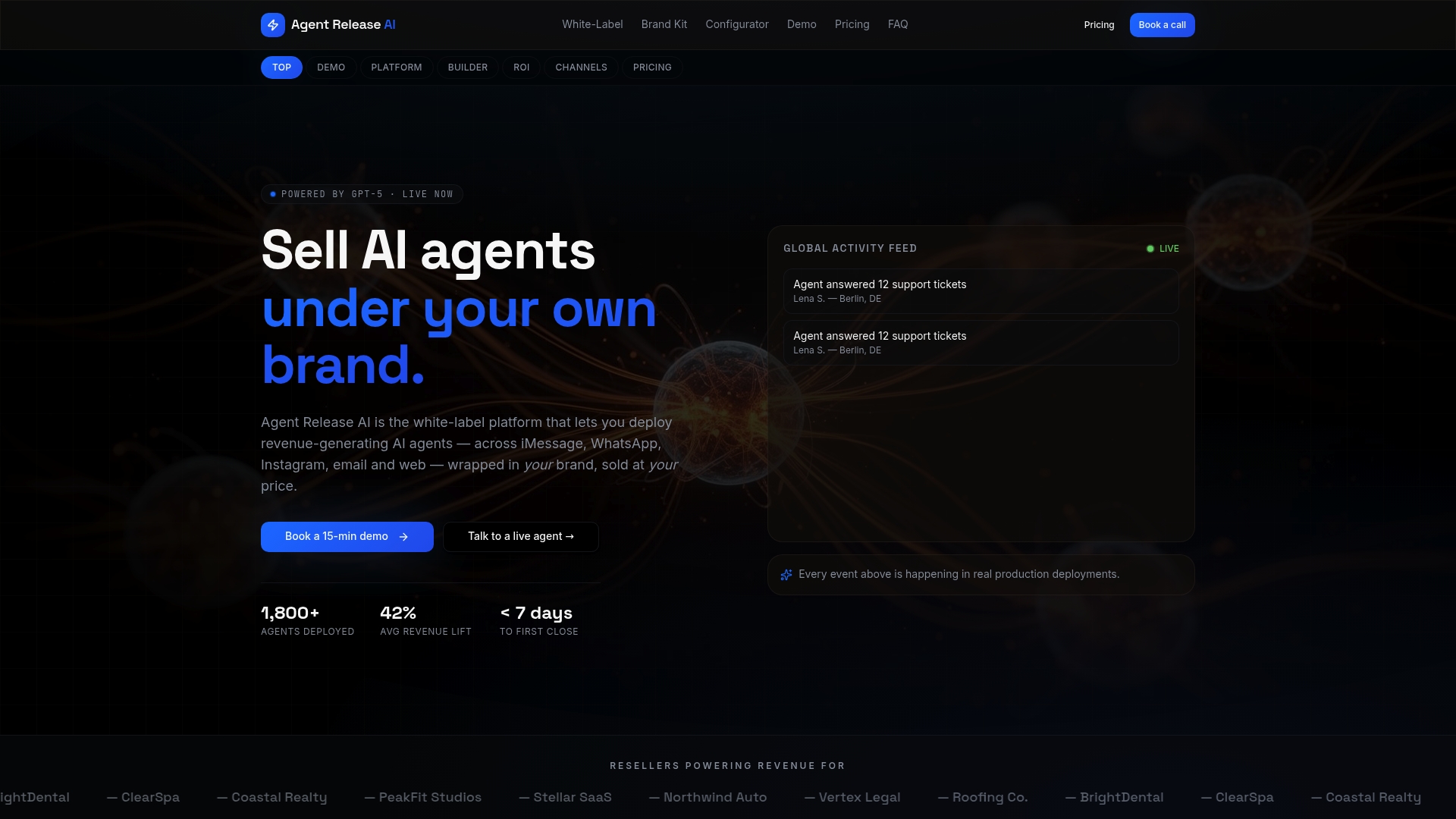
A Brand-Kit Generator handles visual setup quickly, and unlimited tenant creation allows scaling across clients without renegotiating terms each time. Pricing is flat at $497 per month with no setup fees or revenue share, and our White-Label Program is scoped separately for agencies ready to resell under their own brand.
Open the white-label configurator to see how fast a branded agent comes together, or head to Agent Release AI to book a call and walk through your first client pilot.
FAQ
How long does it take to deploy a white-label AI agent?
With a ready configurator and prebuilt templates, a single-channel pilot can go live in under a week. Full multi-channel rollout for a client typically follows once the first channel proves out, usually over the following few weeks.
Do I need to tell customers they’re talking to an AI agent?
Yes. OAIC guidance requires clear identification of AI to users and an updated privacy policy reflecting its use, regardless of which platform you deploy it on.
What does Agent Release AI cost for agencies?
The core platform runs at $497 per month with unlimited agents and channels and no setup fees. The White-Label Program for agencies reselling under their own brand is scoped separately with pricing available on request.
Which messaging channels should I launch first?
Start with the channel your client’s customers already use most, often WhatsApp or SMS for service businesses, or web chat for inbound enquiries. Expanding to additional channels after the first one proves accuracy and resolution rate keeps the rollout low-risk.
Am I still responsible for privacy compliance if I use a white-label platform?
Yes. Using a third-party platform doesn’t transfer legal responsibility: both the agency and the client remain accountable under the Australian Privacy Principles for how personal information is collected and handled.
Sources
- Guidance on privacy and the use of commercially available AI products | OAIC
- Business adoption of artificial intelligence accelerates, 2024–25 (ABS)
- Business
- Being clear about AI-generated content | National AI Centre
- Final report: Review of AI and the Australian Consumer Law