September 18, 2026
Businesses: 7 Use Cases That Need an AI Agent, Not a Chatbot
Business buyers: pick chatbots or AI agents with a 7 case checklist, cost and risk comparisons, and a white label deployment example.
Businesses: 7 Use Cases That Need an AI Agent, Not a Chatbot
A chatbot answers questions; an AI agent gets things done. If the task ends with information a human still has to act on, a chatbot is the right tool. If the task ends with an action inside your systems, such as a booking, a refund, or a data update, you need an AI agent. That single filter decides most technology adoption calls before you even open a vendor deck.
TL;DR:
- AI agents are designed to execute multi-step actions and directly modify external systems, unlike chatbots that only provide information or responses.
- Building an AI agent requires extensive integration, ongoing governance, and complex testing, making it significantly more costly and time-consuming than deploying a chatbot.
- Most enterprise uses benefit from a hybrid approach, with a conversational layer to capture intent and an autonomous agent to perform system actions.
- Cost differences are substantial, with chatbots typically reaching MVP faster at lower costs, while AI agents need persistent memory and sophisticated infrastructure.
- For quick deployment, white-label platforms can provide branded AI agent solutions in under a week, without the months of custom development.
Table of Contents
- AI agent vs chatbot: the core definitions you need straight
- Chatbot vs AI agent: how the underlying loops actually differ
- When to use AI agents vs chatbots: matching the tool to the job
- What AI agents and chatbots cost to build, run, and scale
- The real risks: hallucinations vs actions with consequences
- Production architectures: chatbot-only, agent-only, and hybrid
- How to choose: a decision checklist for business buyers
- A white-label example: how agent platforms serve resellers and agencies
- Prioritise data readiness and governance over autonomy for its own sake
- Getting agentic capability live without building it yourself
- Sources
- FAQ
AI agent vs chatbot: the core definitions you need straight
Vendors throw these terms around loosely, so start with operational definitions you can actually use in a scoping conversation. Interface alone tells you nothing. A chat window can sit in front of either technology, which is exactly why so many buyers get burned.
A rule-based chatbot follows decision trees. It matches keywords or intents to pre-written responses, escalates when it hits a branch it doesn’t recognise, and cannot generalise beyond its scripted flows. These are cheap, predictable, and still common in banking IVR-style deployments.
An LLM-powered chatbot replaces the rigid script with a language model. It can hold a natural conversation, answer open-ended questions, and summarise information from a knowledge base. But it still works in a single-turn loop: input comes in, output goes out. It doesn’t independently decide to check three systems before answering you.
An AI assistant sits somewhere in the middle. It might retrieve calendar data or draft an email for your approval, but a human generally confirms the final action.
An AI agent pursues a goal rather than answering a single prompt. It plans a sequence of steps, calls external tools or APIs, observes what comes back, and adjusts its next move, repeating that cycle until the objective is met or it hits a stopping condition. Redis describes this as the fundamental split: agents take external action, while chatbots generally hand back text for a person to act on.
The confusion that trips up most buyers:
- Interface doesn’t equal architecture. A product with a chat window can be running an agent loop underneath; a product that looks fully automated can just be a well-scripted chatbot with clever prompts.
- The model isn’t the differentiator. Google Cloud notes that the same large language model can power both a chatbot and an agent — what changes is the surrounding scaffolding: tool integration, memory, and multi-step reasoning.
- Autonomy is a spectrum, not a switch. Some deployments let an agent act freely; others require a human to approve every consequential step. Ask where on that spectrum a vendor’s product actually sits.
Many practitioners also misjudge a product by assuming it must present as a chat interface at all. Plenty of agents run mostly in the background, surfacing only a final result or a checkpoint notification, with no conversational front end at all.
Chatbot vs AI agent: how the underlying loops actually differ
The architectural gap is the reason cost, latency, and risk all diverge so sharply between these two categories. A chatbot runs a conversation loop: it receives a message, generates a response using context from the current session, and returns it. That’s the whole cycle. Nothing changes in the outside world.
An agent runs a sense, think, act, observe loop. It senses the current state (a customer request, a system alert, a scheduled trigger), reasons about the best next step, acts by calling a tool or API, then observes the result before deciding whether the goal is met or another step is needed. This loop can run for seconds or, in monitoring use cases, continuously.
Four properties fall out of that difference:
- Tool access. A chatbot typically reads from a knowledge base. An agent writes to systems: it can update a CRM record, issue a refund through a payments API, or send a confirmation email without a person clicking send.
- Memory depth. Chatbots usually work with session-scoped context that resets or truncates once the conversation ends. Agents need persistent memory that survives across sessions and tasks.
- State management. Because an agent might be mid-task when a system times out, it needs a way to resume rather than restart from scratch.
- Reasoning steps. A chatbot answer generally takes one model call. An agent task might take five, ten, or more chained calls before it’s done.
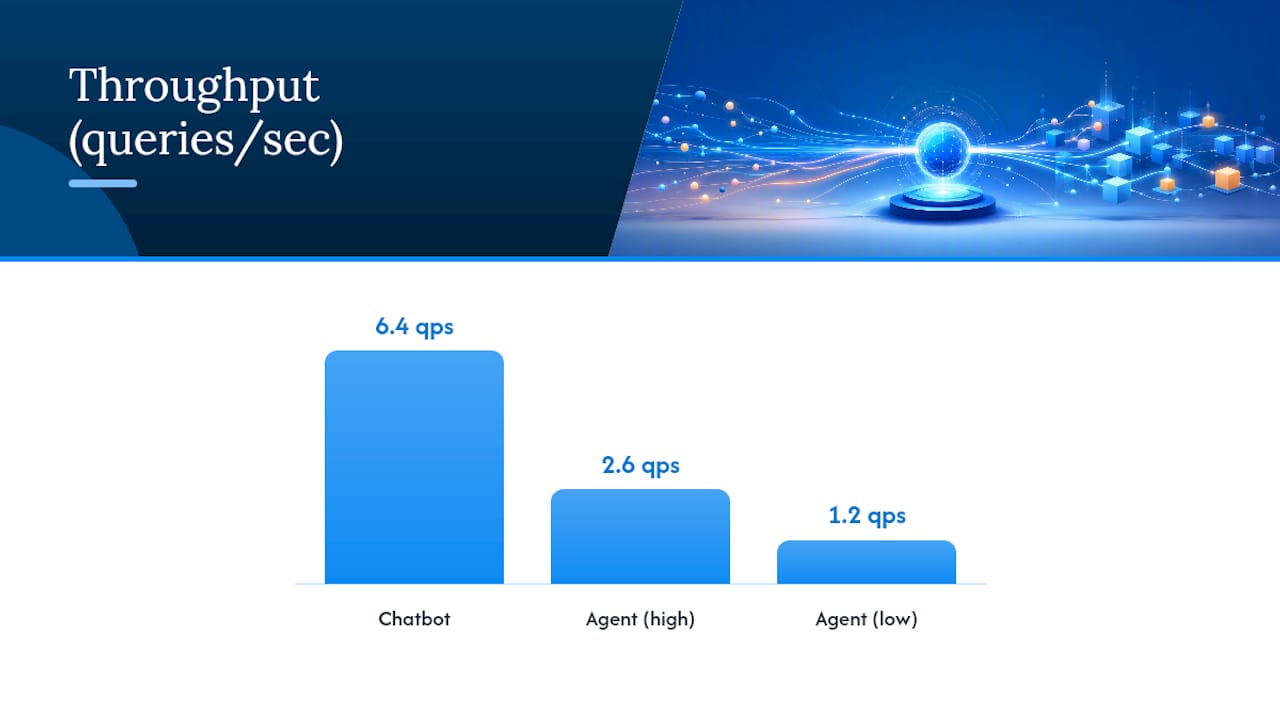
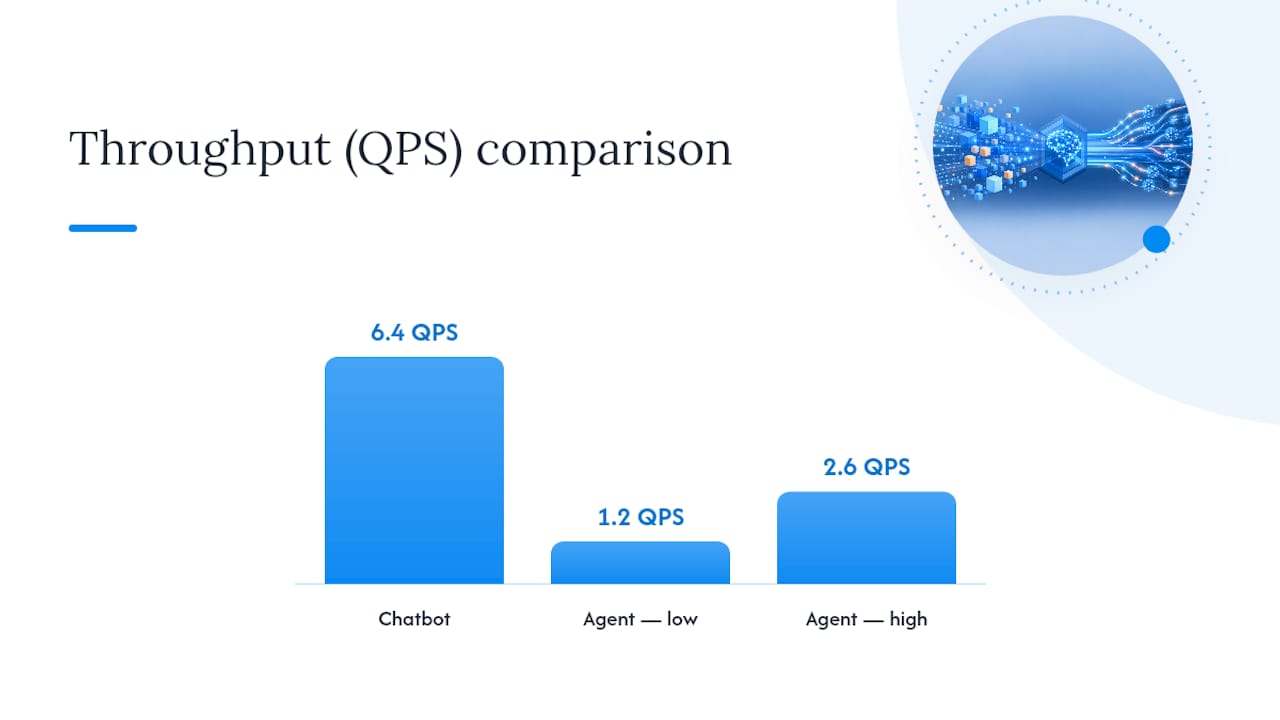
That last point has a direct performance cost. In a measured comparison, a chatbot workload sustained roughly 6.4 queries per second, while a ReAct-style agent handled only 1.2 to 2.6 queries per second on the same infrastructure, because each agent task chains multiple reasoning and tool calls instead of returning a single response.
Pro Tip: Before you approve any agent build, ask the vendor to show you the exact tool-call sequence for one real task, end to end. If they can’t produce it, they haven’t built a real agent loop yet.
Infrastructure requirements scale with that complexity. Persistent memory generally means a vector store for long-term retrieval, alongside fast, in-memory working memory (something like Redis) for sub-second coordination between steps. Combining both reduces the friction of multi-step tasks considerably, because the agent isn’t waiting on slow lookups between every action. Caching layers matter too: repeatable queries can be served from a semantic cache instead of triggering a fresh model call each time, which keeps both latency and cost down as usage scales.
When to use AI agents vs chatbots: matching the tool to the job
Most over-engineering in this space comes from businesses building an agent when a chatbot would have done the job for a fraction of the cost, or the reverse: bolting a chatbot onto a workflow that genuinely needed autonomous action.
- Customer FAQ deflection. Answering “what are your opening hours” or “how do I reset my password” is pure information retrieval. A chatbot handles this well and cheaply, and it’s the highest-volume, lowest-risk use case in customer service.
- Knowledge retrieval and internal search. Employees asking an internal tool to summarise a policy document or find a past ticket resolution don’t need an agent that can take action, just one that can find and explain.
- Lead capture and triage. Qualifying a lead by asking a handful of scoping questions and routing it to the right salesperson is conversational, not operational. A chatbot suits this fine.
- Refunds and bookings. These end in a state change, a payment reversed, a slot reserved, a ticket rebooked. ServiceNow’s practical test applies directly here: if completion requires changing state in a system, you need an agent, not a chatbot.
- Multi-system orchestration. Cross-checking inventory, pricing, and shipping systems before confirming an order touches several platforms in sequence, exactly the kind of chained tool-calling an agent loop is built for. A supplier-sourcing agent that autonomously checks wholesale supplier data across multiple sources is a good real-world example of this pattern in procurement.
- Personalised, long-running workflows. Onboarding a new client over several weeks, adjusting next steps based on their behaviour, needs persistent memory an agent has and a stateless chatbot doesn’t.
- Proactive monitoring. Watching a system for anomalies and acting on them (flagging a fraud pattern, pausing a campaign that’s overspending) requires the agent to initiate action without waiting for a prompt.
The most common production pattern doesn’t force a binary choice at all. A hybrid architecture, a conversational front end that triggers an agent backend for the actual task, is the standard enterprise deployment right now. The customer talks to what looks like a chatbot; behind the scenes, an agent processes the refund or updates the booking once the conversation confirms intent.
What AI agents and chatbots cost to build, run, and scale
Budgeting for either technology means understanding that the price difference isn’t marginal, it’s structural. Chatbots typically cost less and reach a working MVP faster than agents, because there’s no tool integration, no permission scoping, and far less testing surface area. Agent builds commonly require several times more integration, governance, and monitoring effort before they’re safe to put in front of real customers or real money.
Three things drive that gap in practice:
- Integration count. Every system an agent needs to write to (a CRM, a payments gateway, an inventory database) is a separate integration with its own authentication, error handling, and failure mode to design for.
- Testing surface. A chatbot’s testing burden is mostly about response quality. An agent’s testing burden includes every possible sequence of tool calls, which multiplies fast.
- Governance overhead. Agents need audit logging, permission scoping, and often a human approval gate before anything irreversible happens. None of that is optional once real transactions are involved.
Throughput differences compound the cost question. The roughly 6.4 QPS versus 1.2 to 2.6 QPS gap between chatbot and agent workloads noted earlier isn’t just a performance number, it’s a cost multiplier, because more model calls per task means more compute spend per resolved interaction.
Semantic caching is the main lever for controlling that spend. In one measured example, caching repeatable queries can significantly lower LLM costs, though results are heavily workload-dependent and won’t transfer directly to every deployment. A vector store for retrieval and an in-memory cache for repeat lookups are the two infrastructure pieces that make agent economics workable at scale.
Maintenance costs follow the same pattern after launch. A chatbot mostly needs its knowledge base refreshed. An agent needs ongoing monitoring of every integration point, because a silent API change on a partner system can send it acting on stale or wrong data without anyone noticing until a customer complains.
Enterprise adoption is accelerating despite these costs. Gartner projects that 40% of enterprise applications will include task-specific AI agents by the end of 2026, which tells you the investment case is increasingly settled for the right use cases, not that every business needs one immediately.
The real risks: hallucinations vs actions with consequences
Both technologies fail, but they fail in different registers, and understanding that difference is the single most important governance lesson in this entire comparison.
Chatbot failure modes are mostly informational:
- Hallucination: confidently stating something false, an outdated policy, a wrong price, a made-up feature.
- Misrouting: sending a customer down the wrong intent path and frustrating them before a human intervenes.
- Privacy leaks: surfacing information from one user’s context in another user’s conversation due to a memory or session bug.
These are bad, but generally recoverable. A human can correct the record.
Agent failure modes are operational, and some are not recoverable at all:
- Compounding errors: a wrong decision at step two propagates through steps three, four, and five before anyone notices.
- Irreversible side effects: an agent that issues a duplicate refund, deletes a record, or sends an email to the wrong list can’t always undo that action.
- Autonomy creep: as an agent’s permissions expand over time, so does the blast radius of any single mistake. Governance needs to scale at least as fast as autonomy does, not catch up after an incident.
The controls that matter most in production:
- Human-in-the-loop checkpoints on any action involving money, deletion, or irreversible communication.
- Audit logs for every tool call an agent makes, so you can reconstruct exactly what happened and why.
- Confirmation gates that require explicit approval before high-risk steps execute.
- Canary releases that expose an agent to a small slice of real traffic before a full rollout, so a bad decision affects ten customers, not ten thousand.
Pro Tip: Set a monetary or reversibility threshold below which your agent can act freely, and above which it must pause for human sign-off. Most teams skip this until after their first costly mistake.
Production architectures: chatbot-only, agent-only, and hybrid
Three deployment patterns show up repeatedly once you look across real enterprise rollouts, and choosing between them shouldn’t be a one-off decision, it should follow a deliberate sequence.
Chatbot-only architectures suit high-volume, low-risk, purely informational workloads: FAQ deflection, basic troubleshooting, lead qualification. No tool-write access, minimal governance overhead, fastest to ship.
Agent-only architectures suit backend automation where no conversational interface is needed at all, monitoring systems, batch processing pipelines, autonomous sourcing tools. These often run with no chat window whatsoever.
Hybrid architectures are now the dominant enterprise pattern. A conversational layer handles intent capture and confirmation, then hands off to an agent that executes the actual task. This is deliberate risk management: keep the unpredictable, judgement-heavy part (understanding what the customer wants) in a lower-risk conversational layer, and reserve the higher-risk part (executing a system change) for a tightly scoped, tool-permissioned agent.
The recommended adoption path follows that same logic. Enterprise builders generally advise starting with a chatbot to clean up your knowledge base and prove where the real value sits, then layering agentic automation on top only where the return justifies the added governance burden and your data is actually ready to support it. Skipping straight to agent autonomy on messy, unstructured data is one of the more common and costly mistakes in this space.
Integration considerations to plan for regardless of pattern:
- API permission scoping, giving the agent exactly the write access it needs and nothing more.
- Error recovery logic for when an external system times out or returns an unexpected response mid-task.
- Observability tooling that logs every step, not just the final outcome, so debugging doesn’t mean guessing.
- Monitoring alerts for anomalous action patterns, a sudden spike in refunds issued, for instance, that flag a possible malfunction early.
How to choose: a decision checklist for business buyers
Run any proposed use case through this filter before you commit budget:
- Does the task end with an action, or with information? If a human still has to do something after the interaction, a chatbot is probably sufficient. If the interaction itself needs to change a system, you need an agent.
- Does it require touching multiple systems? A task that stays within one data source rarely justifies agent-level complexity. One that spans a CRM, a payments platform, and an inventory system usually does.
- How high is the exception rate? If 30% of cases need a human to intervene anyway, an agent’s automation upside shrinks fast, and a well-designed chatbot with clean escalation might deliver more value for less spend.
- Can the vendor show you a tool access matrix? Ask exactly which systems the agent can read from and write to, and under what permission scope.
- What governance and audit capabilities exist? Request sample audit logs, not just a description of “enterprise-grade security”.
- Can they produce a sample integration diagram? A vendor who can’t show you how their agent actually connects to your systems hasn’t done that work yet.
- What do their SLA and security documents actually commit to? Verbal assurances aren’t a substitute for a written service level agreement.
Run any pilot against a small, honest set of metrics rather than vague satisfaction scores:
| Metric | What it tells you |
|---|---|
| Resolution rate | Percentage of interactions completed without human handoff |
| Percentage of automated actions | Share of tasks the agent completed end to end versus flagged for review |
| Error rate | Frequency of incorrect or reversed actions during the pilot |
| Cost per resolved interaction | Total spend divided by successfully completed tasks |
For specialised procurement decisions, applying structured vendor selection criteria built for professional services, weighing integration depth, governance, and support quality, transfers well to evaluating any AI vendor, not just tax or legal tools.
A white-label example: how agent platforms serve resellers and agencies
Not every business wants to build agent infrastructure from scratch, and for a specific buyer, marketing agencies, consultants, and SaaS resellers, that’s not the right use of their time anyway. Their job isn’t building agent architecture; it’s deploying automated client interactions under their own brand and monetising that deployment.
That’s the exact gap a white-label platform is built to close, and it’s worth knowing what to actually ask for when you’re evaluating one.
Multi-channel support matters because your clients’ customers don’t all live on one platform. A platform that reaches iMessage, WhatsApp, Instagram DMs, Messenger, SMS, email, web chat, and voice from one backend saves you from stitching together separate tools for each channel.
Server-side revenue tracking matters if you’re reselling to multiple clients and need to attribute revenue accurately per tenant without building that accounting logic yourself.
Enterprise-grade security and unlimited tenant creation matter once you’re running more than a handful of client deployments, since you don’t want a platform that charges per client or caps how many brands you can spin up.
A brand-kit configurator is what actually makes “white-label” real rather than aspirational: the ability to apply your client’s branding, domain, and tone without a custom build for every account. Agent Release AI’s configurator is built around exactly that job.
On timelines, Agent Release AI’s white-label program targets deployment in under a week, which sets a useful benchmark to hold any white-label vendor against, since agencies typically need to onboard clients fast to make the resale model work financially. Whatever platform you’re evaluating, ask for integration touchpoints and observability details up front, not after signing.
Prioritise data readiness and governance over autonomy for its own sake
The industry conversation around agents tends to skip straight to autonomy as the goal, more independence, more automation, less human involvement. That framing gets adoption backwards.
Start with the reactive layer. A chatbot forces you to clean up your knowledge base, your FAQ content, your policy documents, before you ever hand decision-making to something that acts on your behalf. Businesses that skip this step and go straight to agent deployment usually end up automating a mess rather than a process.
Observability and human checkpoints for irreversible actions aren’t bureaucracy, they’re the only thing standing between a small mistake and a costly one. Insist on audit logs and confirmation gates before autonomy expands, not after an incident forces the issue.
Measure success with plain metrics: resolution rate, error rate, cost per resolved interaction. Expand autonomy only where those numbers show it’s replacing genuine manual work, not because a vendor’s roadmap says it’s time.
— Agent
Getting agentic capability live without building it yourself
If you’ve read this far and landed on “we need agent capability, but not the six-month build,” that’s precisely the gap Agentrelease exists to close. Agentrelease is the alternative to building agent infrastructure in-house: you get a white-label platform that deploys branded AI agents across iMessage, WhatsApp, Instagram DMs, Messenger, SMS, email, web chat, and voice, typically within a week, instead of the multi-month integration and governance build this article just walked through.
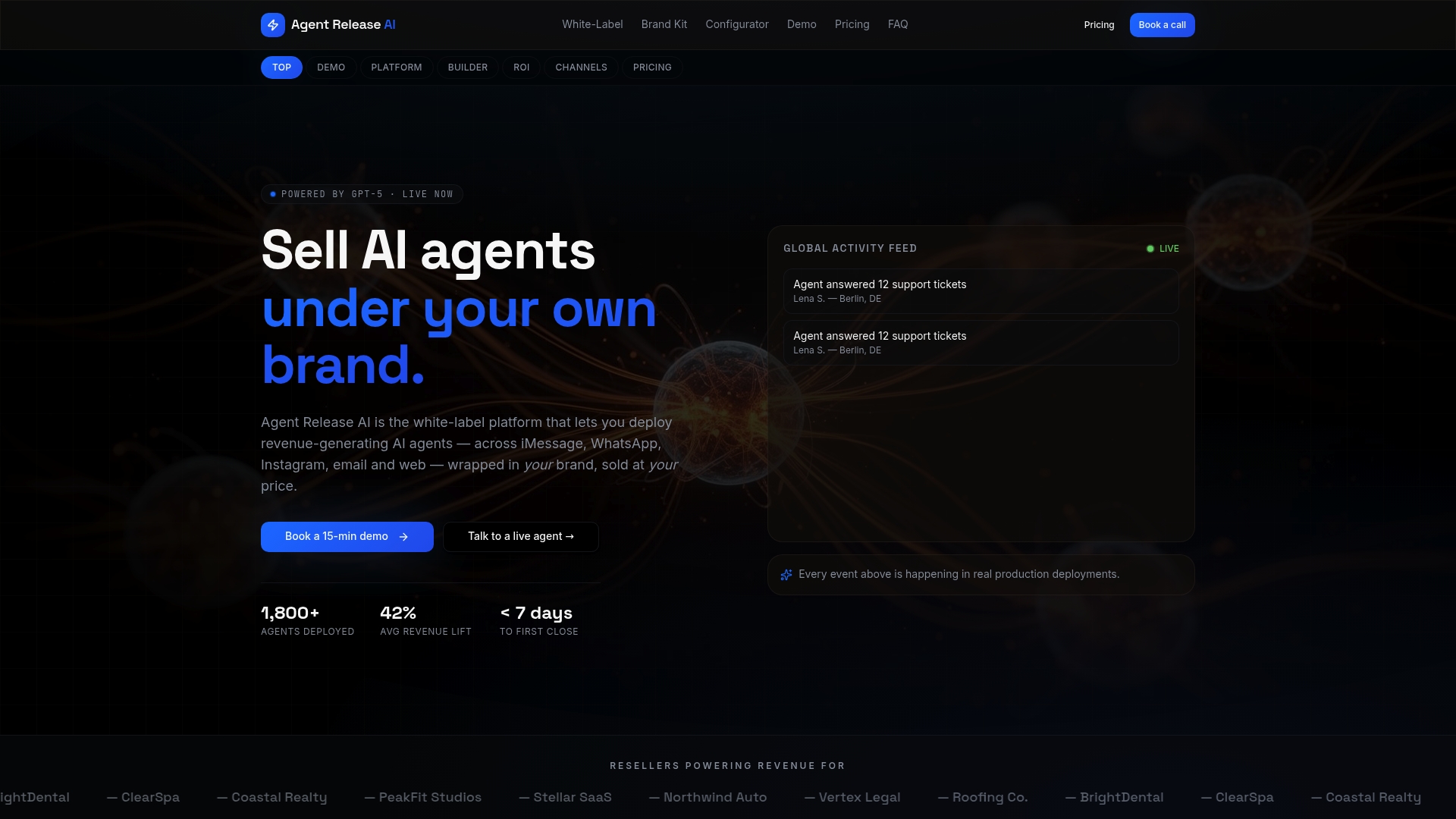
The platform is built specifically for marketing agencies, consultants, and SaaS resellers who want to resell automated client interactions under their own name. It comes with server-side revenue tracking so you can attribute earnings per client without building that logic yourself, enterprise-grade security, unlimited tenant creation for however many client brands you’re running, and a brand-kit configurator that applies each client’s domain and tone without a bespoke build every time.
Deciding between building in-house and going white-label comes down to timeline and integration appetite: if your team has months to spend on tool permissioning, memory infrastructure, and governance testing, build it. If you want billable agent deployments live this month, a white-label partner gets you there faster.
Agent Release AI runs at $497 per month for the core platform, with the white-label program priced on request for agencies ready to resell. Check current plan details and book a call to see the configurator in action.
Sources
For teams planning an implementation, these sources are worth bookmarking directly: Redis’s technical breakdown of agent versus chatbot architecture covers throughput and memory in detail; Google Cloud’s explainer on AI agents clarifies how the same model can power both; ServiceNow’s practical decision framework is the clearest business-facing test available; and Gartner’s enterprise adoption projection sets useful context for budget planning.
- AI agent vs chatbot: Key differences explained
- AI agent vs chatbot: Key differences & when to use each (2026)
- What are AI agents? (Google Cloud)
- AI Agents and Chatbots: What’s the Difference? (ServiceNow)
FAQ
Is ChatGPT a chatbot or an AI agent?
ChatGPT on its own is a conversational chatbot: it answers prompts and returns text without independently taking action in outside systems. When connected to tools, APIs, or plugins that let it plan multi-step tasks and act on your behalf, that same model becomes part of an agentic system rather than staying a pure chatbot.
What are the 7 types of AI agents?
Definitions vary across sources, but common categories include simple reflex agents, model-based reflex agents, goal-based agents, utility-based agents, learning agents, hierarchical agents, and multi-agent systems. Most business deployments in practice use goal-based or hierarchical patterns rather than the full academic taxonomy.
Is an AI agent just a bot?
No. A bot or chatbot typically returns information in a single-turn exchange, while an AI agent plans, calls external tools, observes results, and iterates until a goal is met, often taking real actions like updating a database or issuing a refund. The interface can look identical; the underlying loop is what differs.
What is the difference between an AI agent and a conversational AI chatbot?
A conversational chatbot exists to answer questions and hold a dialogue, generally within a single session and without writing to external systems. An AI agent is goal-driven: it can chain multiple steps across different systems and take action, not just respond, which is the core distinction enterprise guides converge on when advising business buyers.
How much does it cost to build an AI agent versus a chatbot?
Chatbots generally cost less and reach a working version faster because they don’t need tool integrations or heavy governance. Agent builds typically cost several times more due to integration, testing, and audit requirements, though a white-label platform like Agent Release AI, at $497 per month, can shortcut that build cost for resale use cases.