September 15, 2026
Behavior First AI Lead Nurturing: 20–30% Lift for B2B
Behavior first AI lead nurturing that scores, segments, and triggers personalized outreach in real time. Includes starter stack costs, KPIs, channels, and...
Behavior First AI Lead Nurturing: 20–30% Lift for B2B
AI lead nurturing scores every lead in real time, groups them by behaviour rather than demographics alone, and triggers personalised outreach the moment intent signals appear. The outcome is faster qualification, higher reply rates, and conversions that no longer depend on a rep remembering to follow up. The mechanism is simple to state: signals in, score out, next action triggered automatically.
TL;DR:
- Behavior-based AI scoring separates fit from intent, providing clear rationale for each score change to increase sales trust and actionability.
- Fast response times within five minutes of high-intent actions significantly improve lead qualification and conversion rates.
- AI-powered lead nurturing generally yields a 20 to 30 percent increase in conversions and two to three times higher reply rates over static email methods.
- Implementation requires first cleaning CRM data, defining clear customer profiles, and running pilot programs to ensure model accuracy before scaling.
- Low-cost starter stacks for small teams start around $60 to $100 monthly, while enterprise solutions involve tens of thousands of dollars annually for advanced customization.
Table of Contents
- What is AI lead nurturing and how does it work?
- What results can you expect from AI-powered lead nurturing?
- How do you implement AI lead nurturing without breaking your pipeline?
- Which channels work best for AI-driven lead nurturing?
- What KPIs and timelines should you expect?
- What does a typical AI lead nurturing tech stack cost?
- How white-label AI agents fit into a lead nurturing stack
- When AI lead nurturing is worth it, and when it isn’t
- Deploy branded AI agents without the build time
- Primary sources and further reading
- Sources
- FAQ
What is AI lead nurturing and how does it work?
AI lead nurturing is the practice of using machine learning models to score, segment, and personalise outreach to prospects based on live behavioural signals rather than a fixed calendar of emails. That last distinction matters more than any other in this field. Traditional automated lead nurturing sends email three, four, and five on a schedule set weeks in advance. AI-driven systems watch what a lead actually does, then decide what happens next.
The process starts with data ingestion. Every serious deployment pulls from form fills, website behaviour, email engagement, chat transcripts, and paid ad leads, then enriches that raw activity with firmographic and technographic detail (company size, industry, tech stack) so the model has context beyond a name and an email address. Without clean, connected data here, nothing downstream works. Salesforce’s guidance on AI lead nurturing puts a data foundation, transparent scoring criteria, and native CRM integrations at the centre of any credible rollout, and that order of priority is deliberate. Skip the foundation and the personalisation layer has nothing worth acting on.
Scoring is where most teams get the model wrong. A single blended score that mixes “this company fits our ICP” with “this person is ready to buy” produces confusing recommendations, because a perfect-fit account with zero recent activity looks identical to a mediocre-fit account browsing your pricing page daily. Splitting the score into fit (how well the account matches your ideal customer profile) and intent (how actively they’re engaging right now) fixes that. The best systems also surface a one-line rationale for every score change, something like “score raised 12 points: visited pricing twice, opened last two emails within an hour.” That explainability is what gets sales reps to trust and act on a score instead of ignoring it.
Segmentation then becomes dynamic rather than static. Instead of a lead sitting in “Q2 Webinar Attendees” forever, they move between clusters as behaviour shifts, from “cold, low engagement” to “warm, evaluating” to “hot, comparison shopping” within days or hours.
From there, generative personalisation writes the actual outreach:
- Subject lines adapted to the specific page or content the lead engaged with last
- Opening lines referencing their company’s stated use case or recent activity
- Content and media selection (case study vs demo video vs pricing sheet) matched to where they sit in the funnel
- Send-time optimisation based on when that individual has previously opened email
The final layer is real-time prioritisation. The system ranks every open lead by predicted next-best action, so a rep’s morning queue isn’t sorted by “who came in first” but by “who is most likely to convert if contacted right now.” Sendspark’s nurture framework frames this as a continuous re-ranking exercise rather than a one-time scoring event, which is the behaviour-based shift this whole category is built on.
What results can you expect from AI-powered lead nurturing?
The honest answer depends heavily on your starting point, but the pattern across implementations is consistent enough to plan around. Replacing rules-based drip automation with adaptive, behaviour-triggered journeys typically produces a 20 to 30% conversion lift, and teams using AI-personalised video in outreach have reported reply-rate improvements of two to three times over static text emails, according to Sendspark’s data.
Beyond conversion numbers, the efficiency gains show up in three places:
- Reduced manual rep time spent triaging cold leads that were never going to convert
- Faster time-to-contact on high-intent leads, since scoring and routing happen automatically instead of waiting for a manual review
- Improved MQL to SQL conversion, because sales only sees leads the model has already validated against fit and intent criteria
Not every business gets equal value here. AI lead nurturing pays off fastest where inbound volume is high enough that manual triage becomes a bottleneck, where B2B sales cycles run long enough that consistent touchpoints matter over months, and where multiple stakeholders are involved in a single deal and need different messaging angles simultaneously. A five-person sales team with 40 inbound leads a month and a two-week sales cycle will see far less lift than a team drowning in 2,000 leads a month with a four-month enterprise cycle. Scale and complexity are what make the automation worth the setup effort.
How do you implement AI lead nurturing without breaking your pipeline?
Rushing this is the single most common way teams waste a good tool on bad data. Work through it in order.
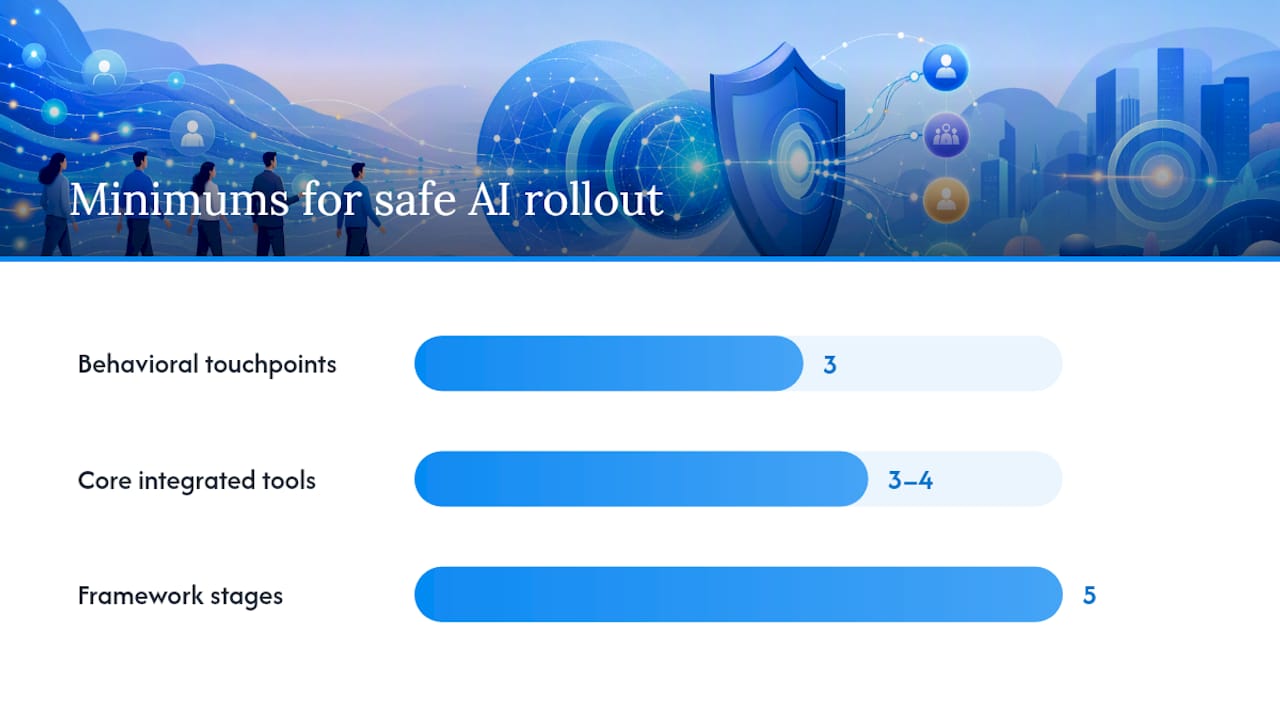
- Audit and clean your CRM first. Before any AI model touches your leads, confirm you have consistent fields for company size, industry, source, and at minimum three behavioural touchpoints per lead (email opens, page visits, form fills). Duplicate records and inconsistent naming conventions will poison a scoring model faster than anything else.
- Define your ideal customer profile explicitly, then build separate fit and intent scores against it. Fit should draw from firmographic data that rarely changes; intent should draw from behavioural data updated in near real time. Keep the two visible to sales as separate numbers, not one blended figure.
- Select three to four core tools with native integrations, not a dozen point solutions duct-taped together. Salesforce’s own guidance is explicit that teams succeed by prioritising a small, connected stack over a sprawling one. Every extra disconnected tool is another place data goes stale.
- Set guardrails for what AI can do autonomously versus what needs a human. A reasonable starting rule: AI can send nurture emails, update scores, and schedule meetings automatically, but any pricing negotiation, contract discussion, or leads flagged as enterprise-tier gets a warm handoff to a rep before the next message goes out.
- Run a narrow pilot before expanding. Pick one high-intent trigger, such as a pricing page visit or demo request, map the ideal next action for it, and run a 30 to 90 day optimisation sprint measuring lift against your current baseline before adding a second trigger.
That sequencing matters because the failure mode isn’t usually the AI. It’s teams skipping straight to step five with none of the first four in place, then blaming the model when it recommends nonsense based on garbage data.
Pro Tip: Don’t let the AI touch pricing conversations or contract terms in its first 90 days live. Use that window to build trust in the scoring and segmentation before you hand over anything commercially sensitive.
The five-stage framework worth keeping on your wall through this whole process is: score, segment, personalise, trigger, optimise. Each stage builds on the last, and Sendspark’s playbook recommends treating it as an incremental rollout with measurable milestones at each stage, not a single big-bang launch.
Which channels work best for AI-driven lead nurturing?
Channel selection isn’t a preference question, it’s a behaviour-matching exercise. Email remains the right default for early-stage nurturing and low-urgency touchpoints, where a lead is still researching and doesn’t need an immediate response. The moment intent signals spike, though, email alone starts costing you conversions.
Here’s how to map channel to behaviour:
- Email for ongoing nurture sequences, educational content, and re-engagement after a period of inactivity
- SMS or WhatsApp when a lead has shown high intent (pricing page visit, demo request) and speed of response matters more than message length
- Voice for enterprise or high-value deals where a human or AI voice agent can qualify quickly and route to a specialist
- Personalised video for re-activation of cold leads or as a differentiator in a competitive deal, where a short, tailored clip outperforms another templated email
The assets themselves need to reflect the specific behaviour that triggered them. A lead who watched 80% of a demo video and then visited the integrations page should get an opening line referencing that integrations page, not a generic “thanks for your interest” template. Dynamic video that swaps in the prospect’s company name, logo, or specific use case is one of the more effective personalised assets teams are using right now, largely because it’s still rare enough to stand out.
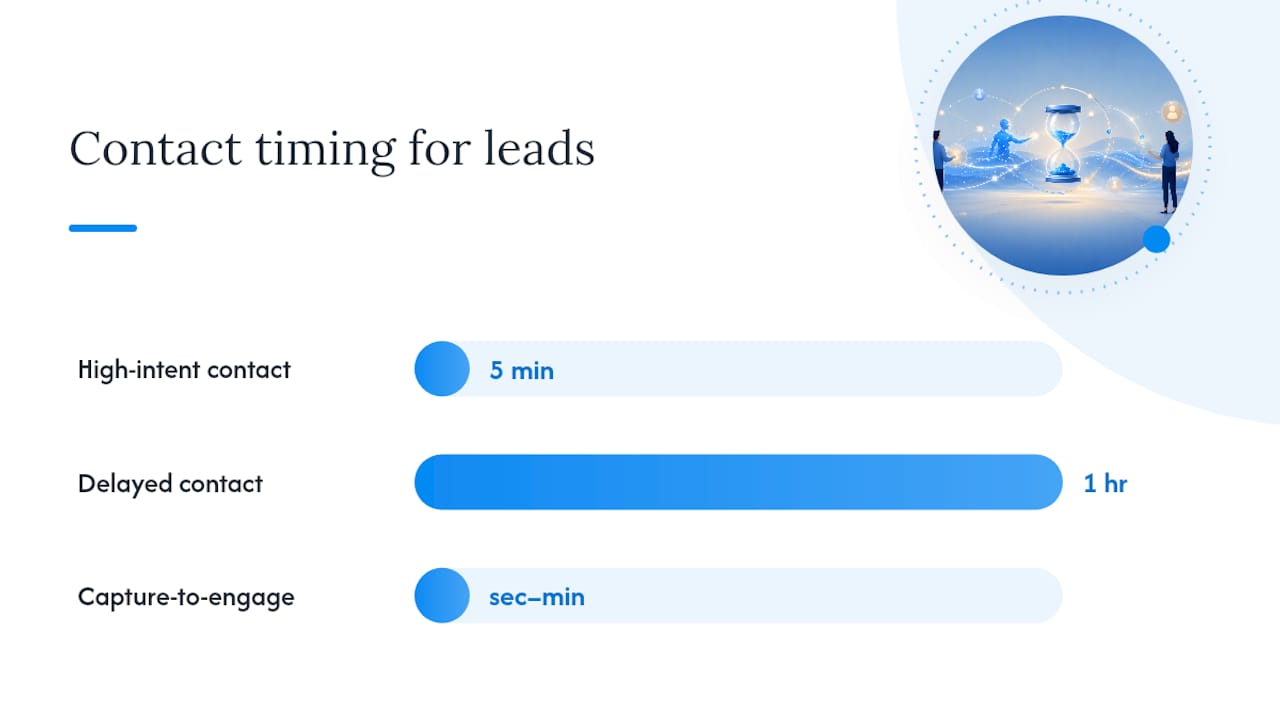
Timing rules make or break this channel strategy. Contacting a lead within five minutes of a high-intent action, like a pricing page visit or a demo request, produces materially higher qualification rates than waiting even an hour, based on LeadResponseManagement’s research on speed to lead. That five-minute window isn’t arbitrary. It’s roughly the point where a prospect’s attention and intent are still fresh before they move on to a competitor’s site or simply get distracted.
Warm handoff design deserves the same rigour as message timing. The best setups let an AI agent qualify a lead through a natural conversation, then auto-book a meeting directly on a rep’s calendar with full context attached, so the rep opens the call already knowing what the prospect asked and what they’re evaluating. Vendor case studies from Swiftex show this capture-to-engagement sequence happening within seconds to minutes in practice, which is the kind of speed a manual process simply cannot match.
What KPIs and timelines should you expect?
Four metrics matter more than the rest: reply rate, conversion to opportunity, MQL to SQL conversion rate, and time-to-contact. Track all four from week one, because they tell you different things. Reply rate tells you if your personalisation is landing. Time-to-contact tells you if your triggers and routing are actually firing. The conversion metrics tell you if any of it is translating into pipeline.
Model stabilisation doesn’t happen overnight, and setting the wrong expectations here is a common reason pilots get killed too early.
| Timeframe | What to expect |
|---|---|
| 2 weeks | Early behavioural signals visible; not enough data for reliable scoring accuracy |
| 30 to 60 days | Scoring accuracy improves meaningfully as the model sees more labelled outcomes |
| 90 days | Lift stabilises enough to compare confidently against your pre-AI baseline |
On testing methodology, continuous multi-armed bandit testing (where the system shifts traffic toward whichever variant is winning in real time) tends to outperform periodic A/B tests for nurture sequences, simply because it adapts faster than a human running quarterly test reviews. Either approach depends on one non-negotiable step: writing closed-won and closed-lost outcomes back into the model as labelled training data. Skip that feedback loop and your scoring model never actually learns from real sales outcomes, it just keeps repeating its original assumptions indefinitely.
What does a typical AI lead nurturing tech stack cost?
Budget scales with ambition here more than with company size, and there’s no reason a small team needs to start big. A starter stack for a small team or solo operator can run as little as US$60 to US$100 a month, according to Sendspark’s published estimates, typically combining a CRM with built in automation, an email personalisation tool, and a lightweight scoring add on.
Mid-market teams running higher lead volumes and multiple channels usually land in a noticeably wider monthly range, once you add a dedicated lead scoring platform, a conversational AI layer for chat and SMS, and tighter CRM integrations across the stack. The jump in cost buys you native integrations that don’t break, better data enrichment, and support when something goes wrong at 2am before a big campaign launch.
Enterprise stacks look different again. These typically run into the tens of thousands of dollars annually, and the spend goes toward custom model training, dedicated data infrastructure, and vendor support contracts with actual SLAs attached.
The trade-offs across all three tiers come down to the same four questions:
- How much control do you need over the model’s logic versus accepting a vendor’s black-box scoring?
- Who maintains the integrations when a CRM field changes or an API updates?
- Who owns the data, and can you export it cleanly if you switch vendors later?
- How locked in are you to a single vendor’s roadmap and pricing changes?
There’s no universally correct answer to any of those four questions. A fast-growing startup might accept more vendor lock-in for speed, while a regulated enterprise will pay more for the data ownership and control.
How white-label AI agents fit into a lead nurturing stack
A growing number of agencies and consultants are handling the conversational layer of lead nurturing through white-label platforms rather than building it in-house, and it’s worth understanding how that model works before deciding if it fits your stack. Agent Release AI is one example: a platform that lets a business deploy AI agents across iMessage, WhatsApp, Instagram DMs, SMS, email, web chat, and voice, all branded as the business’s own product rather than a third-party tool bolted on.
The deployment pattern is straightforward. Agents connect into your existing CRM, capture and enrich lead data as conversations happen, and hand off warm, qualified leads to a human rep once the conversation reaches a point that needs one. Some white-label AI platforms market deployment inside a week, which changes the pilot math considerably. Instead of a three-month build cycle, you’re testing a live conversational nurture flow within days.
For agencies and resellers specifically, the multi-tenant architecture matters more than the AI itself. Unlimited tenant creation means one agency can run separate branded agent instances for every client without spinning up new infrastructure per account, and server-side revenue tracking gives resellers visibility into what each deployment is actually generating, rather than guessing at attribution after the fact.
If you’re evaluating a white-label conversational agent for this purpose, run it against a short checklist:
- Does it support the channels your leads actually use, not just email?
- Can it sync bidirectionally with your CRM, not just push data one way?
- What’s the realistic time to first live conversation, not the marketing claim?
- Does branding control extend to domain, sender identity, and conversation tone, not just a logo swap?
- Is revenue or performance tracked at the tenant level if you’re reselling it?
That last point separates a tool built for single-business use from one genuinely built for resale.
When AI lead nurturing is worth it, and when it isn’t
Hold off if your CRM data is inconsistent, if you haven’t defined an ideal customer profile, or if sales and marketing don’t agree on what “qualified” even means. AI lead nurturing amplifies whatever process you already have. Feed it a broken manual process and it will automate the broken parts faster, not fix them.
The most common mistake I see isn’t a bad algorithm. It’s teams replicating a flawed manual workflow into an automated one and expecting different results, or deploying a scoring model with no explainability, so reps stop trusting it within a month and quietly go back to gut instinct. Opaque scores are worse than no scores at all, because they erode confidence in the whole system.
The practical path forward is narrow and specific: pick one high-intent trigger, measure the lift honestly against your current baseline, and only then expand scope. Teams that start broad almost always end up managing complexity instead of managing leads.
— Agent
Deploy branded AI agents without the build time
Most teams weighing up AI lead nurturing face a build-versus-buy decision that eats months before a single lead gets touched. Agentrelease skips that step: a white-label platform for deploying AI agents across iMessage, WhatsApp, SMS, email, and voice under your own brand, live in under a week instead of a quarter.
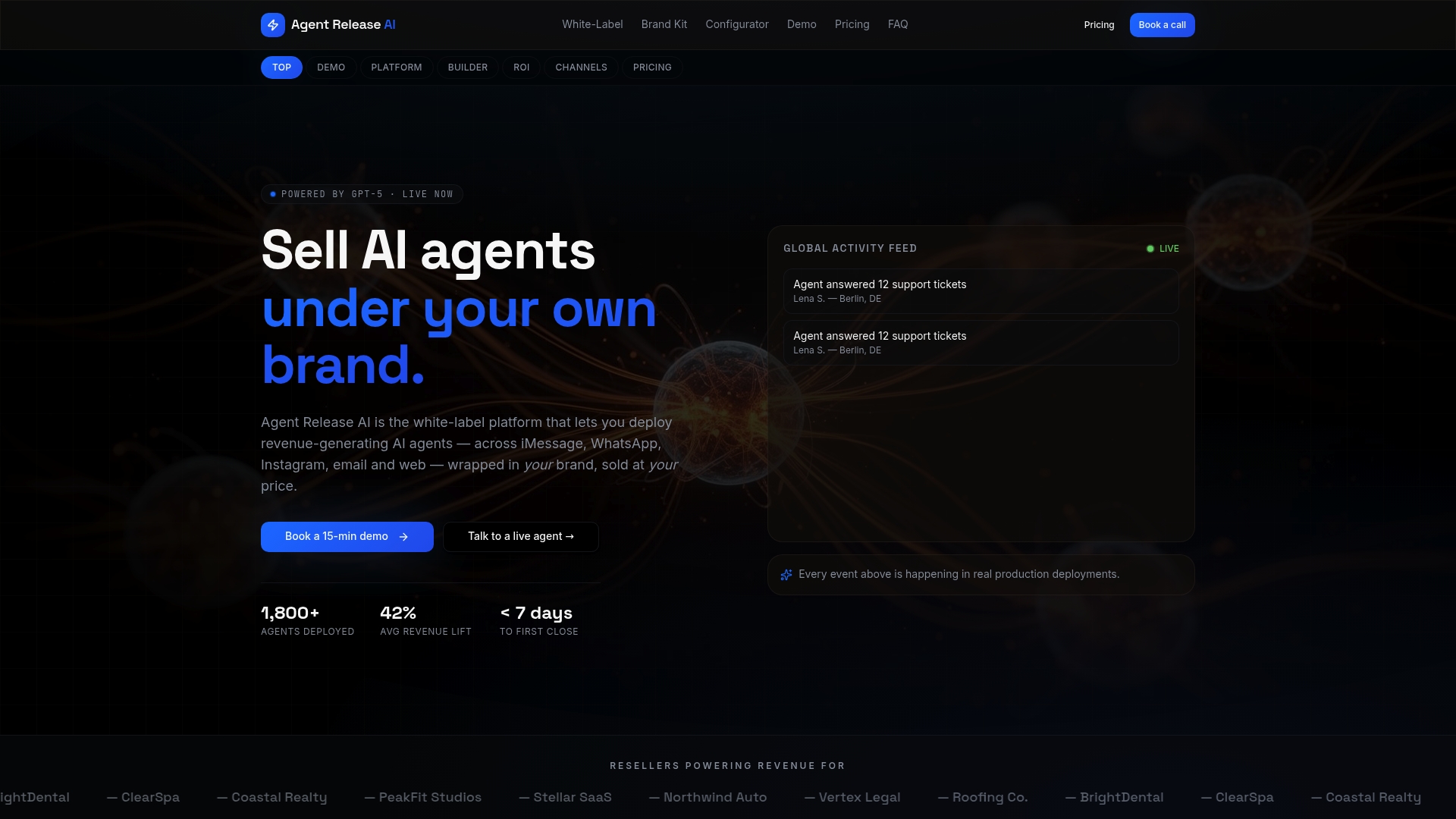
For agencies and consultants specifically, the appeal isn’t just speed. It’s running unlimited branded tenants for every client from one platform, with server-side revenue tracking so you can actually see what each deployment is generating. The Agent Release AI plan runs $497 a month with no setup fees, per-message charges, or revenue-share cuts, unlimited agents and channels included. If reselling is the goal, the White-Label Program adds full domain and branding control on top, with pricing available on request.
Before committing spend elsewhere, check what a fully branded agent looks like using the white-label configurator, map it against the CRM integrations you already run, and scope a single high-intent trigger as your pilot.
Primary sources and further reading
The claims in this guide draw on named, checkable sources rather than general industry consensus:
- Salesforce’s AI lead nurturing guide covers data foundation and scoring transparency best practices
- Sendspark’s nurture playbook sources the five-stage framework and conversion lift figures
- LeadResponseManagement’s speed-to-lead study backs the five-minute response window
- Meera AI’s conversational nurturing analysis supports the case for two-way messaging over email-only approaches
Sources
- AI Lead Nurturing: A Complete Guide to How It Works | Salesforce
- AI lead nurturing: Smart nurture playbook | Sendspark
- LeadResponseManagement study
- AI Lead Management Software — Capture, Enrich, Route, Convert | Swiftex
FAQ
What does lead nurturing mean?
Lead nurturing is the ongoing process of building relationships with prospects who aren’t ready to buy yet, guiding them toward a purchase decision through relevant, timed communication. AI lead nurturing does this by adapting that communication to real-time behaviour instead of a fixed schedule.
What is automated lead nurturing and how does it work?
Automated lead nurturing uses software to send pre-set sequences of emails or messages triggered by actions like a form fill or download. AI-driven versions go further by scoring intent continuously and personalising the content, timing, and channel of each message based on what the individual lead does next.
What is the 30% rule in AI?
There’s no single, universally recognised “30% rule” specific to AI as a field. In lead nurturing specifically, the closest documented figure is the reported 20 to 30% conversion lift that adaptive, behaviour-based AI nurturing achieves over rules-based automation, per Sendspark’s data.
What is lead nurturing in Salesforce?
Salesforce frames lead nurturing as a data-driven process built on a solid CRM foundation, transparent scoring criteria, and native integrations that let AI personalise outreach without disconnecting sales from how scores are calculated. Its platform guidance treats explainable scoring as a core requirement, not an optional feature.
Can white-label platforms like Agent Release AI handle lead nurturing directly?
Yes. Agent Release AI deploys conversational agents across messaging channels to qualify and nurture leads under a business’s own brand, syncing with existing CRM systems and handing off warm leads to human reps when needed. Pricing for the core platform is $497 a month, listed on the pricing page.