September 17, 2026
Get a Branded AI Sales Agent Live in 7 Days Without Engineering
For agencies and resellers: choose copilot or autonomous AI sales agents, compare vendor criteria, and launch a branded white label agent in seven days...

Get a Branded AI Sales Agent Live in 7 Days Without Engineering
An AI sales agent is software that qualifies leads, runs outreach, and books meetings without a human writing every message. If your team drowns in inbound enquiries or slow follow-up, a supportive copilot tool is the safer first step; if you run high-volume, repeatable outbound, an autonomous agent pays off faster. Agencies and consultants wanting a branded product to resell should look at white-label AI agent platforms designed for quick deployment.
TL;DR:
- AI sales agents are most beneficial for high-volume, repetitive workflows like inbound lead qualification and meeting booking, with response time being critical.
- Supportive, autonomous, and channel-specific agents vary in complexity and channel coverage, requiring careful evaluation of integration, ownership, and governance.
- Successful deployment relies on starting with one low-risk flow, setting human handoff triggers early, and continuously reviewing pilot interactions for improvements.
- White-label platforms enable quick, branded agent setups within a week, with costs starting around $497 monthly and support for multiple channels and tenants.
- Operational risks such as poor CRM data, sync failures, and compliance issues must be managed through tight governance and oversight to ensure reliable results.
Table of Contents
- What is an AI sales agent and how is the category structured?
- Where do AI sales agents deliver measurable results?
- What are the real benefits and limitations of AI sales agents?
- How do you evaluate and choose an AI sales agent?
- What does a white-label AI sales agent rollout actually look like?
- What I’d actually prioritise in a rollout
- Launch a branded AI sales agent without building it yourself
- Sources
- FAQ
What is an AI sales agent and how is the category structured?
An AI sales agent is not the same thing as a scripted chatbot. A chatbot follows a decision tree; a sales agent uses a large language model to hold an open-ended conversation, pull context from your CRM, and take action, such as booking a slot or updating a deal stage. Creatio’s glossary frames the category this way: agents are built to complete a job, not just answer a question.
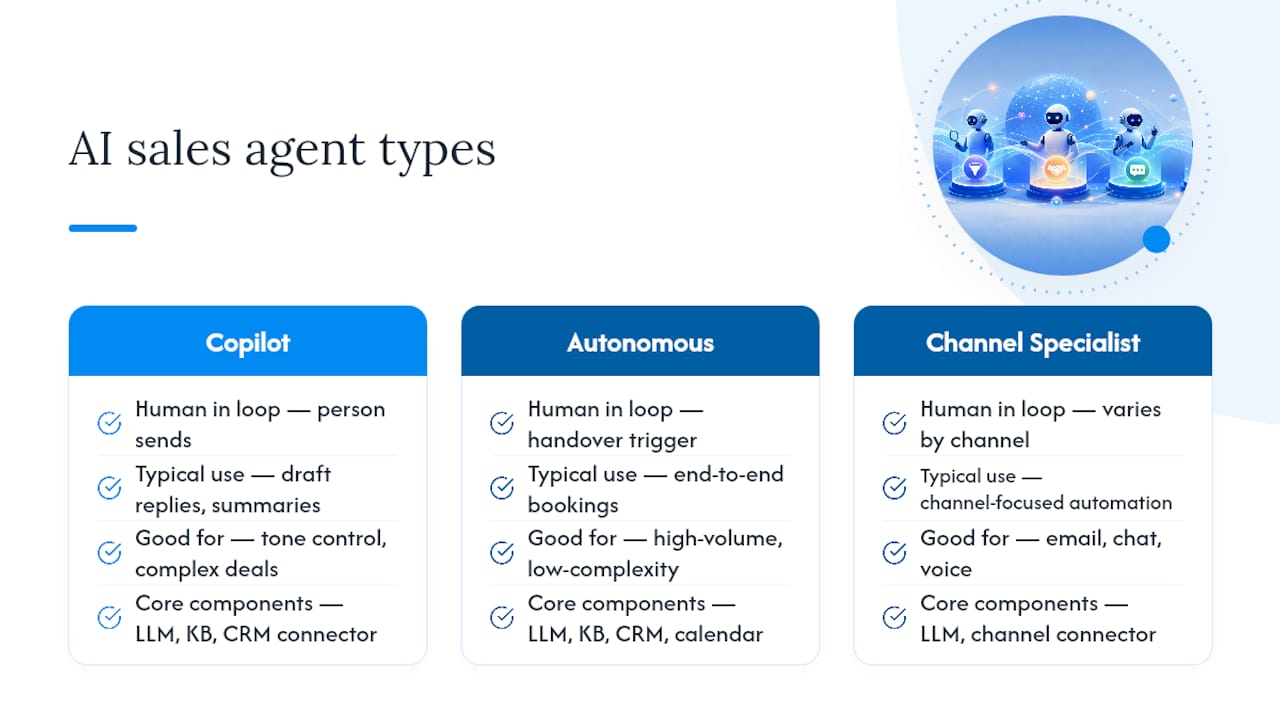
The category splits into three broad types, and mixing them up is where a lot of buyers waste evaluation time.
Supportive or copilot agents sit beside a human rep. They draft replies, summarise calls, and suggest next steps, but a person hits send. These suit teams worried about tone control or complex, high-value deals where a misstep costs a contract.
Autonomous end-to-end agents run the full conversation from first contact to booked meeting, with no human in the loop until a handover trigger fires. These fit high-volume, lower-complexity flows: inbound demo requests, standard onboarding questions, renewal reminders.
Channel-specialist agents are built around one medium. Some focus purely on email sequencing, some on live chat, and some, like Wattle’s voice agents, are built specifically to answer and qualify phone calls. Voice remains one of the harder channels to automate well, so a specialist tool often outperforms a generalist agent trying to do everything.
Underneath all three types sit the same building blocks: a knowledge base the agent draws answers from, an LLM handling the dialogue itself, connectors into your CRM and calendar, and an orchestration layer that decides when to escalate to a human. Gartner’s research on sales operations notes that integration and governance around these connectors matter as much as the model doing the talking. A brilliant conversational model plugged into a messy CRM will still misroute leads and quote the wrong pricing.
Where do AI sales agents deliver measurable results?
The clearest wins show up in high-volume, repetitive workflows where speed matters more than nuance.
Inbound qualification is the most common starting point. A website visitor fills out a form at 11pm; an agent responds within seconds, asks the two or three questions your reps always ask first, and either books a meeting or routes the lead to a human. Response time is the whole game here. A lead contacted within minutes converts at a dramatically higher rate than one left for even an hour, which is why 24/7 coverage is the single biggest argument for deploying an agent on inbound.
Outbound prospecting works differently. The agent personalises opening messages using firmographic and behavioural data, manages a multi-touch cadence across email and chat, and hands off the moment a prospect shows buying intent. This is where hallucination risk climbs, because outbound agents are writing more speculative content rather than answering a direct question.
Meeting booking and calendar handling is arguably the least glamorous use case and the easiest to get right. The agent checks live calendar availability, proposes times, sends confirmations, and reschedules without a human touching the exchange. Because the task is transactional, error rates are low and adoption friction is minimal.
Follow-up and nurture rounds out the list. Agents can re-engage leads that went cold, enrich records with new firmographic data, and score leads against your ideal customer profile so reps spend time on the accounts worth chasing.
Realistic outcomes teams report include:
- More qualified meetings booked per week, driven largely by faster response times on inbound
- A measurable lift in lead-to-meeting conversion when follow-up cadence is consistent rather than sporadic
- Meaningful time saved on manual data entry and calendar chasing, freeing reps for actual selling
Treat any of those as directional, not guaranteed. Results vary heavily by industry, deal complexity, and how clean your CRM data is going in. Harvard Business Review’s analysis of AI in sales work makes the same point: automation removes routine tasks, but the surrounding process still needs redesigning for the gains to show up.
What are the real benefits and limitations of AI sales agents?
The benefits are genuine, but so are the failure modes, and pretending otherwise sets teams up for a rocky rollout.
On the upside, agents scale conversations that a human team physically cannot handle at 2am or during a traffic spike. They keep messaging consistent, because an agent does not have an off day or forget the value proposition. And they extend coverage hours without extending headcount, which matters most for businesses selling across time zones.
The limitations are just as real. Agents lack the domain judgement a seasoned rep builds over years. They can hallucinate: state a wrong price, promise a feature that does not exist, or misread a complaint as a compliment. Buyers can also tell when a conversation feels robotic, and trust erodes fast if the tone is off or the agent loops on the same non-answer.
Operational risk sits underneath both of those problems:
- Poor CRM data quality means the agent qualifies leads against outdated or incomplete fields
- Sync failures between the agent and CRM create duplicate records or missed handoffs
- Privacy and consent rules vary by channel and region, and an agent that ignores them creates compliance exposure
- Vague handover rules leave leads stuck in agent limbo when they need a human
Harvard Business Review’s guidance on this is blunt: automation without human oversight and process redesign underdelivers, no matter how good the underlying model is. The fix is not more automation, it is tighter governance around the automation you already have.
Pro Tip: Set a hard rule that any lead mentioning price objections, contract terms, or a complaint gets routed to a human within one interaction. Agents handle information requests well; they handle conflict poorly.
How do you evaluate and choose an AI sales agent?
Treat this as a procurement decision, not a feature comparison. The agent that wins the demo is not always the one that survives six months of live traffic.
Six criteria matter more than any flashy demo trick:
- CRM and calendar integration — does it write back to your actual CRM, or just log activity in its own dashboard?
- Channel coverage — does it cover the channels your leads actually use, whether that is web chat, WhatsApp, email, or voice?
- Data access and ownership — who owns the conversation data, and can you export it if you switch providers?
- Security and compliance — what certifications or data handling standards does the vendor publish, and do they match your industry’s requirements?
- Explainability — can you see why the agent made a qualification decision, or is it a black box?
- Handoff rules and human oversight — how granular is the control over when a conversation escalates to a person?
Gartner’s report on sales operations puts integration and governance at the centre of adoption success, ahead of raw conversational quality. That ordering surprises a lot of buyers who assume the model itself is the differentiator.
Before signing anything, run these checks during the demo or trial period:
- Ask the vendor to show a live handoff, not a recorded one
- Test the agent with a genuinely awkward or off-script question
- Confirm what happens to a lead’s data if you cancel the subscription
- Check whether pricing changes as message volume or lead count grows
- Ask how long a real pilot took for an existing customer, not the theoretical minimum
On pricing, expect one of a few common shapes: flat monthly subscriptions, per-agent bundles, or enterprise-negotiated rates. Costs vary by channel coverage and how much onboarding and customisation the vendor needs to do, so a like-for-like comparison across vendors takes some digging. Implementation timelines swing widely too. Some platforms need weeks of integration work before the first live conversation; others, built specifically for fast reseller deployment, can have a branded agent taking real conversations inside a week.
What does a white-label AI sales agent rollout actually look like?
Agencies and consultants asking this question usually want to know one thing: how fast can I have something sellable, and how much of my own engineering time does it eat?
Some white-label AI agent platforms are built around a configurator and brand-kit generator to enable quick creation of a branded agent without a development team. According to Agent Release AI’s white-label documentation shows the platform supports unlimited tenant creation, meaning an agency can spin up a separate branded instance for each client rather than juggling one shared configuration. Some platforms include server-side revenue tracking to help resellers attribute revenue per tenant without needing separate analytics tools.
A typical rollout, per the vendor’s own positioning, follows a pattern like this:
- Set up a tenant for the client, with its own domain and branding applied through the configurator
- Connect the channels the client actually uses, whether that is WhatsApp, email, SMS, or web chat
- Load onboarding content: the client’s offer, pricing, tone, and common objections
- Run a short pilot against a defined set of KPIs, such as meetings booked or response time
- Review pilot results before expanding to additional tenants or channels
Some white-label platforms aim for deployment under seven days from kickoff to first live conversation, appealing to agencies needing fast time to market. Enterprise-grade security is often a core feature on white-label platforms, relevant for resellers serving regulated industries with strict data handling requirements.
What I’d actually prioritise in a rollout
Start with one flow, not five. Pick the highest-volume, lowest-risk conversation you have, usually inbound qualification, and let the agent run that alone for a few weeks before touching outbound or renewals. Measure two things only: meetings booked and conversion from meeting to next stage. Everything else is noise in week one.
Set human-in-the-loop triggers before launch, not after a bad interaction forces your hand. Review transcripts weekly, not monthly. The agent’s conversation content will need adjusting in the first fortnight no matter how good the initial setup was, and the teams that treat the pilot as a living document outperform the ones that set it and walk away.
— Agent
Launch a branded AI sales agent without building it yourself
White-label AI sales agent platforms provide an alternative to building custom solutions from scratch, often offering flat-rate pricing with no per-message fees and support for multiple tenants.
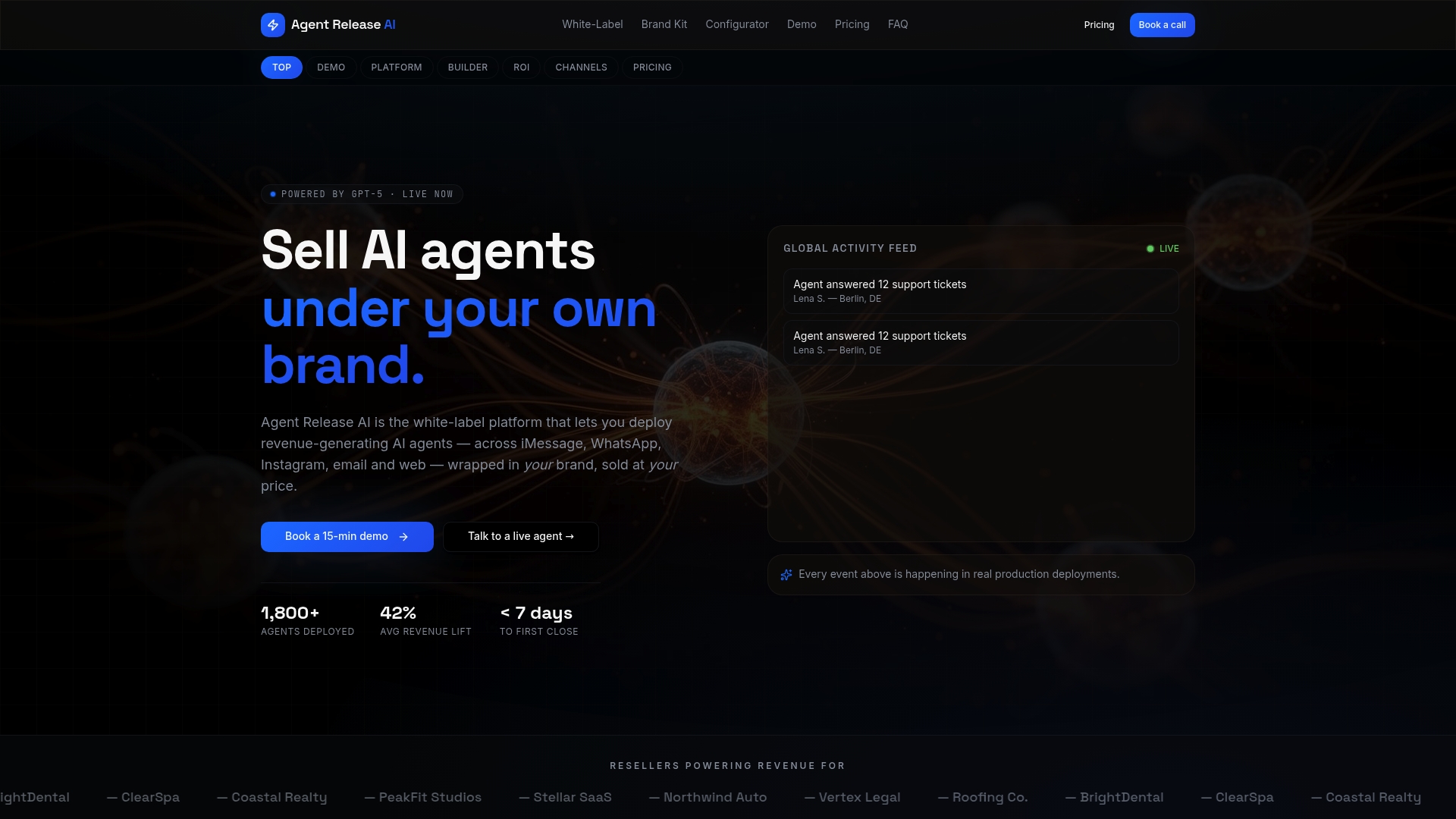
Such platforms aim to solve integration of CRM, channel coverage, and human handoff rules out of the box, allowing agencies and resellers to offer a fully branded product with custom domains under their own name. The configurator and brand-kit generator handle the setup work that would otherwise take a development sprint, and server-side revenue tracking means resellers can see exactly what each client tenant is generating.
Plans start at $497 per month with unlimited agents and channels included. Agencies wanting the full reseller structure, including tenant creation and branding controls, can check the white-label programme for terms.
Sources
- Gartner report: AI in sales and revenue operations
- How AI is streamlining marketing and sales — Harvard Business Review
- What is an AI Sales Agent + 10 Best AI Sales Agents in 2026 — Creatio
FAQ
Can AI agents do sales?
Yes. AI sales agents qualify leads, run outbound outreach, and book meetings without a rep manually handling each conversation. Creatio’s overview confirms this covers the full funnel from first contact through to meeting confirmation, though complex negotiations still tend to need a human closer.
Who has the best AI sales agent?
There is no single best option. It depends on whether you need a supportive copilot or a fully autonomous agent, which channels you need covered, and whether you want to resell the product under your own brand, which is where a white-label platform like Agent Release AI fits agencies and consultants specifically.
What are the big four AI agents?
There is no universally agreed “big four” list for AI sales agents. Definitions vary by source and by whether they mean general-purpose AI assistants or sales-specific tools, so treat any fixed ranking with caution and evaluate against your own criteria instead.
How much do AI agents cost?
Pricing shapes vary between flat subscriptions, per-agent bundles, and enterprise-negotiated rates, with costs shifting based on channel coverage and onboarding scope. Agent Release AI’s platform runs $497 per month for unlimited agents and channels, with white-label programme pricing available on request.