September 22, 2026
Engineers: Hit a 1,000ms Mouth to Ear Budget for AI Voice Agents
Engineer focused guide to ship production AI voice agents: latency targets, a practical checklist, and white label resale options.

Engineers: Hit a 1,000ms Mouth to Ear Budget for AI Voice Agents
An AI voice agent is a system that listens to a caller, transcribes speech, reasons over it with a language model, and replies in synthesised speech, all inside one continuous phone conversation. The architecture is a cascaded pipeline: speech-to-text (STT) feeds a large language model (LLM), which feeds text-to-speech (TTS). Every serious deployment lives or dies on two things: latency low enough to feel like talking to a person, and consent disclosure handled before the caller says a word.
TL;DR:
- Most AI voice agents should aim for a latency under 1,000 milliseconds from start to hearing the agent’s response to appear truly conversational.
- Streaming each stage of the pipeline and colocating services significantly reduce delay, while monitoring performance ensures timely detection of slowdowns.
- Starting with a managed platform enables quick deployment and less operational burden, but custom builds offer full control over latency and data flow at a higher engineering cost.
- Deploying AI voice systems legally requires disclosing AI involvement, recording consent, and offering callers access or correction to their personal data, per Australian privacy laws.
- Resellers benefit most from white-label platforms that support unlimited tenants, branded appearances, and revenue tracking, allowing quick market entry without infrastructure maintenance.
Table of Contents
- How does an AI voice agent actually work?
- What latency should an AI voice agent hit?
- Should you build custom or use a managed platform?
- What does privacy law require before you go live?
- How do you get from prototype to production?
- Where does an AI voice agent actually pay for itself?
- What makes a voice agent’s conversation feel natural?
- How well do voice agents handle multiple languages?
- How do you stop voice spoofing and biometric fraud?
- How do you actually measure whether a voice agent is working?
- Publisher perspective: why white-label matters for resellers
- Ready to resell voice agents without building the stack
- Sources
- FAQ
How does an AI voice agent actually work?
Strip away the marketing and an AI voice agent is three engines stitched together with a fourth layer of business logic sitting on top. Speech-to-text turns the caller’s audio into text. A language model decides what to say. Text-to-speech turns that decision back into audio the caller hears. This is the cascaded STT → LLM → TTS pattern, and it’s the industry standard for realtime voice agents because running each stage in sequence, without streaming, adds seconds of dead air that no caller will tolerate.
Streaming is what makes the cascade usable. Instead of waiting for the caller to finish a sentence, transcribing all of it, then generating a full reply before speaking, a properly built pipeline streams audio to the STT engine in small frames, streams partial transcripts into the LLM, and forwards completed phrases straight to TTS as they’re generated. Each stage overlaps the next rather than waiting its turn.
Above that pipeline sits the agent layer, and this is where most of the engineering effort actually goes:
- Function calling and tool contracts — structured calls out to booking systems, CRMs, or payment rails, with strict schemas so the model can’t improvise a booking that doesn’t exist. This is also the primary defence against hallucination in production systems.
- Retrieval-augmented generation (RAG) — pulling live facts from a knowledge base so the agent quotes your actual pricing, not a guess from training data.
- Conversation state — tracking what’s been said, what’s been confirmed, and what still needs an answer across a call that might run five minutes.
- Integration points — the telephony media edge (SIP or WebRTC), your CRM, your knowledge base, and a monitoring layer watching every hop for failure.
Get the agent layer wrong and you get a voice bot that sounds fluent but books the wrong slot. Get the pipeline wrong and you get a voice bot that sounds fluent three seconds too late.
What latency should an AI voice agent hit?
A well-engineered AI voice agent should target a P50 end-to-end latency that generally falls within a range considered conversationally natural, depending on caching and pipeline design. That’s the number that separates a phone AI agent that feels conversational from one that feels like talking over a bad satellite connection.
Two terms matter here. Time-to-first-token (TTFT) measures how long the LLM takes to produce its first output token once it has the transcript. Time-to-first-audio (TTFA) measures how long until the caller hears the first sound of the reply, the metric that actually determines how human the exchange feels. Engineered pipelines have pushed best-case TTFA to around 729ms, and Twilio’s guidance frames the whole problem as a mouth-to-ear budget of roughly 1,000 milliseconds.
Delay accumulates at every hop: network round trips, STT transcription, LLM thinking time, TTS synthesis, and the inter-service calls stitching it all together. A single unoptimised leg can eat your entire budget.
The fix is a short list of proven levers:
- Stream every stage rather than waiting for complete outputs.
- Use a sentence buffer so TTS starts speaking the first finished phrase while the LLM keeps generating the rest.
- Colocate services in the same region to cut network hops.
- Apply speculative prefetch, caching likely next responses so warm turns feel instant.
- Run tool calls asynchronously wherever the conversation can continue without blocking on the result.
- Monitor per-stage latency continuously, because a silent provider slowdown is invisible until a caller hangs up.
Should you build custom or use a managed platform?
The honest answer depends on how fast you need to move and how much control you actually need over the stack.
Managed orchestration platforms get you to a working phone AI agent in days, with someone else carrying the operational burden of uptime, model updates, and telephony quirks. The tradeoff is less control over model choice and less room to tune the pipeline for your specific latency floor. Custom builds hand you full control over every hop, but that control costs engineering time you’ll spend on infrastructure instead of your actual product.
- Managed platforms: fast time-to-first-call, lower ongoing ops load, less architectural flexibility.
- Custom builds: full control over latency, data flow and model choice, but a heavier engineering budget.
- On-device or hybrid: worth it when data residency rules or ultra-low-latency requirements rule out sending audio to the cloud at all.
Most teams are better served starting with a managed API for their first version and migrating pieces to hybrid or self-hosted infrastructure only once call volume or privacy obligations justify the extra engineering.
Weigh the decision against four criteria: time-to-first-call, your containment target (the percentage of calls the agent resolves without a human), data residency requirements, and the size of your engineering team.
Pro Tip: Don’t decide build-versus-buy in the abstract. Run one real workload, a booking flow or a lead-qualification script, through a managed platform first. You’ll learn your actual latency floor and containment rate in a week, which tells you far more than any vendor’s benchmark slide.
What does privacy law require before you go live?
Under Australia’s Privacy Act 1988 and the 13 Australian Privacy Principles, organisations deploying an AI phone answering system must disclose that callers are speaking with an AI, disclose recording, and maintain a mechanism for callers to access or correct the personal information collected.
A single opening line typically satisfies both the federal collection-notice obligation and most state-level consent rules for recorded calls: identify the agent as AI, state that the call is recorded, and pause briefly before continuing.
| Requirement | What to implement |
|---|---|
| Disclosure | Open every call with an AI and recording notice before collecting any data |
| Consent logging | Timestamp and store the disclosure playback against the call record |
| Subject access | Provide a documented path for callers to request or correct their data |
| Retention | Set an explicit retention window and auto-delete beyond it |
| Redaction | Strip payment details and health information from transcripts and logs |
| Regional processing | Confirm where audio and transcripts are stored and processed |
Build this checklist into your launch gate, not your postlaunch cleanup list.
How do you get from prototype to production?
Shipping a first working call needs less than most teams assume, but scaling it needs discipline they usually skip.
- Wire the minimum pipeline: telephony media ingress, streaming STT, a streaming LLM call, streaming TTS, and one working function call (a calendar booking is a good first test).
- Instrument before you scale: track per-stage latency (STT, LLM TTFT, TTS TTFA), containment rate, transfer-to-human rate, and a proper error taxonomy so failures are categorised, not just logged.
- Set timeouts and idempotency on every tool call. Every backend action the agent triggers needs a unique request ID and a timeout, so a retried call doesn’t double-book a customer.
- Build the failover path: what happens when STT drops, the LLM stalls, or the caller says something the agent can’t handle. A graceful handoff to a human beats a confused loop every time.
- Run a weekly review of transcripts, transfer reasons, and latency outliers. This is where most quality improvements actually come from.
Pro Tip: Your error taxonomy is worth more than any dashboard. “Transferred: booking conflict” tells you something completely different from “Transferred: caller frustrated” — and only one of those needs an engineering fix.
Where does an AI voice agent actually pay for itself?
The business case for an AI phone agent comes down to which calls you can safely automate and which ones still need a human ear.
Call automation for routine enquiries is the obvious starting point: hours, pricing, order status, appointment confirmations. These calls follow predictable scripts, which makes them ideal for an early rollout with a tight containment target.
Appointment booking is where an AI call centre agent earns its keep fastest. A booking flow is a bounded conversation with a clear function call at the end (check calendar, confirm slot, send confirmation), which is exactly the kind of task the function-calling layer handles well.
Lead qualification turns inbound and outbound calls into structured data: budget, timeline, decision-maker status, captured automatically and pushed straight into a CRM instead of sitting in a voicemail queue. For sales teams drowning in unqualified inbound volume, this alone often justifies the build.
Surveys and outbound follow-up are lower-stakes but high-volume: post-service satisfaction checks, appointment reminders, renewal nudges. These calls tolerate a slightly less polished agent because the stakes per call are lower, making them a good testing ground before you deploy to higher-stakes flows.
The pattern across all four is the same: the agent handles structure and volume, a human handles exceptions and emotion. Getting that boundary right is the actual product decision.

What makes a voice agent’s conversation feel natural?
A voice agent’s conversational design matters more than its raw model quality. Callers forgive a slightly robotic voice; they don’t forgive a bot that talks over them, forgets what they just said, or asks a question it already had the answer to.
Turn-taking is the first fix. The agent needs to detect when a caller has actually finished speaking, not just paused, and it needs to handle barge-in gracefully when a caller interrupts mid-sentence. Getting this wrong produces the awkward “after you, no after you” stall that instantly signals “this is a bot.”
Confirmation loops matter almost as much. Repeating back a booking time or an order number before committing to it catches STT transcription errors before they become a wrong action, and it reassures the caller the system actually heard them correctly.
Scripted fallback phrases beat silence every time. When the agent doesn’t understand, “Sorry, could you say that again?” keeps the conversation moving. Dead air makes callers assume the line has dropped.
Finally, design for graceful exit. Every good conversational flow has a clearly defined path to a human, triggered by explicit request, repeated failure to understand, or emotional escalation detected in tone or word choice. A caller who feels trapped in a loop with no way out will hang up angry, and that call becomes a lost customer rather than an automated success.
How well do voice agents handle multiple languages?
Multilingual support in a voice AI agent isn’t one feature, it’s three separate ones that each need testing: speech recognition accuracy per language, the language model’s fluency and cultural fit in that language, and the naturalness of the synthesised voice.
STT accuracy varies meaningfully by accent and dialect, not just by language. A model tuned mostly on North American English audio will stumble more on regional Australian accents than a model trained on broader English-language data. Test with real regional audio samples before assuming an “English” model covers your callers.
Language model customisation goes beyond translation. A script that sounds warm and direct in English can read as blunt or overly casual translated literally into another language. The tone, idiom and formality level need adapting per language, not just the vocabulary, which usually means separate prompt tuning per language rather than one prompt run through a translation layer.
Detecting which language a caller is using, and switching mid-call if they code-switch, is its own engineering problem. The cleanest approach runs a fast language-detection pass on the first few seconds of audio and routes to a language-specific pipeline configuration from there, rather than trying to build one model that improvises across languages on the fly.
How do you stop voice spoofing and biometric fraud?
Voice biometrics introduce a security problem text-based systems never had: a caller’s voice can be recorded, cloned, or synthetically generated to impersonate someone else.
Liveness detection is the first line of defence, checking for the acoustic signatures of live speech versus a played recording or a synthetic voice model. Combine this with multi-factor verification: voice alone should never be the sole gate for a sensitive action like a password reset or a funds transfer. Pair it with a one-time code, an account PIN, or a callback to a verified number.
Watch for replay attacks specifically. A recorded snippet of a legitimate caller’s earlier authentication can be replayed to fool a naive voice-matching system, so genuine deployments need challenge-response elements, asking the caller to repeat a randomly generated phrase rather than a fixed passphrase, so a static recording can’t pass the check.
Treat every voice sample as sensitive personal information under your existing data-handling controls, encrypted in transit and at rest, with access logging on who queried a biometric match and why. The same redaction and retention discipline that applies to call transcripts applies doubly to voiceprint data, given how hard it is to change your voice compared to changing a password.
How do you actually measure whether a voice agent is working?
Benchmarking an AI voice agent needs metrics at three different layers, and mixing them up is the most common measurement mistake.
Technical performance metrics sit closest to the pipeline: per-stage latency (STT, LLM TTFT, TTS TTFA), end-to-end P50 and P95 response time, and transcription word error rate. These tell you whether the engineering is sound.
Task performance metrics measure whether the agent actually did its job: containment rate (calls resolved without human transfer), task completion rate (bookings actually made, not just attempted), and transfer reason breakdown. These tell you whether the product works.
Experience metrics are the hardest to quantify but matter most commercially: caller sentiment shifts across the call, hang-up rate before resolution, and repeat-call rate for the same unresolved issue. A system that hits every latency target but generates a high repeat-call rate is failing somewhere the technical dashboard can’t see.
Run all three together against a fixed test set of real call transcripts before every model or prompt change ships. A latency improvement that quietly drops task completion isn’t an improvement, it’s a trade you haven’t noticed you’re making yet.
Publisher perspective: why white-label matters for resellers
Most agencies don’t need to become voice AI engineering shops. They need branded revenue fast, without inheriting the pipeline problems above. That’s the real argument for a white-label platform over a ground-up build: someone else has already solved latency and tenanting, and you’re selling outcomes under your own name. The features that actually matter at scale, unlimited tenant creation, server-side revenue attribution, and enterprise-grade security, aren’t nice-to-haves for a reseller. They’re what determines whether ten clients or a hundred break your operation.
— Agent
Ready to resell voice agents without building the stack
Another option to hiring a voice AI engineering team is a white-label platform that lets you deploy branded phone, WhatsApp, email and web-chat agents under your own name in under a week, with no per-message or revenue-share fees eating your margin. Every conversation runs on GPT-5, tuned to your client’s niche, pricing and tone, while server-side revenue tracking shows exactly what each tenant generates.
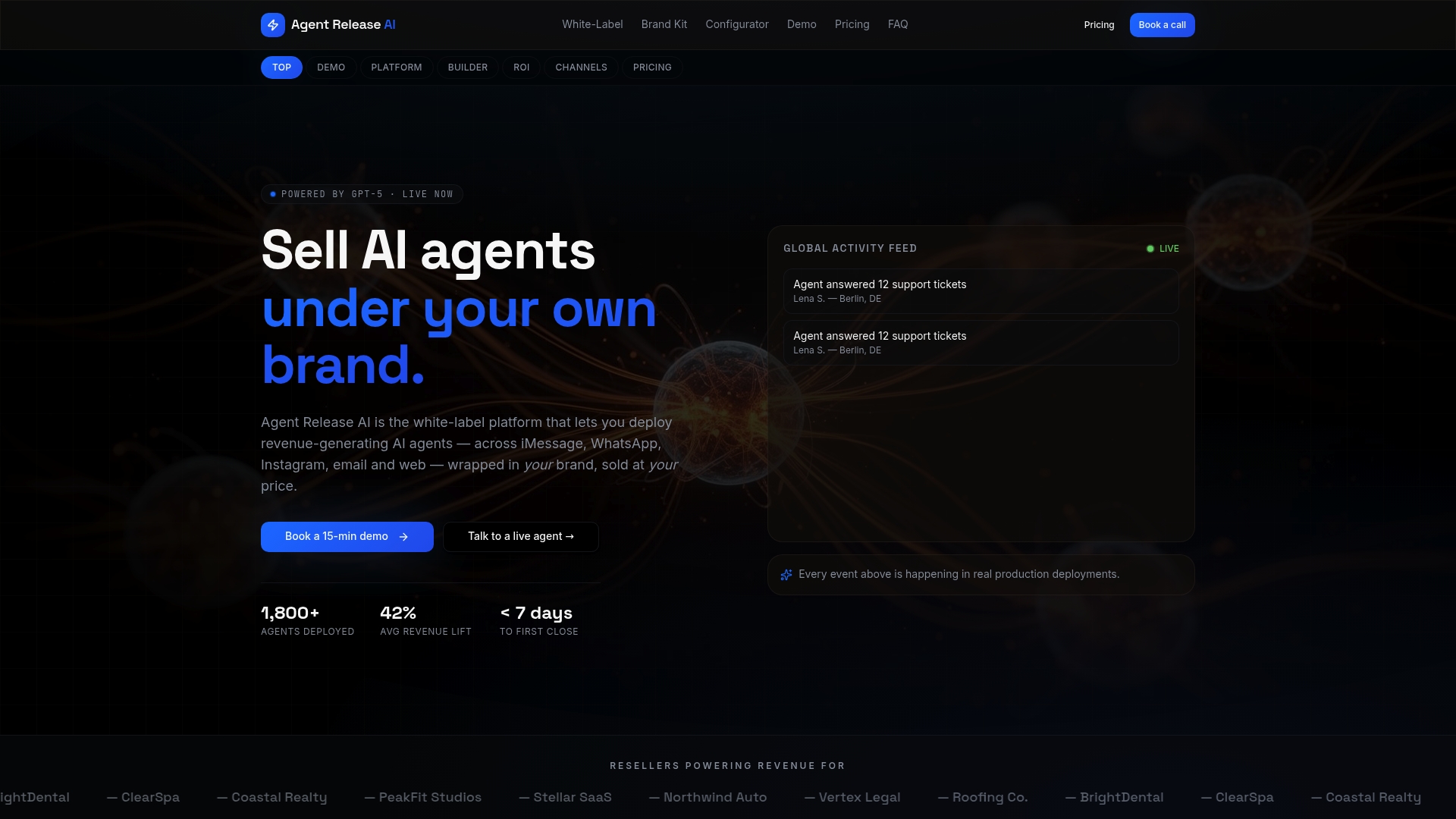
This is built for marketing agencies, consultants and SaaS resellers who want to sell voice AI outcomes without maintaining STT, LLM and TTS infrastructure themselves. Unlimited tenant creation means you scale from one client to a hundred without renegotiating your stack, and custom domain controls keep every deployment looking like it came from your business, not a vendor’s.
The Agent Release AI plan runs $497 per month with unlimited agents and channels. Agencies wanting full resale rights should look at the White-Label Program for branding and domain control, with pricing available on request. Start by exploring the white-label configurator to see how fast your first branded agent goes live.
Sources
- Realtime voice-agent engineering and cascaded pipelines (arXiv field manual)
- Core latency in AI voice agents | Twilio
- Privacy and the use of commercial AI products | OAIC
FAQ
Is there a free AI voice agent available?
Some providers offer limited free tiers or trials for a phone AI agent, usually capped on call volume or minutes. For production use handling real customer volume, expect a paid platform or engineering build, since free tiers rarely include the latency optimisation or compliance tooling a live deployment needs.
Is using an AI voice agent legal?
Yes, deploying an AI voice agent is legal in Australia, but it comes with obligations, not a blanket approval. Under the Privacy Act 1988, you must disclose that callers are speaking with an AI and that the call may be recorded, and provide a path for people to access or correct their data.
Which is the best AI voice agent?
The best AI voice agent depends on whether you’re buying outcomes or building infrastructure. Businesses wanting a fast, branded deployment without in-house engineering are well served by a white-label platform like Agentrelease, while teams with dedicated engineering resources and unique latency requirements may prefer a custom cascaded pipeline built on the architecture pattern described above.
How much do AI voice agents cost?
Costs vary widely by model, with self-built systems facing ongoing STT, LLM and TTS API charges per minute of call time on top of engineering costs. Platform pricing is more predictable: Agentrelease’s core plan runs $497 per month with unlimited agents and channels, while its white-label reseller option is priced on request.