October 2, 2026
Ship a Chatbot in Under a Week: Conversation Design for Practitioners
Practical conversation design for practitioners: implement RAG grounding and provenance, use TD EVAL-style testing, copy-ready templates and a white-label...

Ship a Chatbot in Under a Week: Conversation Design for Practitioners
Conversation design for chatbots is the craft of shaping intent, emotion and action into a loop that moves a user toward a real outcome. The single most important practice: design for intent recovery and test with real users early, not after launch. The OAIC sets the compliance floor; we build platforms like Agent Release AI on top of it.
TL;DR:
- Focus on designing for intent recovery and early user testing with real users to prevent common failures and improve trust.
- Keep conversations narrow and scope clearly limited, as a bot that performs well on a few tasks builds more user confidence than attempting many.
- Use retrieval-augmented generation with citations and validation filters to ensure answers are accurate, especially for knowledge-dependent or legal content.
- Regularly evaluate dialogue with turn-level metrics and pairwise ranking to catch subtle multi-turn failures before deployment.
- Prioritize transparency, privacy notices, accessibility testing, and clear escalation paths to ensure regulatory compliance and user trust.
Table of Contents
- Key principles of conversation design
- A practical step-by-step conversation design process
- Tooling and architecture choices: RAG, guardrails and citations
- Testing and evaluation: metrics, turn-level checks and dialogue-level evaluation
- Privacy, transparency and regulatory guidance for public-facing chatbots
- Accessibility and inclusive design for conversational interfaces
- Common mistakes, failure modes and recovery patterns
- Reusable templates and sample conversation patterns
- Applied example: rapid white-label deployment to test a conversation design
- Author perspective: priorities for practitioners over the next 12 to 24 months
- How a white-label platform can speed validation and launch
- FAQ
- Sources
Key principles of conversation design
Good conversation design borrows from how humans actually talk. The Gricean maxims, be relevant, be clear, say only what’s needed, say only what’s true, translate directly into chatbot rules: don’t ask for information you already have, don’t pad turns with filler, and never state something the backend can’t verify. Google’s conversation design guidance builds its entire framework around these cooperative principles, paired with short turns and clear handoffs.

The intent, emotion, action loop is the mental model worth internalising. A user arrives with an intent (“cancel my order”), carries an emotional state (frustration, urgency, confusion), and the bot’s job is to acknowledge both before producing an action. Skip the emotional read and a technically correct answer still feels cold. A refund confirmation that opens with “Sorry about the mix-up, here’s what’s happening” outperforms a flat “Refund processed” even when the outcome is identical.
Scope discipline builds trust faster than feature breadth. A bot that openly does five things well beats one that vaguely attempts fifty. Narrow personas also make error handling predictable, because the bot can recognise when a request falls outside its lane and hand it off cleanly rather than guessing.
- Acknowledge the user’s emotional state before delivering the action or answer.
- Keep each turn to one idea; split compound questions into sequential prompts.
- Signal clearly that the user is talking to AI, in the first message and in any transfer to a human.
- Build at least one graceful recovery path for every intent you support.
Pro Tip: Write your fallback line before you write your happy-path script. If the recovery feels natural, the rest of the flow usually follows.
A practical step-by-step conversation design process
Treat conversation design as a repeatable workflow rather than a one-off writing task. The order matters: skipping the research steps to jump straight to scripting is the most common cause of bots that sound fine in a demo and fail in production.
- Define goals, KPIs and jobs-to-be-done. Pin down what success looks like, resolution rate, handover rate, time to answer, before writing a single line of dialogue.
- Choose scope and high-value use cases. Pick the two or three intents that carry the most volume or the most cost when handled badly, and build those first.
- Map intents and user journeys. Diagram every path a user might take through an intent, including the ones that go wrong, then write sample dialogs for each branch.
- Prototype and run moderated tests. A clickable wizard or mock chat interface is enough to expose awkward phrasing, confusing confirmations and missing intents long before any code ships.
- Deploy a pilot and instrument analytics. Launch to a limited audience, track turn-level drop-off and intent-recognition failures, and feed what you learn back into the script.
- Iterate on real transcripts. Nothing replaces reading what actual users typed. Patterns that looked obvious on a whiteboard often don’t match how people actually phrase requests.
Each step produces an artefact the next step needs, a KPI list feeds the scope decision, the journey map feeds the sample dialogs, the moderated test feeds the pilot brief. Treat the whole sequence as a loop you repeat every time you add a new intent, not a process you run once at launch.
Tooling and architecture choices: RAG, guardrails and citations
The architecture behind a chatbot determines whether its answers can be trusted, not just how clever its scripts sound. Retrieval-augmented generation (RAG) grounds responses in an organisation’s own documents instead of relying purely on a model’s trained memory, which cuts down on confidently wrong answers. The NIST NCCoE report on building an internal RAG chatbot found that pairing RAG with page-level citations turned the bot from a black box into something closer to a navigation tool, since users could check the source behind any claim.
That same report documented concrete mitigations worth copying: input validation to catch malformed or adversarial prompts, access controls scoped to what each user is allowed to see, and validation filters that catch outputs inconsistent with the retrieved source material. Prompt-injection resistance isn’t a one-off setting, it’s a layer of defence built from policy prompts, output filtering and logging.
- Use RAG when answers depend on a knowledge base that changes often or carries legal weight.
- Add page-level citations wherever a claim could affect a user’s decision or money.
- Validate inputs and filter outputs rather than trusting the model to self-police.
- Match channel to constraint: voice needs shorter turns and no visual citations, web chat can show a source link inline.
- Connect the bot to CRM and consent stores deliberately, not as an afterthought bolted on post-launch.
Testing and evaluation: metrics, turn-level checks and dialogue-level evaluation
Evaluating a chatbot properly means looking at two different layers, because a conversation can fail even when every individual turn looks fine in isolation. Turn-level metrics catch cohesion problems, backend consistency (does the answer match what the system actually knows) and policy compliance on a single exchange. Dialogue-level evaluation looks at the whole conversation: does it stay coherent across ten turns, does context carry forward correctly, does the user actually get what they came for.
TD-EVAL-style frameworks combine turn-level metrics like conversation cohesion and backend knowledge consistency with dialogue-level pairwise ranking, which catches subtle failures that single-turn checks miss entirely. Pairwise ranking and Elo-style arenas, where two bot versions answer the same prompt and a judge (human or LLM) picks the stronger response, reveal preference patterns that raw accuracy scores can’t surface.
LLM-as-judge approaches have matured quickly. AMULET research shows that combining dialog-act and maxim analyses with LLM judges improves accuracy when evaluating multi-turn conversational preferences, especially on the complex cases where a single metric falls short.
- Run turn-level checks on every release candidate before it reaches users.
- Add dialogue-level pairwise ranking for any change that touches multi-turn flows.
- Pair LLM-judge scoring with periodic human review, not as a replacement for it.
- Track task-completion rate in A/B tests, not just satisfaction scores, since the two can diverge.
Building a lightweight test harness that runs both layers on every script change catches regressions before they reach a live audience.
Privacy, transparency and regulatory guidance for public-facing chatbots
Australian organisations deploying public-facing chatbots sit squarely inside the Privacy Act’s obligations. OAIC guidance requires clearly identifying AI interactions, updating privacy notices, and meeting Australian Privacy Principles 3 and 5 whenever a chatbot collects personal information. That’s not a background legal note, it shapes how the first message should read and what the privacy link in the footer needs to say.
Transparency in practice means more than a disclaimer buried in terms of service. It means a visible cue the moment a conversation starts, a plain-language note about what the bot can and can’t do, and an easy route to a phone number or a form for anyone who’d rather not talk to AI at all.
- State clearly, in the first message, that the user is talking to an AI system.
- Update privacy notices to cover what the chatbot collects and why, per APP 3 and APP 5.
- Avoid prompting users to enter sensitive personal information into the chat window.
- Train staff to review and explain AI-generated outputs when a user pushes back.
- Build in a visible, always-available alternative channel for anyone who opts out.
Accessibility and inclusive design for conversational interfaces
Accessibility isn’t optional polish, it determines whether a chatbot works for a meaningful share of the people who try to use it. WCAG-relevant checks include plain readability, full keyboard-only operation, alternative input methods, and error messages that help rather than dead-end the user. Screen reader compatibility and audio-only interaction patterns matter just as much for voice channels as visual cues do for web chat.
- Test flows with assistive-technology users before launch, not after a complaint.
- Write confirmation and error prompts in plain, unambiguous language.
- Design consent steps to follow CX Guidelines patterns for clarity and comprehension.
- Give every critical action a non-visual equivalent for audio-only contexts.
Common mistakes, failure modes and recovery patterns
Most chatbot failures trace back to a handful of repeat offenders. Overpromising capability in the greeting sets an expectation the bot can’t meet two turns later. Long, jargon-heavy bot turns lose users mid-sentence, and ambiguous confirmations (“Got it, processing that”) leave people unsure whether anything actually happened. A missing handover path turns a minor hiccup into an abandoned conversation.
- Replace vague confirmations with specific ones: “I’ve cancelled order #4821” beats “Done.”
- Set a clear escalation trigger, such as two failed recognition attempts, before frustration builds.
- Script the handover line in advance: “Let me bring in a team member who can help with this.”
- Test edge cases deliberately. Insufficient testing is the most common cause of hallucinated answers.
Pro Tip: Keep a running list of real phrases users type that your bot doesn’t recognise. It’s the cheapest intent-expansion research you’ll ever do.
Reusable templates and sample conversation patterns
Copy-ready patterns save a design team weeks of trial and error. Each of these can be adapted to match a specific brand voice without losing its underlying structure.
- Greeting and scope limiter: “Hi, I’m an AI assistant here to help with orders and returns. For anything else, I’ll connect you with our team.”
- Intent confirmation and slot fill: “Just to confirm, you’d like to return the blue jacket from order #4821, is that right?”
- Fallback and clarification: “I didn’t quite catch that. Did you mean to check an order status, or start a return?”
- Handover to human: “I’ll pass this to a team member now, along with your order number and what we’ve discussed so far.”
The handover template matters most of what it carries: order ID, intent history and sentiment flag give the human agent everything needed to pick up without asking the user to repeat themselves.
Applied example: rapid white-label deployment to test a conversation design
Validating a conversation design against real users is faster when the deployment layer isn’t the bottleneck. A white-label configurator lets a team set persona, tone and scope once and push that same script across channels without rebuilding it channel by channel.
- Set brand voice and scope through a configurator rather than custom development per channel.
- Deploy a pilot across web chat, SMS or WhatsApp in under a week to gather real transcripts fast.
- Use server-side revenue tracking to tie conversation changes directly to outcomes, not just satisfaction scores.
- Rely on enterprise-grade security and tenant isolation when running pilots for multiple clients at once.
This kind of setup suits teams who’ve already done the intent mapping and sample-dialog work above and want to test it against live traffic quickly, a travel assistant use case, for instance, where AI assistants speed up trip planning by handling routine questions before handing off the complex ones.
Author perspective: priorities for practitioners over the next 12 to 24 months
The shift worth making now is from scripted prompts to behaviour and guardrail design. Fixed scripts age quickly, guardrails that define what the bot won’t do age much better. Provenance and a working test harness matter more than another flashy feature nobody asked for. Evaluation frameworks and human oversight aren’t compliance overhead, they’re what makes a chatbot trustworthy enough to keep using after the novelty wears off.
— Agent
How a white-label platform can speed validation and launch
Everything in this guide works better with a fast feedback loop, and that’s exactly what we built our platform to shorten. Our platform supports multiple messaging channels from one configurator, with a brand kit generator that keeps persona consistent across every channel you test.
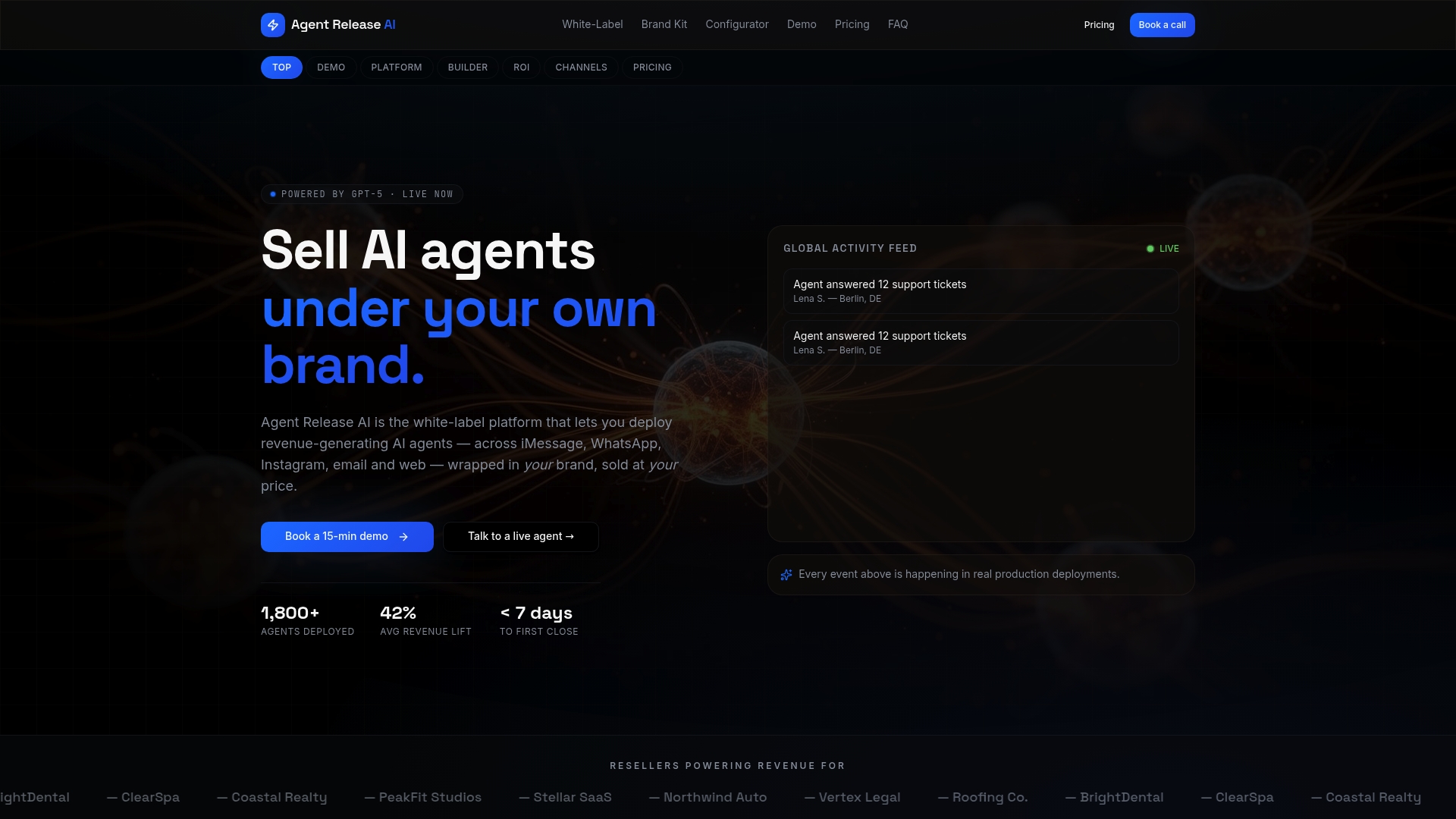
A sensible pilot: pick one high-value use case from your journey map, deploy it through our white-label program, and measure conversion and handover rate against the KPIs you defined in step one. Server-side revenue tracking gives you the numbers without extra instrumentation work. Plans start at $497 per month with unlimited agents and channels, and agencies can layer on full white-label branding. Book a call to see how quickly your first agent could be live.
FAQ
What are 5 things I should avoid discussing with a chatbot?
Avoid sharing sensitive personal information, financial account details, health records, government ID numbers or passwords in a public-facing chatbot window. OAIC guidance recommends against entering sensitive information into commercially available AI products as a general precaution.
What is the best UI design for a chatbot?
There’s no single best UI, the right design depends on channel and context, but Google’s conversation design principles favour short turns, clear confirmations and visible handoff points over dense visual interfaces. Simplicity and predictable structure tend to outperform novelty.
What is an AI conversational designer?
An AI conversational designer plans how a chatbot’s dialogue flows, writes sample scripts, maps intents and error paths, and works with engineers to test and refine the experience. The role blends writing, user research and basic understanding of how the underlying model retrieves and generates answers.
How do I have a conversation with a chatbot?
Start with a clear, specific request rather than an open-ended one, since most bots recognise intent better from concrete phrasing. If the bot misunderstands, rephrase rather than repeat the same wording, and look for an option to reach a human if the conversation stalls.
Sources
- Guidance on privacy and the use of commercially available AI products | OAIC
- IR 8579, Developing the NCCoE Chatbot: Technical and Security Learnings from the Initial Implementation | CSRC
- Conversation design | Google for Developers
- AMULET: Putting Complex Multi‑Turn Conversations on the Stand with LLM Juries