September 27, 2026
Build or Buy a Multi Tenant Chatbot: Silo, Pool, Bridge for Architects
Architect-focused, implementation-ready overview of multi tenant chatbot architecture. Compare silo, pool and bridge patterns, RAG security, and build vs...

Build or Buy a Multi Tenant Chatbot: Silo, Pool, Bridge for Architects
For most scale-first RAG systems, the pool pattern with strict tenant metadata filtering wins on cost and speed, while silo deployments remain the right call under hard compliance mandates. Whichever pattern you pick, one control is non-negotiable: tenant_id must be an immutable, first-class claim bound end-to-end, from auth token to retrieval query to logs. Enforce it in your auth middleware, then filter every retrieval call by it.
TL;DR:
- Tenant ID must be a permanent, verified claim in authentication tokens and enforced across all data retrieval and logging processes, preventing cross-tenant leaks.
- Pool architectures are easier to scale but rely entirely on application-level metadata filtering, making strict enforcement essential to avoid data breaches.
- Silo deployments provide maximum regulation compliance and data isolation but come with higher operational complexity and management costs.
- Runtime scoping, including tenant context binding into prompts and tool restrictions, is critical to prevent indirect prompt injection and data leakage during model inference.
- Automated onboarding, quota enforcement, and tenant-specific backup and recovery workflows are vital to maintain secure, compliant multi-tenant operations.
Table of Contents
- What multi-tenancy means for chatbots and when it matters
- Isolation patterns: silo, pool and bridge trade-offs
- Security and contextual isolation: identity, runtime scoping and prompt hardening
- Data architecture: embeddings, vector stores and metadata filtering for RAG
- RAG pipeline and prompt orchestration for multi tenant chatbots
- Onboarding, control plane and tenant lifecycle management
- Deployment and scaling patterns: containers, namespaces and service mesh
- Operational best practices: testing, monitoring and cost control
- How Agent Release AI implements multi-tenant agents
- Data privacy compliance strategies for multi tenant chatbots
- Best practices for tenant-specific customisation and configuration
- Approaches to tenant-aware analytics and reporting
- Disaster recovery and backup strategies for multi tenant systems
- Architect’s perspective: when to build versus when to buy
- How Agent Release AI can accelerate multi tenant deployments
- Sources
- FAQ
What multi-tenancy means for chatbots and when it matters
A multi-tenant chatbot serves multiple customers, clients or business units from one shared application and infrastructure, with each tenant’s data, configuration and conversation history kept logically separate. That’s different from a single-tenant deployment, where each customer gets a dedicated instance, and from per-customer forks, where every client runs a copy of the codebase with its own database. Multi-tenancy trades some isolation for shared infrastructure economics: one deployment serving a hundred tenants costs a fraction of a hundred separate deployments.
The decision to build multi-tenant, and how strictly to isolate, usually comes down to a handful of forcing functions:
- Regulated data: healthcare, finance and government tenants often require hard isolation guarantees that a shared index cannot promise.
- Reseller or white-label models: agencies reselling chatbots under their own brand need fast tenant provisioning, not architectural rework per client.
- Per-tenant customisation: different knowledge bases, tones, escalation rules and integrations per tenant push you towards flexible, tenant-scoped configuration rather than hardcoded logic.
- SLA differences: an enterprise tenant paying for guaranteed response times cannot share a compute pool with a noisy trial tenant without quota controls.
These forcing functions map fairly cleanly to business models. An internal platform serving multiple departments of one company can often tolerate a looser pool architecture because trust between tenants is high. A reseller model, where agencies onboard their own end clients, needs strong tenant boundaries because tenants are commercial competitors who never expect to see each other’s data. An embedded agent sold into other software products sits somewhere in between: isolation matters, but the provisioning pipeline and API surface matter just as much because tenants are other engineering teams integrating against you.
Get this framing right before you touch infrastructure. The tenancy pattern you choose downstream, and the security controls you layer on top of it, all flow from which of these pressures dominates your product.
Isolation patterns: silo, pool and bridge trade-offs
Three canonical patterns cover almost every multi tenant chatbot platform in production. Architects commonly choose between silo, pool and a hybrid bridge approach, and the AWS guidance on multi-tenant RAG with Amazon Bedrock knowledge bases frames the trade-off around scalability versus isolation strength.
Silo gives each tenant a dedicated vector index, dedicated encryption keys and often a dedicated compute path. It is the safest option for regulated tenants because there is no shared retrieval layer that could leak across tenant boundaries, but it multiplies operational overhead: every schema change, every model upgrade and every config fix has to be rolled out per tenant.
Pool puts every tenant’s chunks into one shared vector index and separates them with metadata filters at query time. Skip that filter once and you have a cross-tenant leak.
Bridge is the practical hybrid: a shared control plane and shared compute, but per-tenant indexes or namespaces for tenants that need stronger isolation, while smaller or lower-tier tenants share a pooled index. It lets you serve a long tail of small tenants cheaply while still offering enterprise tenants a dedicated boundary.
A simple decision matrix helps here:
- High tenant count, low compliance pressure, cost-sensitive: pool, with strict metadata filtering enforced in code, not convention.
- Regulated data (health records, financial identifiers), small tenant count: silo, accepting the higher per-tenant cost.
- Mixed tenant base with a few enterprise accounts and many smaller ones: bridge, silo for the enterprise tier, pool for the rest.
- Heavy per-tenant customisation of prompts, tools or knowledge bases: bridge or silo, since pooled architectures make per-tenant prompt divergence harder to manage cleanly.
Pro Tip: Default to pool for new products. It is far easier to peel a high-value tenant out into its own silo later than to retrofit isolation into a system that was never designed to enforce it.
Security and contextual isolation: identity, runtime scoping and prompt hardening
Isolation architecture only matters if identity enforcement is airtight. Security guidance on hardening multi-tenant SaaS architectures treats tenant_id as a first-class identity construct, not a convenience field, enforced through mandatory claims in JWT tokens and extracted by middleware on every request so it can tag database queries, tool calls and logs consistently.
Practically, that means:
- Bind tenant_id at the token level: issue it as a signed claim, never a client-supplied header, and reject any request where it is missing.
- Extract it once, in middleware: every downstream call, retrieval, tool invocation or database query inherits the same tenant context rather than each service parsing it independently.
- Fail closed: if tenant context cannot be resolved, the request is rejected outright rather than falling back to a default or shared scope.
- Compose an isolation key: combining tenant_id and user_id (for example
{tenant_id}::{user_id}) keeps keyspaces logically disjoint and helps prevent noisy-neighbour effects across shared caches and rate limiters.
Runtime scoping matters as much as storage-layer scoping. Bind tenant context directly into the system prompt for every request, and instantiate a fresh agent context per request rather than reusing a global agent instance across tenants, which is where state leakage most often creeps in. On top of that, capability envelopes and multi-stage orchestrators constrain what tools a model can call at runtime, and this matters because indirect prompt injection is now considered one of the most serious weaknesses in deployed generative AI systems.
Practitioners are increasingly moving away from static regex-based filters and towards runtime capability restrictions and orchestrators that assess intent to catch indirect or semantic jailbreak attempts, according to research on indirect prompt injection. That shift matters because a single successful injection in a pooled architecture can potentially pull context across tenant lines if capability boundaries are not enforced at the orchestrator level, not just the retrieval level.
Logging deserves the same discipline. Redact tenant identifiers before they hit shared observability pipelines, segment telemetry per tenant where volume justifies it, and audit caches for unscoped activations that could serve one tenant’s cached response to another.
Data architecture: embeddings, vector stores and metadata filtering for RAG
The retrieval layer is where most cross-tenant leaks actually happen, so the choice between per-tenant indexes and a pooled index with metadata filters deserves its own scrutiny. A per-tenant index gives you physical separation and simple deletion semantics, at the cost of managing many small indexes and duplicating infrastructure for tenants with light usage. A pooled index with metadata filters scales far better operationally, but the AWS guidance is blunt about the trade-off: pooled architectures have no physical separation, so isolation depends entirely on the application enforcing tenant metadata on every retrieval call.
A few practices keep pooled retrieval safe:
- Tag every chunk immutably: tenant_id is written at ingestion time and never altered, so it cannot be spoofed downstream.
- Make the metadata filter mandatory, not optional: build it into your retrieval client so a developer cannot accidentally call the vector store without it.
- Design deletion around tombstones, not managed delete APIs: when a tenant exercises a right to erasure, delete the source objects and reindex, or mark tombstones, rather than assuming a provider’s delete endpoint maps cleanly to a tenant prefix.
- Paginate and rank within the tenant boundary: result ranking should never blend relevance scores across tenants, even accidentally through a shared cache key.
Ingestion pipelines need the same rigour as query-time filtering. Chunking strategy, tenant_id assignment and upsert logic should all live in one shared ingestion service so tenant boundaries are enforced consistently rather than reimplemented per integration. Governance follows the same pattern: backups need tenant-aware restore paths, deletion workflows need audit trails proving the data is actually gone, and access logs need to show which tenant’s data was touched by which process, not just which user was authenticated.
RAG pipeline and prompt orchestration for multi tenant chatbots
A tenancy-aware RAG pipeline enforces isolation at every stage, not just at the database. Building one in practice looks like this:
- Attach tenant context at the request boundary: extract tenant_id from the validated token and carry it through the entire request lifecycle as a typed value, not a loose string.
- Filter retrieval calls by tenant: every vector search includes the tenant metadata filter as a mandatory parameter, never an optional keyword argument a developer might forget.
- Bind tenant context into the prompt template: the system prompt should explicitly scope the model’s knowledge and behaviour to the current tenant, reinforcing the retrieval boundary at the model layer too.
- Instantiate per-request agent contexts: avoid a single long-lived agent instance serving multiple tenants sequentially, since guidance on defending against indirect prompt injection recommends creating a new runtime context per request specifically to prevent state reuse and cross-tenant leakage.
- Validate and redact before returning a response: a post-inference check should confirm the response doesn’t reference another tenant’s data or leak internal system instructions.
- Constrain tool calls with a capability envelope: even if the model is tricked by a crafted prompt, the runtime should limit which tools and data sources it can touch for that tenant’s session.
Model runtime choices affect how enforceable all of this is. Sandboxed execution environments and orchestrators that can inspect intent, rather than just pattern-match against known jailbreak strings, give you a better shot at catching semantic injection attempts that a static filter would miss. None of these steps is exotic engineering, but skipping any one of them is exactly how tenant data ends up in another tenant’s chat window.
Onboarding, control plane and tenant lifecycle management
Provisioning and offboarding tenants safely is a control plane problem, not a one-off script. The AWS prescriptive guidance for agentic AI multi-tenant architectures recommends automating onboarding the same way mature SaaS platforms do: identity creation, resource provisioning, policy assignment and mapping the new tenant to its knowledge base or index prefix, all as one orchestrated workflow.
A practical onboarding sequence looks like this:
- Create the tenant record with a unique, immutable tenant_id and its initial tier.
- Provision credentials and API keys scoped to that tenant alone.
- Assign quotas for compute, storage and request rate based on tier.
- Create or map the knowledge base, whether that is a new index, a namespace or a metadata prefix in a pooled store.
- Apply default policies: retention period, allowed tools, escalation rules.
- Run a provisioning smoke test that confirms retrieval and generation both respect the new tenant’s boundary before the tenant goes live.
Tiering and quotas matter operationally as much as they matter commercially. Without enforced quotas, one tenant running a traffic spike can degrade response times for everyone else sharing the same compute pool, the classic noisy-neighbour problem. Predictable service levels depend on rate limits and resource quotas being enforced per tenant, not just monitored.
Offboarding deserves the same rigour as onboarding, and it’s the step most teams under-build. A complete offboarding checklist deletes the tenant’s data from the vector store, purges any cached embeddings or responses, removes the tenant from backups on their next rotation cycle, and revokes all credentials immediately rather than on a delay.

Pro Tip: Treat offboarding as a first-class workflow you test in staging, not a manual runbook someone follows once a quarter. Partial deletions are how “deleted” tenant data resurfaces in an audit eighteen months later.
Deployment and scaling patterns: containers, namespaces and service mesh
Kubernetes gives you several ways to draw tenant boundaries at the infrastructure layer, and the right choice depends on how much isolation your tenants actually need. A namespace-per-tenant pattern gives strong resource and network boundaries but scales poorly once you have hundreds of tenants, since each namespace carries its own overhead. Pooled workloads behind a shared API, with tenant routing handled at the application layer, scale further but push isolation responsibility back onto your code.
- Sidecar RAG APIs: a sidecar handling retrieval alongside the main inference container keeps tenant-scoped logic close to the request path without duplicating the whole stack per tenant.
- Service mesh for auth and routing: a mesh layer like Istio can enforce authentication and route requests to the correct tenant-scoped backend before they ever reach application code, which the AWS EKS walkthrough for multi-tenant RAG chatbots demonstrates using namespaces and Istio together.
- Resource quotas and cgroup limits: cap CPU, memory and concurrent request counts per tenant so one workload cannot starve another sharing the same node pool.
- Managed vector storage and inference: offloading the vector database and model serving to a managed provider reduces the operational surface you have to secure and scale yourself, at the cost of some control over tuning.
Observability needs tenant-aware dashboards, not just aggregate ones. Track latency, error rate and throughput per tenant so a degraded SLO for one account doesn’t hide inside a healthy-looking aggregate metric.
Operational best practices: testing, monitoring and cost control
Tenant scoping needs to be tested the same way you test authentication, because it fails the same way: silently, until someone notices the wrong data in the wrong place. Write unit tests that assert every retrieval call carries a tenant filter, integration tests that simulate two tenants querying simultaneously and confirm no cross-contamination, and system tests that simulate a noisy neighbour hammering the shared pool.
- Chaos test your cache layer: deliberately corrupt or delay a cache entry for one tenant and confirm it never serves another tenant’s data.
- Canary model upgrades per tier: roll a new model version out to a small tenant cohort before a full release, so a regression shows up on a handful of accounts, not all of them.
- Redact tenant identifiers in shared telemetry: the IEEE research on end-to-end contextual isolation points out that conversational artefacts persist across inference boundaries in ways standard isolation primitives don’t catch, so observability pipelines need their own redaction and segmentation logic.
- Cache embeddings, not raw context: reusing embeddings for unchanged content cuts inference cost without touching per-tenant conversation state.
Pro Tip: Set retention policies per tier rather than globally. A free-tier tenant’s conversation logs rarely need the same retention window as an enterprise tenant under a compliance obligation, and shortening the former cuts storage cost meaningfully.
How Agent Release AI implements multi-tenant agents
Agent Release AI’s platform is built around tenant creation to let agencies spin up branded AI agents for clients without re-architecting infrastructure per account. It offers white-label deployment across common messaging channels, paired with server-side revenue tracking to help resellers attribute earnings per tenant. Security controls and a configurator round out the stack, aimed at compressing what would otherwise be a multi-month build into a deployment in a short time.
Data privacy compliance strategies for multi tenant chatbots
Regulatory obligations like GDPR and HIPAA don’t change your tenancy pattern, but they do dictate how strictly you enforce it. GDPR’s right to erasure means your deletion workflow has to reach every place tenant data lives: primary database, vector store, caches and backups, not just the record a user sees. In a pooled vector store, that means deleting or tombstoning the specific chunks tied to a tenant_id and reindexing, since generic delete APIs rarely map cleanly to a single tenant’s data.
HIPAA and similar health data regimes generally push towards the silo end of the spectrum for any tenant handling protected health information, because auditors want to see a demonstrable boundary, not a metadata filter they have to trust was applied correctly on every query.
A few practices apply regardless of jurisdiction:
- Maintain an audit trail that records which tenant’s data was accessed, by which process, and when.
- Encrypt tenant data at rest with per-tenant keys where compliance demands it, particularly in silo deployments.
- Document your data flow end to end, from ingestion to retrieval to model inference, so a compliance review has a clear map rather than a verbal explanation.
- Treat consent and retention settings as tenant-level configuration, since different tenants may operate under different regulatory regimes depending on where their own customers are based.
None of this is a one-time certification. Compliance postures need revisiting as tenants grow, as regulations shift and as your retrieval architecture evolves, particularly if you migrate from silo to pool or introduce a bridge pattern for a subset of tenants.
Best practices for tenant-specific customisation and configuration
Every tenant wants their chatbot to sound like their brand, follow their escalation rules and draw on their own knowledge base, and configuration management is where that flexibility either stays clean or turns into a maintenance problem. The safest pattern separates configuration from code entirely: tenant-specific prompts, tone settings, tool permissions and knowledge base references live in a configuration store keyed by tenant_id, never hardcoded into application logic.
A layered configuration model tends to hold up well: a global default, a tier-level override and a tenant-level override, applied in that order so most tenants inherit sensible defaults and only diverge where they genuinely need to. Version your tenant configurations the same way you version code, so a bad prompt change can be rolled back per tenant without redeploying the whole platform.
Validate configuration changes before they go live. A tenant-submitted system prompt or tool permission change should pass through a validation step that checks it doesn’t accidentally grant access to another tenant’s data source or disable a safety control. Treat configuration as an attack surface, not just a convenience feature, because a misconfigured tenant is often how isolation failures start.
Approaches to tenant-aware analytics and reporting
Analytics on a multi tenant chatbot platform has to answer two different questions at once: how is the platform performing overall, and how is each tenant performing individually. Aggregate metrics like total conversations or average response time are useful for capacity planning, but they hide the tenant-level detail that actually matters to a reseller checking on a client account or an engineer diagnosing a specific complaint.
Build reporting around a tenant_id dimension from day one rather than retrofitting it later. Every event, whether it’s a conversation started, an escalation triggered or a tool called, should carry tenant_id so dashboards can filter and roll up by tenant without a separate data pipeline. Keep tenant-level dashboards isolated from each other in the presentation layer too, since a reseller’s client should never be able to see another client’s usage data through a shared reporting view.
Cost attribution deserves its own reporting line. Tracking compute and storage cost per tenant lets you spot which accounts are disproportionately expensive relative to their tier, which is often the first sign a quota needs tightening or a pricing tier needs revisiting.
Disaster recovery and backup strategies for multi tenant systems
Backup strategy in a multi tenant chatbot has to account for the fact that a single restore operation can touch every tenant at once, so recovery testing needs to prove it won’t corrupt tenant boundaries in the process. Back up vector indexes, configuration stores and conversation logs on a schedule that matches each tenant’s compliance obligations, since an enterprise tenant under a data retention agreement may need a different backup cadence than a trial account.
Recovery drills should test tenant-level restore, not just full-system restore. Confirm you can restore a single tenant’s data without touching others, particularly in a pooled architecture where a naive restore could overwrite metadata filters or reintroduce data a tenant had already asked to have deleted. Document recovery time objectives per tier, since an enterprise SLA may require a faster restore than your default target.
Cross-region redundancy matters more for platforms serving tenants with continuity requirements written into their contracts. Where that applies, replicate vector stores and configuration data across regions, and test failover regularly rather than assuming it works because it was configured once.
Architect’s perspective: when to build versus when to buy
Building buys you control and deep integration, buying you speed. If you are a reseller racing to onboard clients, or your compliance needs are ordinary, a white-label platform gets you live in days. Build only when your isolation or integration requirements are genuinely unique.
— Agent
How Agent Release AI can accelerate multi tenant deployments
If you have read this far, you know how much engineering time goes into getting tenant isolation, retrieval filtering and onboarding right. Agent Release AI’s platform handles that layer for you: tenant creation, a brand kit generator for fast client onboarding, and multi-channel delivery across common messaging channels, all under your own brand rather than ours.
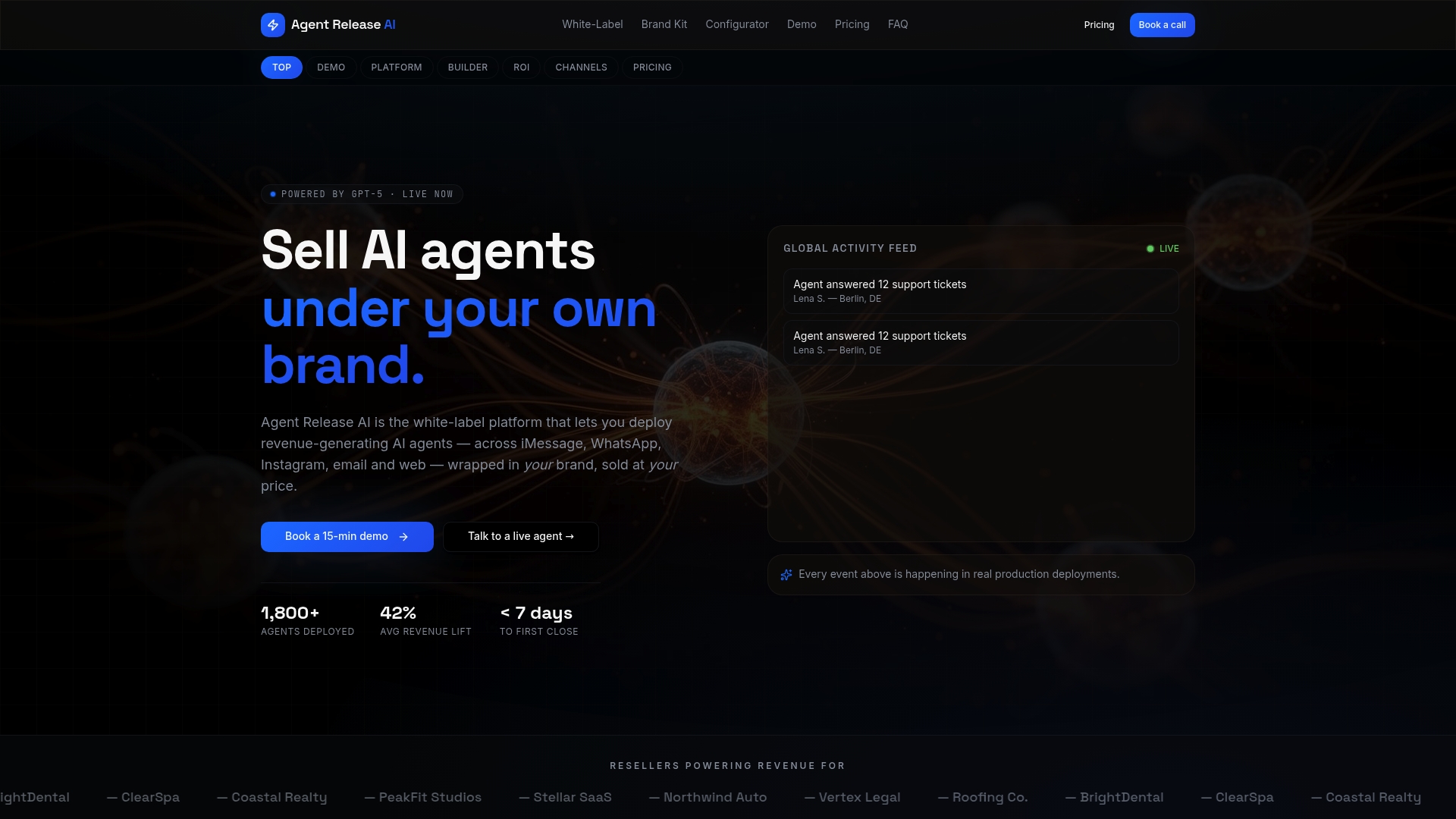
For agencies and consultants who want to resell branded AI agents without building a control plane from scratch, the white-label programme covers full branding and domain control alongside server-side revenue tracking, so you can see exactly what each client account is generating. Teams that just want the platform itself can check current plans on the pricing page, and anyone weighing configuration options can try the white-label configurator directly to see how quickly a branded agent comes together.
Sources
- Multi-tenant RAG with Amazon Bedrock knowledge bases
- How to secure a multi-tenant SaaS architecture before your first enterprise deal
- Indirect prompt injection: generative AI’s greatest security flaw
FAQ
Is Kafka a multi-tenant system?
Kafka can support multiple tenants sharing a cluster through topic-level access controls and quotas, but it does not enforce tenant isolation by default the way a purpose-built multi tenant chatbot platform does. Teams typically layer their own tenant_id conventions and ACLs on top of Kafka to achieve isolation.
What are the three types of chatbots?
Chatbots are commonly grouped into rule-based bots that follow scripted decision trees, retrieval-augmented bots that pull from a knowledge base to ground responses, and fully generative bots that rely on a large language model with little or no retrieval layer. Many production systems, including multi tenant chatbot platforms, combine retrieval and generative approaches.
What is a multitenant model?
A multitenant model is a software architecture where a single application instance and shared infrastructure serve multiple customers, or tenants, while keeping each tenant’s data and configuration logically separated. It contrasts with single-tenant architecture, where each customer runs on dedicated infrastructure.
What are the disadvantages of multi-tenancy?
The main disadvantages are shared-infrastructure risk, since a bug or breach in the isolation layer can potentially expose multiple tenants at once, and the noisy-neighbour problem, where one tenant’s heavy usage degrades performance for others sharing the same pool. Pooled architectures also make per-tenant customisation and compliance harder to guarantee than dedicated, silo deployments.
How long does it take to deploy a multi tenant chatbot platform?
A custom-built multi tenant chatbot platform with proper isolation, security controls and a control plane typically takes months to design, build and harden. A white-label platform like Agent Release AI can have a branded agent live in under a week, according to its own deployment claims.