October 1, 2026
Omnichannel Messaging: Launch in Under a Week for Australian Agencies
Step by step playbook for agencies and in house teams to build an omnichannel messaging strategy with Australian compliance and a white label path to...

Omnichannel Messaging: Launch in Under a Week for Australian Agencies
An omnichannel messaging strategy means every channel a customer touches, SMS, WhatsApp, email, web chat, draws on the same customer profile and the same conversation history, so no one repeats themselves. The first move isn’t picking new channels. It’s centralising customer identity and setting up an orchestration layer that decides the next best action, wherever the conversation happens. Platforms like Agent Release AI show one fast route to that outcome.
TL;DR:
- A successful omnichannel strategy requires a unified customer profile, real-time data updates, and an orchestration engine to guide next actions across channels.
- Starting with a single, high-value customer journey and instrumenting it thoroughly minimizes rework and facilitates gradual expansion.
- SMS remains the most reliable fallback, while WhatsApp and in-app chat excel for ongoing conversations, and email handles detailed communications.
- Cross-channel metrics like total resolution time and end-to-end customer satisfaction are essential for accurate performance measurement and scaling decisions.
- Platforms like Agent Release AI enable fast deployment of branded, multi-channel AI agents, making omnichannel implementation accessible for small and large teams alike.
Table of Contents
- Omnichannel vs multichannel: what’s the actual difference?
- Why omnichannel messaging matters for marketing and CX teams right now
- Core components of an omnichannel messaging system
- Step-by-step playbook to design and implement an omnichannel messaging strategy
- Channel selection, handoffs and message design patterns
- Measure, iterate and scale: KPIs, attribution and governance
- Compliance and operational controls teams need to build in
- How Agent Release AI maps to the omnichannel playbook
- Customer journey mapping and personalisation across channels
- Where omnichannel messaging is heading next
- Agent Release AI: a white-label route to omnichannel in days, not quarters
- Sources
- FAQ
Omnichannel vs multichannel: what’s the actual difference?
Multichannel means your brand shows up on several channels. Omnichannel means those channels share one customer record and one continuous conversation. Salesforce frames the difference as integration-driven: omnichannel centralises data and orchestrates interactions so every channel behaves like part of one journey, not a separate silo.
Picture a customer who messages your WhatsApp number about a delayed order, then emails support the next day. In a multichannel setup, the email team has no idea the WhatsApp chat happened, so the customer explains everything again. In a true omnichannel setup, the email agent, human or AI, sees the WhatsApp thread, the order status and the customer’s prior tone, and replies with context already loaded.
The shift matters because customer behaviour has already moved past single-channel habits:
- Customers now bounce between channels mid-conversation as a default, not an exception.
- Conversational channels like WhatsApp and in-app chat are growing fastest, while SMS still carries enormous volume as a reliable fallback.
- Treating channels as separate systems creates the repetition customers complain about most.
Why omnichannel messaging matters for marketing and CX teams right now
Continuity isn’t a nice-to-have. It’s what keeps a customer from abandoning a purchase or escalating a complaint out of sheer frustration at repeating themselves. When context carries across channels, resolution happens faster, conversion holds up better through multi-touch journeys, and support teams spend less time reconstructing history instead of solving problems.
The scale of multi-channel behaviour is no longer a marginal trend.
The vast majority of customer interactions now span multiple channels, according to Infobip’s analysis of 628 billion interactions in 2025. That means a strategy built around any single channel is, by definition, missing the way almost every customer actually behaves. Teams that still measure channels in isolation are measuring the wrong thing.

Core components of an omnichannel messaging system
Four building blocks have to work together before continuity is possible. Miss one and the others underperform, because context breaks somewhere in the chain.
- Identity resolution and a customer data platform (CDP): a single profile per customer, updated in real time as new interactions land, so every channel reads the same facts.
- An orchestration engine: rules or models that decide the next best action, SMS now, email tomorrow, escalate to a human, based on live profile data rather than a static campaign calendar.
- A unified inbox with preserved context: whoever or whatever responds, human agent or AI agent, sees the full thread across channels before replying.
- Data governance: consent records, suppression lists and sender ID management kept in sync across every channel and system.
Salesforce’s implementation framework puts data unification and orchestration at the top of the technical priority list, ahead of adding more channels. That ordering matters: channels without orchestration just multiply the places a customer can get a disjointed experience.
Pro Tip: Fix identity resolution before you add a single new channel. A fourth channel on top of broken data just means four places customers get ignored instead of one.
Step-by-step playbook to design and implement an omnichannel messaging strategy
Building this in the right order saves months of rework. Here’s the sequence that holds up in practice.
- Audit your data sources and map one customer journey end to end, listing every system that holds a piece of the customer record.
- Pick a single high-value use case to start, such as post-purchase support or lead qualification, rather than attempting every journey at once.
- Define objectives and KPIs tied to business metrics, not channel vanity metrics like open rate alone.
- Choose your architecture, typically a CDP paired with an orchestration layer, or a middleware approach that connects existing tools without a full platform rebuild.
- Build a minimum viable journey, test it with real traffic, and iterate on the handoff points where context tends to drop.
- Expand channels and automation only after the pilot validates, adding SMS, WhatsApp or voice once the first journey proves out.
A few rules keep this from sprawling into a multi-year project:
- Start narrow: one journey, fully instrumented, beats five journeys half-built.
- Instrument before you automate, so you can see where handoffs fail before AI or rules take over.
- Treat the pilot as a template, not a one-off, so expansion reuses the same orchestration logic.
Mailchimp’s guide to omnichannel customer service makes the same case: starting with a single high-value journey, instrumented properly, reduces risk and gets you to measurable results faster than a simultaneous rollout across every channel.
Channel selection, handoffs and message design patterns
Different channels earn their place for different reasons. SMS remains the dependable workhorse: Infobip’s 20-year analysis found SMS accounted for a major portion of traffic in 2025, making it the fallback channel you can count on when a customer’s inbox or app notifications go unread. WhatsApp and in-app chat, by contrast, are where conversational AI activity is growing fastest, suited to ongoing back-and-forth rather than a single alert. Email still does the heavy lifting for detail: order confirmations, policy documents, anything with more than a few lines.
A handoff sequence that preserves context might look like this: a customer books a service through web chat, receives an SMS reminder the day before with a reply-to-reschedule option, then gets a post-service email with a review request that already references the service they booked and when. Each channel plays to its strength, and each message carries forward what the last one established.
Design rules worth holding to:
- Match the channel to the message’s urgency and depth, SMS for time-sensitive, email for detail-heavy.
- Cap frequency per journey stage so customers aren’t hearing from three channels about the same event within an hour.
- Use rich media (images, buttons, quick replies) where the channel supports it, but never at the cost of a fast fallback to plain text when a customer’s device or connection can’t handle it.
Measure, iterate and scale: KPIs, attribution and governance
Omnichannel performance needs its own measurement approach, because single-channel metrics miss the handoffs that make or break the experience.
- Resolution time across the full journey, not just within one channel, shows whether context is actually transferring.
- Customer satisfaction (CSAT) measured at journey completion, not per channel, reflects the end-to-end experience.
- Conversion rate and revenue per contact, tracked across the whole sequence, reveal which journeys are worth scaling.
- Multi-touch attribution, crediting each channel’s contribution rather than only the last touch, gives a truer picture of what’s driving results.
Governance has to run alongside measurement, not after it: suppression lists synced across every channel in near real time, consent records audited on a schedule, and integration tests run whenever a new channel or automation rule goes live. Skipping this step is how a customer who opted out on one channel keeps getting messaged on another.
Compliance and operational controls teams need to build in
Consent, identification and a working opt-out are the three non-negotiables under the Spam Act 2003, and they apply regardless of which channel carries the message.
- Capture and record consent (express or inferred) before sending, and keep that record accessible for audit.
- Identify your business clearly in every marketing message and include a functional opt-out.
- Register alphanumeric sender IDs, a requirement that has applied since 1 July 2026, or use a reply-capable number instead.
- Sync suppression lists across every channel and test the unsubscribe flow regularly.
Opt-outs must be honoured within five business days, and enforcement under the ACMA’s guidance has already led to substantial penalties for senders who let suppression lists fall out of sync between systems.
How Agent Release AI maps to the omnichannel playbook
Agent Release AI is built around the same components this playbook calls for, packaged for agencies and businesses that want to deploy fast rather than build from scratch.
- Multi-channel agents under one brand: iMessage, WhatsApp, Instagram DMs, Messenger, SMS, email, web chat and voice, all run by GPT-5-powered conversations tuned to your niche, offer and tone.
- Unified inbox and context preservation: conversations across channels stay connected to the same customer record instead of scattering across separate tools.
- Server-side revenue attribution: tracks which conversations actually convert, closing the attribution gap most teams struggle with.
- Enterprise-grade security and brand controls: custom domains, branding and unlimited tenant creation for resellers managing multiple clients.
- Deployment typically under a week, using the brand kit generator and configurator to get a client-ready agent live fast.
Customer journey mapping and personalisation across channels
Journey mapping for omnichannel messaging starts with the moments a customer actually crosses channels, not the channels themselves. Map where a prospect typically moves from a web chat enquiry to an SMS follow-up, or from an email receipt to a WhatsApp support thread, and you’ve found the handoff points that need the most instrumentation. Generic journey maps built around a single channel miss exactly the friction points customers experience most.

Personalisation inside that map works best when it’s drawn from behaviour, not just declared preference. A customer who’s asked about pricing three times across two channels should see pricing-focused messaging next, regardless of which channel picks up the conversation. That requires the identity resolution and real-time profile updates covered earlier, feeding personalisation decisions rather than sitting in a dashboard nobody checks.
The practical technique is to segment by journey stage and recent behaviour together, not by channel. A customer in the consideration stage who’s gone quiet for a week needs a different message than one who just abandoned a cart, even if both are reachable on the same channel. Building personalisation rules around stage and recency, rather than around which channel happens to be open, is what keeps messages relevant instead of repetitive. Test personalisation changes on the single pilot journey from the playbook before rolling them across every channel at once, so you can see which adjustments actually move resolution time and conversion rather than guessing.
Where omnichannel messaging is heading next
Agentic AI is the real shift to watch. Orchestration is moving from rules someone wrote last quarter to systems that decide the next best action on their own, across channels, in real time. That’s a bigger change than any single new channel.
The priorities stay the same regardless: clean identity data, one well-instrumented pilot journey, and governance that doesn’t lag behind automation. Start with one journey, get it right, then let the system earn its way to autonomy.
— Agent
Agent Release AI: a white-label route to omnichannel in days, not quarters
Agencies and consultants building this playbook for clients face a choice: spend months assembling a CDP, orchestration layer and channel integrations, or deploy a platform that already does it under your own brand. Agent Release AI runs AI agents across popular messaging channels, all under your branding, with server-side revenue tracking built in to track conversation outcomes.
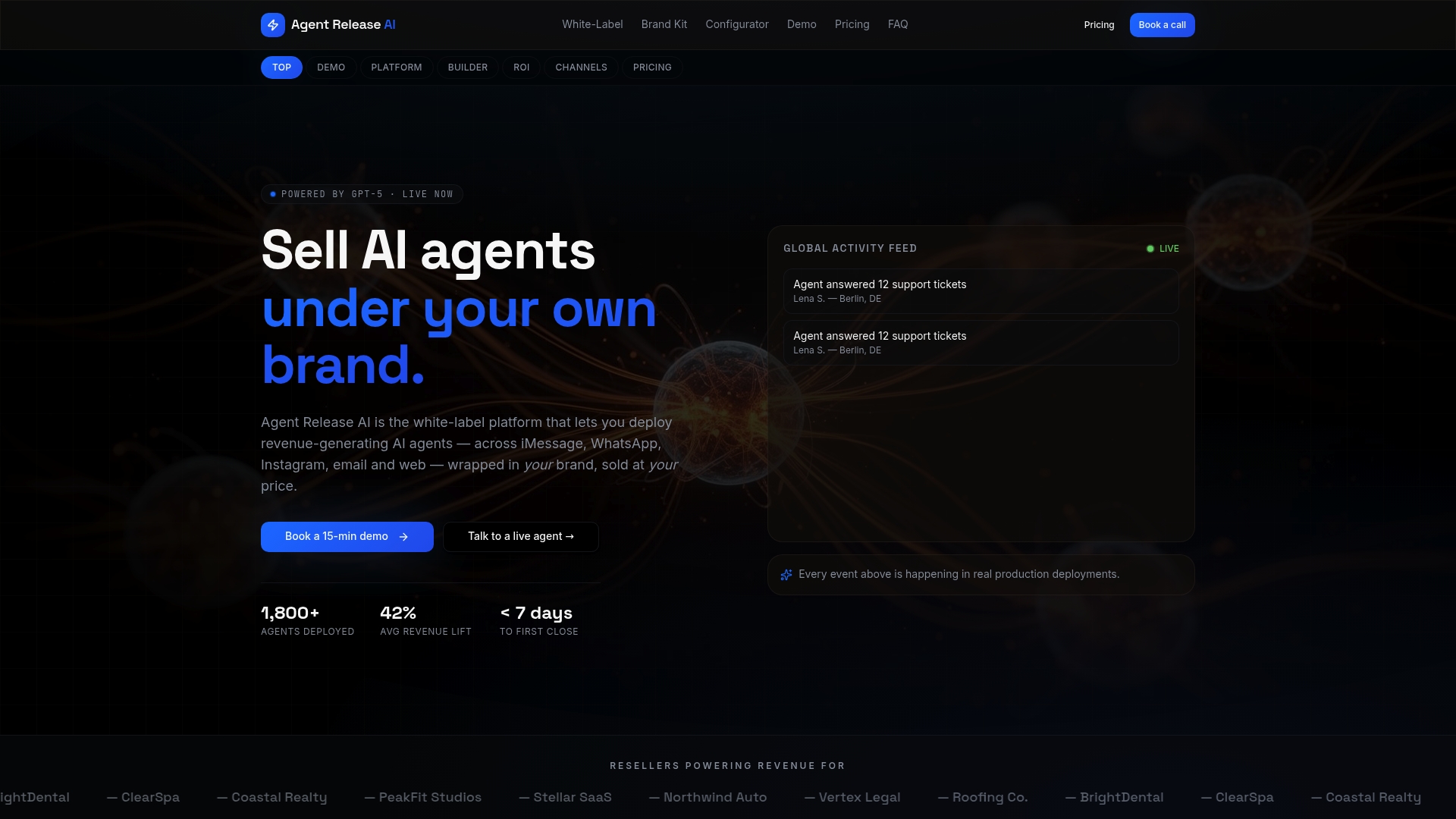
- Multi-channel agents live under your domain and branding, not a third-party logo.
- Deployment typically takes under a week, with a configurator and brand kit generator handling the setup.
- Unlimited tenant creation suits agencies managing several clients from one account.
Agent Release AI is priced at $497 per month, with a separate White-Label Program for agencies and resellers wanting full brand and domain control. Explore the white-label configurator to see how fast a branded agent can go live.
Sources
- Infobip’s 20-Year Analysis of 3.8 Trillion Messages Reveals Rise of Omnichannel, RCS and AI-Driven Communication
- Omnichannel vs Multichannel: Key Differences Explained | Salesforce
- SMS marketing laws in Australia: 2026 compliance guide | Sinch
- SMS marketing compliance Australia: ACMA Spam Act guide
FAQ
What are the four C’s of omnichannel?
Definitions vary across the industry, but a common version centres on consistency, continuity, context and convenience, meaning the brand experience, conversation history, customer data and ease of interaction all carry across channels. The goal behind all four is the same: a customer shouldn’t feel like they’re starting over when they switch channels.
What are the four pillars of an omnichannel strategy?
Most practical frameworks point to the same four pillars covered in this guide: unified customer data, an orchestration layer that decides next actions, integrated channels that share context, and governance covering consent and suppression. Skipping any one of these tends to break continuity somewhere in the customer journey.
What does omnichannel mean in simple terms?
Omnichannel means a customer can start a conversation on one channel and continue it on another without repeating themselves, because the brand sees one connected history rather than separate channel logs. It’s the difference between being present on many channels and actually connecting them.
How is omnichannel messaging different from having a shared inbox?
A shared inbox centralises where messages land, but it doesn’t automatically mean the data behind those messages is unified or that next actions are orchestrated. Omnichannel messaging requires that deeper layer, identity resolution and orchestration, on top of a unified inbox to deliver true continuity.
Can a small business realistically run an omnichannel messaging strategy?
Yes, starting with one high-value journey rather than every channel at once, as the playbook’s implementation advice suggests. Platforms like Agent Release AI also let smaller teams deploy multi-channel agents under their own brand without building the underlying infrastructure themselves.