September 26, 2026
Payback Fast: Small Business Chatbots, SaaS, Custom or White Label
Compare SaaS, custom API and white label chatbot paths for small businesses and agencies. See timelines, real costs ($30–$500/mo), ROI checks and...

Payback Fast: Small Business Chatbots, SaaS, Custom or White Label
Yes, for many small businesses a chatbot pays back quickly. Choose a SaaS platform for the fastest time to value, an API or custom build if you have high volume and developers on hand, and a white label partner such as Agent Release AI if you’re an agency or reseller that needs branded, ready-to-launch deployment. Check OAIC guidance before you send any customer data through a public model.
TL;DR:
- Small businesses with high after-hours inquiry volume and simple booking flows can see quick ROI from chatbots that qualify leads and schedule appointments automatically.
- Cost-effective SaaS platforms are best for low to moderate volumes, while high-volume businesses benefit from API or custom solutions requiring developer support.
- Agency or reseller deployment of branded chatbots with white label platforms like Agent Release AI enables rapid rollout across multiple clients with minimal branding setup time.
- Vendors should be evaluated based on transparent pricing, native CRM integration, human handoff capabilities, and data ownership terms, with clear SLAs in writing.
- Regular knowledge base maintenance and monitoring metrics such as resolution rate and qualified lead volume are essential for sustained chatbot ROI and performance.
Table of Contents
- What modern AI chatbots do for small businesses
- The business case: ROI, volume and quick wins
- How to choose the right chatbot approach
- Implementation options: SaaS, custom build or agency
- Why a white label platform suits agencies and resellers
- Comparing popular small business chatbot platforms
- Case studies: what successful small business deployments look like
- Measuring ROI and performance for your chatbot
- What running chatbot projects for small businesses has taught me
- Agent Release AI: launch branded agents for your clients fast
- Sources
- FAQ
What modern AI chatbots do for small businesses
Chatbots have moved well past scripted FAQ pages. The current generation, built on large language models, handles genuine conversation and hands off cleanly to a human when the question gets complicated.
For small businesses, that translates into four practical jobs:
- Support deflection: answering order status, return policy and account questions without a person touching them.
- Lead capture and qualification: asking the right questions, then routing hot leads straight to a calendar booking.
- Bookings and account updates: letting customers reschedule appointments, update details or check balances without a phone call.
- Multi-channel presence: meeting customers on the website, WhatsApp, Instagram DMs, SMS or email instead of forcing them into one inbox.
IBM’s breakdown of customer service chatbots notes that these tools deliver support around the clock, cut operational costs and connect into CRM systems so the conversation history follows the customer rather than living in a separate silo. That CRM link matters more than most owners expect: a bot that can see past purchases or open tickets gives noticeably better answers than one starting cold every time.
Channel choice should follow where your customers already are, not where it’s easiest to build. A tradie business fields more through SMS and missed calls than website chat. A retail brand often gets more traction on Instagram DMs than email. Matching the bot to the channel your customers actually use is the difference between a tool that gets ignored and one that quietly handles half your inbox.
The business case: ROI, volume and quick wins
The fastest payback for small businesses tends to come from a narrow use case: catching enquiries after hours and qualifying them before a human ever sees the thread. According to practitioner data on chatbot ROI, a bot often pays for itself quickly when three or more chatbot-ready traits apply, such as high after-hours enquiry volume, a simple booking flow and a sales process that benefits from faster response times.
A useful rule of thumb: businesses with steady evening or weekend enquiries and a straightforward next step (book a call, get a quote, schedule a visit) see returns fastest, according to chatbot revenue data from small business deployments.
Before committing budget, run through these checks:
- Estimate your current after-hours enquiry volume and how many go unanswered until the next business day.
- Map your qualification questions: what do you need to know before a lead is booking-ready?
- Confirm the bot routes qualified leads to calendar booking or a live handoff rather than just logging a message.
- Check the platform’s per-message or subscription cost against your expected volume.
- Ask what ongoing maintenance the vendor expects from you, and how much of it is included.
Two things quietly erase ROI. The first is knowledge base rot: answers go stale, the bot starts giving outdated information, and customers stop trusting it. The second is hidden message costs, particularly on channels like WhatsApp where costs shift once a conversation moves outside the free messaging window. Both are avoidable, but only if you budget for them from day one rather than discovering them in month three.
How to choose the right chatbot approach
Picking a platform is less about finding the flashiest demo and more about matching the tool to your volume, channels and compliance obligations. Work through these criteria before you sign anything:
- Volume: how many conversations per month, and does pricing scale sensibly with that?
- Channels: does it cover where your customers actually message you, not just the website?
- Integration: does it plug into your CRM, booking system or point-of-sale without custom development?
- Compliance: does the vendor explain how customer data is stored, used and, if relevant, used to train models?
- Ownership and brand control: do you own the conversation data, and can the bot look and sound like your business?
- Budget: is pricing predictable, or does it fluctuate with usage in ways you can’t forecast?
When you’re talking to vendors, ask directly: what happens when the bot can’t answer, how is the handoff to a human triggered, and what’s the average response time for that handoff? Ask whether your data is used to train their models, and whether you can opt out. Ask for their uptime SLA and their escalation SLA in writing, not just a verbal assurance. Cost breakdowns for chatbot platforms in 2026 point to a specific procurement clause worth copying: confirm data ownership, data retention period, model training opt-out, uptime SLA and transparent per-message pricing before signing.
Red flags are usually easy to spot once you know what to look for: pricing that’s only revealed after a sales call, no mention of human handoff anywhere in the demo, and no native CRM integration on the roadmap. Salesforce’s review of small business chatbot features lists native CRM integration, human handoff, natural language processing and knowledge base integration as the features that separate a genuinely useful chatbot from a glorified FAQ widget.
Pro Tip: Copy the five procurement questions above into your first vendor email. A vendor that answers all five clearly, without a sales call, is usually the one worth shortlisting.
Implementation options: SaaS, custom build or agency
The three main paths differ mostly in speed, cost structure and how much control you get over the finished product.
- SaaS platforms launch in days and carry low upfront cost, making them the natural choice for low to moderate volume. You trade some customisation for speed, and most small businesses never hit the ceiling where that trade-off starts to hurt.
- API or custom builds cost less per conversation once you’re at scale, but you need developers to build and maintain them. This path suits businesses already running technical teams or expecting high, predictable volume.
- Agency-led builds put someone else on the hook for integrations and ongoing compliance, at a higher upfront cost. This suits businesses that want accountability baked into the contract rather than managed in-house.
Timelines follow the same pattern. Cost and timeline data for AI chatbots in 2026 puts SaaS platforms at $30 to $500 a month, with agency builds ranging from $2,000 to $40,000 or more depending on scope, and maintenance typically adding 15% to 25% of the initial build cost every year. CRM integration work specifically often runs on a 2 to 6 week timeline, depending on how many systems need to talk to each other.
Whichever path you pick, budget for maintenance from the outset. A bot that launches well in week one and gets ignored by month six is the most common way small businesses waste this spend.
Why a white label platform suits agencies and resellers
If you’re a marketing agency, consultancy or reseller rather than a single small business, the calculation changes. You’re not deploying one bot, you’re deploying many, under different client brands, and the platform needs to support that without becoming a full-time job.
This is the gap Agent Release AI is built to fill. Its white label configurator lets you brand each agent with a client’s own name, colours and domain rather than a generic vendor look, and the brand kit generator speeds up that setup considerably. Deployment is typically completed in under a week, and revenue tracking gives resellers visibility into what each client agent is generating without manual reconciliation.
For agencies evaluating any white label platform, not just this one, a short checklist helps separate real capability from marketing copy:
- Can you create unlimited tenants, or does pricing punish you for growing your client base?
- Does branding extend to the domain, not just the logo and colours?
- Is revenue tracking built into the platform, or does it require a separate spreadsheet?
- How long does the vendor say deployment takes, and is that timeline realistic for your first client?
Ask any vendor making these claims for a live look at their configurator before you commit, the same way you’d ask a chatbot vendor for their SLA in writing.
Comparing popular small business chatbot platforms
Small business owners generally land on one of three platform types, each with a clear trade-off. No-code SaaS builders, the kind aimed at solo founders, let you launch a simple bot for well under $50 a month according to build versus buy comparisons for 2026, but customisation and integration depth are limited.
Mid-tier SaaS platforms with CRM and booking integrations cost more but close the gap on features like human handoff and multilingual support, the two items Salesforce flags as essential rather than optional.
Enterprise platforms and custom API builds sit at the top end. They’re cheaper per conversation at genuine scale, but they demand developer time most small businesses don’t have on staff.
White label platforms occupy a different lane entirely: they’re not competing on raw feature depth for a single business, they’re built for agencies managing many branded deployments at once. The right choice depends less on which platform has the longest feature list and more on whether your business needs one bot or fifty.

Case studies: what successful small business deployments look like
The clearest pattern in small business chatbot success stories is narrow scope done well rather than broad ambition done poorly. Documented small business chatbot deployments show that businesses focusing their bot on one job, usually after-hours lead capture and qualification, report the clearest revenue attribution because the bot’s contribution is easy to isolate from the rest of the sales process.
The common thread across these deployments is a qualification flow that routes straight to calendar booking rather than just logging an enquiry for someone to action manually the next day. That routing step, more than raw conversation volume, is what tends to move the needle on conversion value.
Businesses that struggled generally tried to make one bot do everything at launch: support, sales, bookings and account management simultaneously. Trying to launch all of it in one go without disciplined content maintenance is a common way these first deployments stall, which is why a phased rollout, one job to be done at a time, tends to outperform a single ambitious launch.
Measuring ROI and performance for your chatbot
Track a small set of numbers rather than drowning in dashboards. The metrics that actually tell you whether a chatbot is working are: resolution rate without human handoff, qualified leads generated per month, average time to first response, and booking or conversion rate from bot-qualified leads compared with your existing channels.
Set a baseline before launch. Note your current after-hours enquiry volume, your existing lead-to-booking conversion rate and your average response time. Without that baseline, any post-launch number is just a guess dressed up as insight.
Operational guidance on chatbot maintenance recommends monthly transcript reviews, automated failure detection and a QA sampling process to catch knowledge base rot before it shows up in your metrics. Expect to spend somewhere between 2 and 20 hours a month on this depending on how complex your bot’s job is, and build that time into whoever owns the platform internally.
Review the numbers monthly for the first quarter, then quarterly once the bot’s performance stabilises. A bot that’s resolving 60% of enquiries without handoff in month one but slipping to 40% by month four is telling you the knowledge base needs attention, not that the platform has failed.
What running chatbot projects for small businesses has taught me
Most failed chatbot projects don’t fail on technology, they fail on governance. Nobody owns the monthly content review, pricing was unclear from the start, or the handoff to a human was never actually tested before launch. The businesses that get real return prioritise three things: fast time to value, a fee they can predict twelve months out, and a clear answer to who checks the bot’s answers each month.
If you’re evaluating vendors, run the checklist earlier in this article through your top two options before you sign anything.
— Agent
Agent Release AI: launch branded agents for your clients fast
If you’re an agency, consultant or reseller rather than a single operator, Agent Release AI gives you a white label platform built specifically for that job. Deployment typically takes under a week, the brand kit generator handles client branding without a design sprint, and server-side revenue tracking shows you what each client agent earns without a manual spreadsheet.
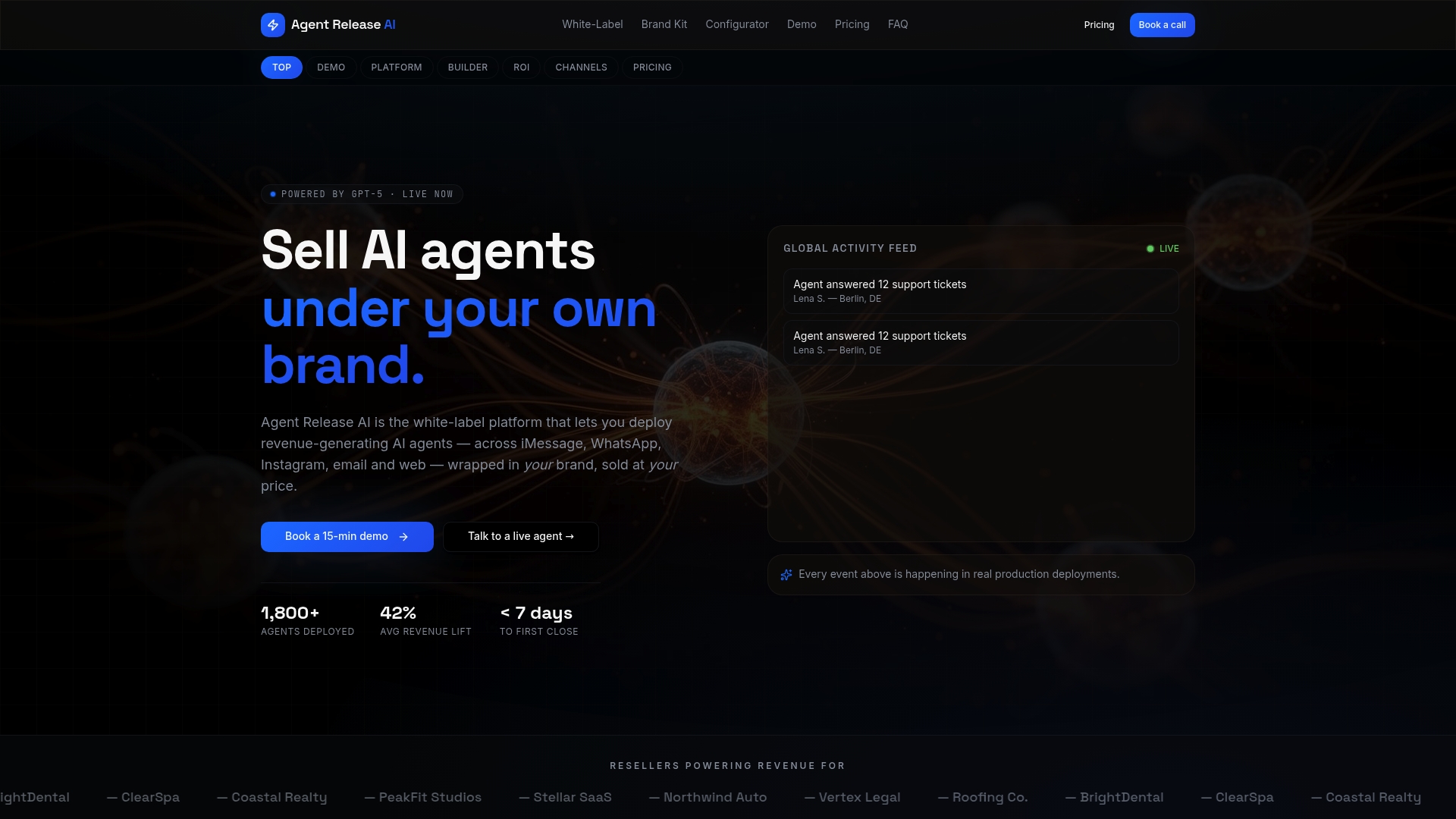
It’s built for marketing agencies, SaaS resellers and consultants who want to sell branded AI agents under their own name rather than a vendor’s. Unlimited tenant creation means growing your client base doesn’t mean renegotiating your plan. Check Agent Release AI pricing at $497 a month, or look at the White-Label Program if branded reseller deployment is the goal.
Sources
- GenAI tools in the workplace: balancing protection of personal information and business efficiency — OAIC
- AI customer service chatbots — IBM
- Chatbot ROI by industry: what small businesses can realistically expect — Scott Armbruster
- AI chatbot costs in 2026 — TopSyde
- What are the best AI chatbots for small business customer service? — Salesforce
FAQ
Which AI chatbot is best for business?
There’s no single best chatbot for every business: the right choice depends on volume, channels and whether you need multi-brand deployment. A SaaS platform suits most single-location businesses, while agencies managing multiple client brands typically need a white label option like Agent Release AI.
What are the top 5 chatbots?
Rankings shift constantly and depend on the use case being measured, so a definitive top five isn’t something any credible source publishes. Focus instead on the features that matter for your business: CRM integration, human handoff and NLP quality, which Salesforce identifies as the features that separate strong platforms from weak ones.
Is there a better chatbot than ChatGPT?
ChatGPT is a general-purpose conversational AI, not a small business customer service platform, so the comparison isn’t quite apples to apples. Purpose-built small business chatbots add CRM integration, booking flows and human handoff that a general assistant doesn’t offer out of the box, per IBM’s overview of customer service chatbots.
What are the four types of chatbots?
Chatbots are commonly grouped as rule-based (menu-driven, following set scripts), keyword-recognition bots, AI or NLP-powered bots that understand natural language, and hybrid bots that combine rules with AI for more flexible conversations. Definitions vary slightly by source, but most small business platforms today fall into the AI or hybrid category.
How much does a chatbot cost for a small business?
Costs vary by approach: SaaS platforms typically run $30 to $500 a month, while agency builds range from $2,000 to $40,000 or more, according to 2026 chatbot cost data. Maintenance usually adds another 15% to 25% of the build cost annually, so factor that into any multi-year comparison.