October 3, 2026
Launch Branded Web Chat AI in 30–90 Days for Agencies and Resellers
Practical guide for agencies and resellers to pick, launch and govern branded web chat AI. Includes procurement checklist, 30–90 day timeline and...

Launch Branded Web Chat AI in 30–90 Days for Agencies and Resellers
Web chat AI is a website-embedded conversational agent powered by generative models that can automate common customer tasks, capture leads and assist human agents. It runs around the clock, handles routine questions without a queue, and hands off to a person when a conversation needs judgement. For agencies and resellers, white-label platforms now make branded deployment fast, often within days rather than months.
TL;DR:
- Web chat AI can understand vague questions, retain context, and perform actions, but output quality heavily relies on training data relevance.
- Successful deployments focus on self-service, lead qualification, and agent assistance, with measurable KPIs like response times and satisfaction scores.
- Choosing a platform requires clear data handling policies, reliable escalation paths, predictable pricing, and verified human handover demonstrations.
- Privacy compliance involves minimizing sensitive data collection, redacting PII, maintaining audit trails, and updating privacy notices per regulations.
- Speedy, branded deployment is achievable within days to weeks through white-label platforms offering full control over branding, data, and revenue attribution.
Table of Contents
- What web chat AI is and how it differs from legacy chatbots
- High-value business use cases and expected outcomes
- How to choose a web chat AI: criteria, questions and red flags
- Privacy, compliance and governance for customer-facing chat agents
- Implementation checklist and realistic timeline for launch
- Operating a hybrid model: how AI and humans should work together
- What agencies ask us before launching a branded chat agent
- How Agent Release AI supports white-label web chat deployment
- FAQ
- Sources
What web chat AI is and how it differs from legacy chatbots
Legacy chatbots run on decision trees: a customer clicks a button, the bot matches it to a scripted reply, and anything outside that script fails. Web chat AI works differently. It uses large language models that generate responses in natural language, hold context across a conversation and infer intent even when the customer phrases things awkwardly.
That shift opens up real capability:
- Intent detection that understands what a customer wants even from vague or multi-part questions
- Context retention across a session, so customers do not repeat themselves
- Action execution, like booking a slot, updating a form or pulling order status
- Smooth handover to a human agent with the conversation history intact
The catch is that output quality depends entirely on what the system is trained and grounded on, and understanding technical background on data collection practices like those explained in Building AI training and RAG datasets with mobile proxies · Masklabs can be critical. A generative model fed a thin or outdated knowledge base will answer confidently and incorrectly, which is worse than not answering at all.
High-value business use cases and expected outcomes
Most deployments succeed when they target a specific, high-feasibility job rather than trying to replace an entire support team at once. Gartner’s customer service AI research points to self-service and agent assist as the use cases that deliver value fastest, because they have clear success metrics and contained risk.
- Self-service and FAQ automation: resolve order status, returns, billing and account questions without a ticket, freeing agents for harder cases.
- Lead capture, qualification and routing: ask qualifying questions in real time, score the lead and route it to the right sales rep before the visitor leaves the page.
- Agent assist: surface suggested replies, summarise long threads and draft after-call notes, cutting resolution time and reducing the admin load on human agents.
Track outcomes against a handful of operational KPIs: first-response time, containment rate (conversations resolved without escalation), lead-to-opportunity conversion and customer satisfaction scores. A generative agent that cannot complete real actions inside the chat, like booking changes or account updates, tends to lose customers to third-party tools instead, according to Gartner’s research on genAI preferences.
How to choose a web chat AI: criteria, questions and red flags
Choosing a platform comes down to six practical checks: how data is handled, how well the model is tuned to your domain, what it integrates with, how handover to humans works, how fast it deploys and how pricing is structured. Skip any of these and you inherit risk later.
Watch for these red flags during vendor conversations:
- Vague or undisclosed answers about what data trained the model
- No ability to export, audit or delete conversation logs
- No defined escalation path when the AI is uncertain
- Pricing that scales unpredictably with volume or message count
Bring a short procurement checklist to vendor calls: ask where customer data is stored and for how long, whether the knowledge base can be updated without a developer, what the average deployment timeline looks like, and how escalation triggers are configured.
Pro Tip: Ask every vendor to show you a live handover from AI to human agent, not a slide. If they cannot demo it, the feature probably does not exist yet.
Privacy, compliance and governance for customer-facing chat agents
Customer-facing AI carries real privacy obligations, and regulators are paying attention. The OAIC’s guidance on commercially available AI products advises organisations to clearly identify AI systems to users, update privacy notices before deployment and confirm that collection and use of personal information meets Australian Privacy Principles obligations.
Regulators are explicitly focused on transparency and data handling, and the OAIC’s guidance frames updating privacy notices and documenting training datasets as practical, non-optional steps rather than nice-to-haves.
Build these controls into every deployment:
- Minimise collection of sensitive information inside chat flows
- Apply PII redaction before data is logged or used for retraining
- Set clear retention periods and honour deletion requests
- Offer an opt-out from AI-handled conversations where appropriate
- Keep an audit trail of conversations for compliance review
Legal commentary on the OAIC’s AI guidance reinforces that consent and APP obligations apply when personal information is used to train or fine-tune a model, not just when it is collected at the point of chat. Pair that with routine testing, periodic audits and a documented incident response plan, and governance stops being an afterthought.
Implementation checklist and realistic timeline for launch
A sensible rollout moves through three phases rather than one big-bang launch.
- Pre-launch: scope the use case, map the customer journey, confirm integrations and run a privacy impact assessment before any code ships.
- Build: groom the knowledge base, design prompts and conversation flows, tune tone and branding, then run structured QA against real customer questions.
- Launch and iterate: soft-launch to a subset of traffic, monitor containment and satisfaction KPIs, then refine the knowledge base and escalation rules weekly.
In practice, most of the timeline sits in knowledge-base grooming and backend integration rather than the chat interface itself. A first useful reply can happen in days, but reliable automation across edge cases typically takes a few weeks of iteration.
It surfaces knowledge-base gaps before they reach your full customer base.*

Operating a hybrid model: how AI and humans should work together
The most durable setups are not “AI replaces agents,” they are AI plus agents working the same queue. Gartner’s prediction on customer service workforce plans notes that many organisations attempting to remove human agents entirely end up reversing course, which backs a hybrid approach over a fully autonomous one.
- Escalate automatically on low confidence scores, repeated customer frustration signals or explicit requests for a human
- Pass structured metadata, intents, conversation IDs and confidence scores, to the agent desktop so context is not lost
- Use agent-assist suggestions to cut after-call work and speed up resolution
- Retrain support teams to manage AI-assisted queues rather than raw ticket volume
What agencies ask us before launching a branded chat agent
Every reseller conversation starts the same way: how fast can this go live, who owns the revenue, and does it carry our brand or the platform’s? Those three questions shape almost every deployment decision that follows.
Realistic first wins in the 30 to 90 day range tend to be modest and specific: one well-groomed knowledge base, one lead-capture flow live on a client’s site, one clean handover rule. The common pitfall is trying to automate everything at once before the knowledge base is ready, which produces confident wrong answers and erodes trust fast. Narrow scope first, then expand once containment and satisfaction numbers hold steady.
— Agent
How Agent Release AI supports white-label web chat deployment
We built our platform around the exact problem agencies raise first: speed without losing brand control. Deployment can be fast, agents run under your own branding and domain, and server-side revenue tracking provides insight into client relationships.
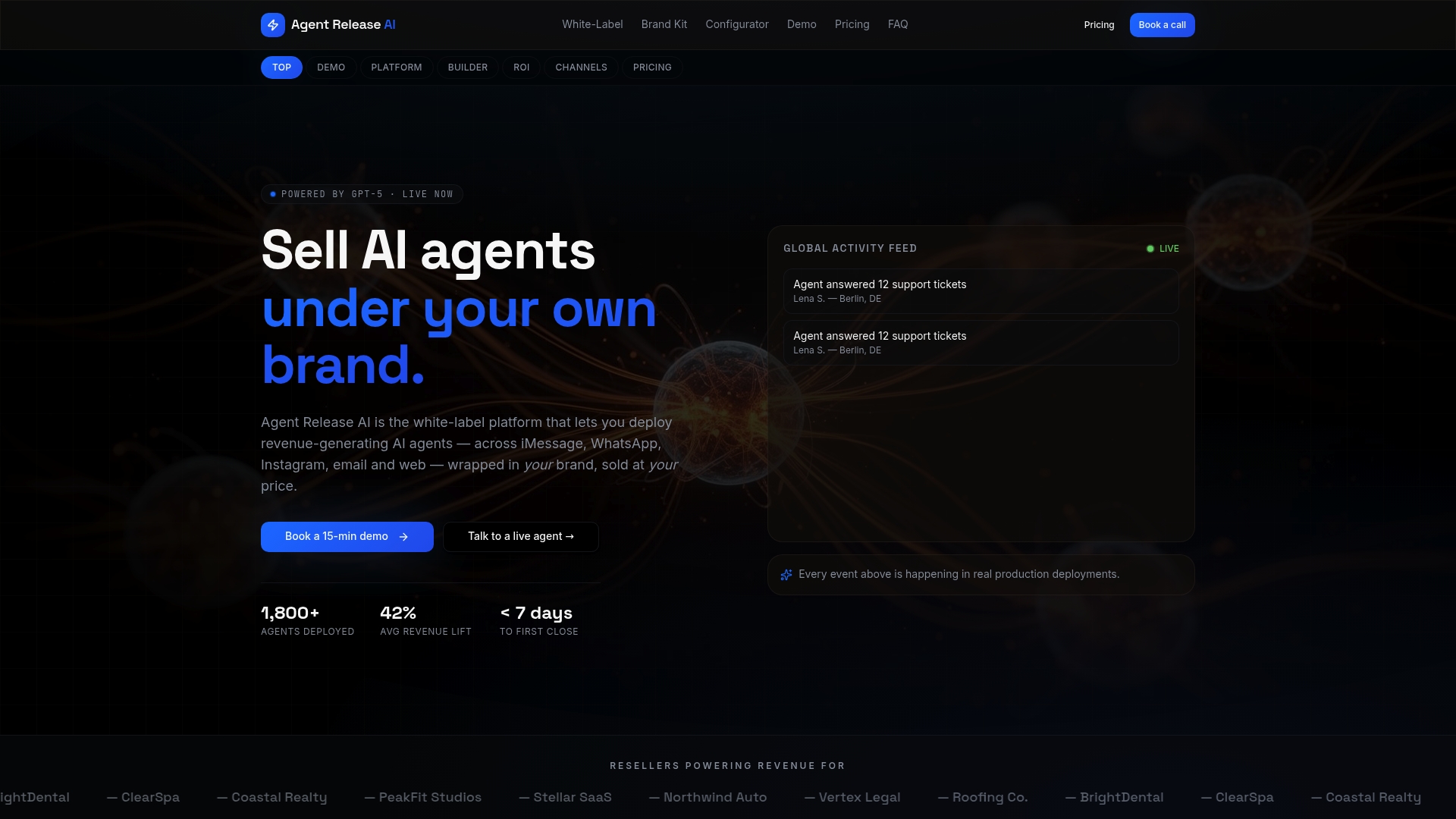
- Launch branded AI agents across web chat, WhatsApp, iMessage, email and more from one platform
- Use the white-label configurator to apply your brand kit, domain and tone without custom development
- Create unlimited tenants for client accounts, each with its own conversations, data and controls
- Track revenue attribution at the server level, built for agencies managing multiple client deployments
Our Agent Release AI plan runs $497 per month with unlimited agents and channels, and our White-Label Program adds the branding, domain and reseller tooling agencies and consultancies need to resell under their own name. If you are weighing build-your-own against a managed platform, check pricing to see what a branded launch looks like this week.
FAQ
What is web chat AI and how is it different from a chatbot?
Web chat AI is a website chat agent built on generative language models rather than fixed decision trees, so it can understand varied phrasing, hold context and complete actions like bookings or account updates. A legacy chatbot only matches scripted buttons or keywords and fails outside its script.
How long does it take to launch a web chat AI agent?
A first working version can be live within days once the knowledge base and core flows are ready, though reliable handling of edge cases usually takes a few weeks of iteration. White-label platforms built for quick deployment, including Agent Release AI, can shorten the branded setup phase to under a week.
What privacy rules apply to AI chat on an Australian business website?
The OAIC’s guidance on commercially available AI products advises identifying AI systems to users, updating privacy notices and ensuring data collection and use meets Australian Privacy Principles obligations. Practical steps include minimising sensitive data collection, redacting personal information in logs and keeping an audit trail.
Will AI replace human customer service agents?
Unlikely in most cases. Gartner’s research found that many organisations that tried removing human agents entirely abandoned those plans, which points toward AI and agents working the same queue rather than AI operating alone.
How much does a white-label web chat AI platform cost?
Our Agent Release AI plan costs $497 per month with unlimited agents and channels, and our separate White-Label Program adds branding and reseller tooling on top. Pricing for the white-label add-on is available on request.