October 12, 2026
Agent Assist Suggestions for Support Teams: Start Near 0.4
See how support teams configure agent assist suggestions, tune confidence thresholds, test golden sets, and keep AI replies grounded with human review.

Agent Assist Suggestions for Support Teams: Start Near 0.4
Agent assist suggestions give human support agents real-time reply drafts, knowledge links and next-best actions while they stay fully in control of what gets sent. The result is faster handling, more consistent answers and better compliance, without replacing the person on the chat. This guide walks through how suggestions get generated, the main types you’ll see, and how to configure, roll out and measure them properly.
TL;DR:
- Google recommends confidence thresholds around 0.4 to 0.44, with filters for greetings, agent messages, and duplicate prompts; raise the threshold as pilot evidence accumulates.
- Use FAQ Assist for repetitive questions, article links when agents need context, summaries for long threads, and coaching prompts for complex workflows.
- One online retail deployment reported roughly 50% lower average handle time, but the result relied on clean knowledge and policy grounding.
- Track acceptance, coverage, average handle time, and escalations after launch; pause suggestions when dismissals or escalations spike, and retrain before resuming.
Table of Contents
- What agent assist suggestions are and what they do in support workflows
- How suggestions are generated: retrieval, routing and grounding
- The main suggestion types and when each one fits
- Getting from pilot to production: a practical checklist
- Measuring suggestion quality and business impact
- How Agent Release AI supports rapid agent assist deployment
- Where conventional agent assist advice gets it wrong
- Run a faster agent assist pilot with your own brand on it
- FAQ
- Sources
What agent assist suggestions are and what they do in support workflows
Agent assist suggestions are AI-generated prompts, drafts or knowledge pointers shown to a human agent mid-conversation. The agent reviews, edits or dismisses each one. Nothing reaches the customer without a human decision in the loop, which is the whole point: speed from automation, judgement from the person.
Teams adopt suggestions for a few concrete reasons, often after assessing their readiness and pinpointing workflow bottlenecks with tools like workflow automation with AI:
- Faster responses: agents spend less time searching knowledge bases mid-chat.
- More consistent answers: suggestions pull from the same approved source every time.
- Easier compliance: policy-grounded snippets reduce improvised or risky answers.
- Lower average handle time (AHT) when suggestions are tuned well.
The trade-off sits between accuracy and coverage. Show too many low-confidence suggestions and agents start ignoring all of them. Set the bar too high and coverage drops to a handful of easy queries. Most platforms manage this with a configurable confidence threshold, which we’ll cover next.
How suggestions are generated: retrieval, routing and grounding
Behind every suggestion sits a pipeline, not a single model call. A query rewriter cleans up the customer’s message, an intent classifier works out what they actually want, and a retrieval step fetches the closest matching policy or knowledge base snippets. Retrieval experiments described in the ShopEase framework found dense retrieval methods like FAISS often outperform sparse, keyword-based search (BM25) on accuracy, though adding heavy reranking can slow things down without a clear accuracy gain.
Once relevant snippets are retrieved, a suggestion generator acts like an expert editor: it drafts or revises a reply using constrained prompts, so the output stays grounded in what the knowledge base actually says rather than inventing an answer.
- Rewriters and intent classifiers narrow down what to search for.
- Retrieval (dense or sparse) pulls the closest matching snippets.
- A constrained generator drafts or edits a ready-to-send response.
- Trigger filters decide when a suggestion appears at all.
Those trigger filters matter more than most teams expect. Google Cloud’s Agent Assist documentation recommends starting confidence thresholds around 0.4 to 0.44, alongside settings like noSmallTalk (skip greetings and chit-chat) and onlyEndUser (only trigger on customer messages, not agent replies), plus deduplication so the same suggestion doesn’t repeat.
Pro Tip: Start your confidence threshold low during the pilot, then raise it gradually as you confirm which suggestion types agents actually accept.
The main suggestion types and when each one fits
Suggestions aren’t one thing. Most platforms split them into categories that solve different problems.
- FAQ Assist: short, sourced answers with a confidence score and the source snippet attached, best for high-volume, repetitive questions.
- Article or knowledge suggestions: links or snippets to longer documents, useful when the answer needs context the agent should read before replying rather than paste verbatim.
- Generative knowledge assist and proactive suggestions: short drafts, conversation summaries or suggested follow-up queries, useful for more open-ended or multi-turn conversations.
- AI coach or instruction-driven sample responses: multi-step guidance for complex flows like retention offers or upsell prompts, where the agent needs a sequence of talking points rather than a single line.
Picking the right type for the right moment matters. FAQ Assist suits a customer asking about return windows. Generative summaries suit a long, messy thread an agent is picking up mid-shift. Research on agentic-RAG systems found that returning multiple grounded candidate replies, rather than one fixed answer, gave operators more useful options to choose from in real-time trials.
Getting from pilot to production: a practical checklist
A good pilot starts small and measured, not broad and hopeful.
- Build a small golden set of representative conversation-and-response pairs and measure baseline accuracy before changing anything, a practice Google Cloud’s generative assist guidance recommends for tuning before wider rollout.
- Clean up your knowledge base: split long documents, remove irrelevant intro content, and keep only articles agents actually use, per Google Cloud’s knowledge document best practices.
- Write prompts in an expert-editor style: ask the model to revise or fill gaps in a baseline draft rather than generate free-form.
- Decide where suggestions surface (inline in the agent console, or via event-based Pub/Sub notifications) and set deduplication thresholds so repeats don’t clutter the screen.
- Know when to pause suggestions entirely: a spike in dismissals or escalations is the signal to stop and retrain, not push harder.
A modular human-in-the-loop pipeline, including rewriter, intent classifier, retrieval and policy grounding, reported AHT reductions of roughly 50% in a large production e-commerce deployment. That kind of result depends on disciplined knowledge hygiene and grounding, not the model alone.
Move from pilot to production once your golden set accuracy holds steady for two consecutive review cycles and agent acceptance rate is trending up, not flat.
Measuring suggestion quality and business impact
Track a small set of numbers consistently rather than everything at once:
- Suggestion acceptance rate: how often agents use a suggestion as-is or with minor edits.
- Suggestion coverage: the share of conversations where a relevant suggestion appeared at all.
- AHT and issues resolved per hour.
- Escalation rate, as a check that speed isn’t coming at the cost of accuracy.
The same production deployment referenced above paired its AHT reductions with deterministic policy grounding, passing backend eligibility flags straight into the generator, which cut down on risky, improvised reasoning for policy-sensitive cases.
Keep watching for drift after launch: knowledge bases go stale, intents shift, and a suggestion that was accurate in month one can quietly become wrong by month six. Review your golden set on a schedule, not just at launch, and keep data-handling and disclosure practices current as your knowledge base grows.
How Agent Release AI supports rapid agent assist deployment
We provide a white-label platform for deploying AI agents across multiple messaging channels under your own brand. That multi-channel reach matters for agent assist because suggestion quality has to hold up wherever the conversation happens, not just in one channel.
A few features map directly onto the checklist above:
- Server-side revenue tracking, so suggestion-driven upsell and retention conversations tie back to measurable outcomes.
- Enterprise-grade security built into every deployment, relevant anywhere customer data flows through a knowledge base.
- Unlimited tenant creation, which lets agencies run separate branded pilots for multiple clients without rebuilding infrastructure each time.
- A White-Label Configurator for adjusting branding, triggers and knowledge sources without engineering support.
Deployment can be rapid, supporting a tight and iterative testing and tuning cycle rather than one drawn out over months.
Where conventional agent assist advice gets it wrong
Most agent assist content treats the model as the hard part. It isn’t. The retrieval pipeline and knowledge hygiene decide whether suggestions are useful long before any generation happens, and teams that skip straight to prompt tuning without fixing their knowledge base end up blaming the AI for what is actually a documentation problem.

The bigger miss is treating the confidence threshold as a set-and-forget setting. It’s a dial you should be adjusting weekly during a pilot, not a default you configure once and leave. Teams that start conservative, around 0.4 as Google Cloud recommends, and raise it only as golden-set accuracy proves out, end up with agents who trust the suggestions. Teams that start loose to maximise coverage end up with agents who click past everything, which defeats the purpose entirely.
If you take one thing from this guide, prioritise the golden set before the prompt. Twenty to thirty well-chosen examples will tell you more about where your suggestions fail than any amount of prompt rewriting, and that evidence should drive every configuration change that follows.
— Agent
Run a faster agent assist pilot with your own brand on it
If you’re exploring agent assist suggestions as part of a broader support stack, the configuration work above (confidence thresholds, golden sets, knowledge hygiene) applies whichever platform you choose. Where we come in is speed and ownership: we get a branded, multi-channel AI agent live in under a week, with no setup fees, per-message charges or revenue-share cuts eating into what you build.
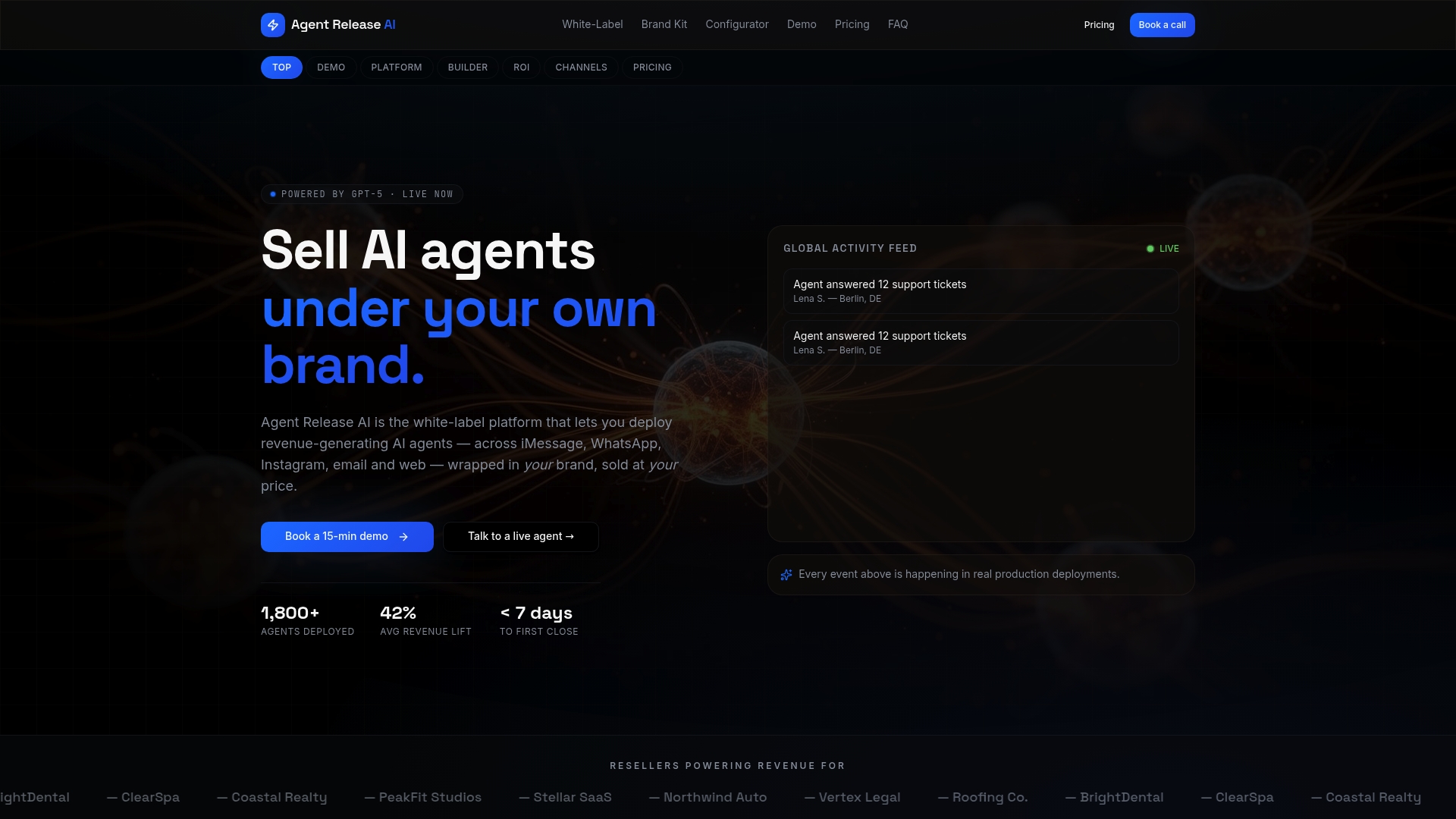
That matters most for agencies and resellers who want to run pilots for multiple clients without rebuilding the stack each time. Our White-Label Program adds full domain and branding control on top of the core platform, and the White-Label Configurator lets you adjust triggers and knowledge sources yourself once a pilot is live.
- Check pricing for the Agent Release AI plan at $497 per month, unlimited agents and channels included.
- Review the White-Label Program if you’re reselling to clients under your own brand.
- Read our guide to running a branded pilot for pilot KPIs before you configure your first conversation profile.
Ready to see it running under your own name? Book a demo and we’ll walk through a seven-day pilot plan built around your channels.
FAQ
What are some cool AI agent ideas?
Beyond customer support, teams use AI agents for lead qualification, appointment booking, order tracking and post-purchase follow-up across channels like WhatsApp and email. The most effective ideas pair a clear, narrow job (like answering shipping questions) with a grounded knowledge base rather than trying to handle everything in one agent.
What does agent assist do?
Agent assist surfaces real-time reply drafts, knowledge article links and next-best-action prompts to a human agent during a live conversation, without sending anything automatically. The agent reviews and edits each suggestion, which keeps speed gains from automation while keeping judgement with the person on the chat.
Can you give me some examples of agent skills?
Common agent-assist skills include FAQ Assist for quick sourced answers, article suggestions for longer policy documents, generative summaries for catching up on long threads, and coach-style prompts for multi-step flows like retention offers. Each skill type suits a different moment in the conversation rather than replacing the others.
How much does Google Agent Assist cost?
Google doesn’t publish a single flat Agent Assist price. It’s billed through Google Cloud’s usage-based model alongside Dialogflow, so cost depends on conversation volume and which features (FAQ Assist, Article Suggestion, generative assist) you enable. Businesses wanting a flat-rate alternative can compare that usage-based structure against fixed-fee platforms before committing.
Sources
- A cost-efficient AI copilot for high-volume e-commerce customer support
- FAQ assist | Agent Assist | Google Cloud Documentation
- Supporting human operators during customer service interactions with agentic-RAG
- ShopEase: A Generative AI-Based Multi-Agent Framework for Intelligent Enterprise Customer Support