October 10, 2026
Chatbot Pricing in Australia: When White Label Pays Off in 2026
Compare chatbot costs by resolution, seat, flat rate, and hybrid billing. See how Australian GST and white label options shape 2026 budgets and payback.

Chatbot Pricing in Australia: When White Label Pays Off in 2026
If you’re paying a moderate monthly amount for a chatbot, stick with a SaaS subscription. Above that, a white-label licence or a custom build usually pays off faster. Expect three billing models to dominate your quotes this year: per-resolution, per-seat and flat-rate tiers. For agencies and resellers who want predictable costs and faster payback, Agent Release AI is our pick for a flat-rate, white-label alternative to per-message billing.
TL;DR:
- Per resolution charges can rise from $250 at 500 completed conversations to $2,500 at 5,000, while seat plans may require three to five seats.
- Growth and business tiers typically cost $100 to $2,500 monthly; separately metered AI can add about $60 for 3,000 conversations at illustrative rates.
- A proof of concept costs roughly $8,000 to $25,000 and takes four to eight weeks, while enterprise builds can exceed $150,000 and take six months.
- Before signing, compare quotes using actual volume and check overage rates, data export, GST invoices, app store markups, and per tenant or channel fees.
Table of Contents
- How chatbot billing works: per-resolution, per-seat, flat-rate and hybrid models
- Market price bands in 2026: entry, growth, business and enterprise tiers
- Build versus buy: one time build budgets, running costs and the crossover point
- Key cost drivers and levers you control
- A worked budgeting example and payback calculator you can reuse
- How a white-label AI agent platform changes cost and speed to market
- Comparing white-label pricing against standard or branded chatbot plans
- Breaking down white-label platform fees: setup, customisation and revenue share
- How multi-channel deployment affects your pricing
- Scaling costs for unlimited tenant creation
- Contract terms worth negotiating before you sign
- What to look for when choosing a white-label provider
- One procurement rule worth remembering
- Agent Release AI: how we solve the same buyer job and next steps
- FAQ
- Sources
How chatbot billing works: per-resolution, per-seat, flat-rate and hybrid models
Every chatbot quote you get in 2026 will map to one of four billing structures. Knowing which one you’re looking at changes how you forecast cost, because each model punishes a different kind of growth.
- Per-resolution pricing charges you for every conversation the bot successfully closes without a human. It looks cheap at low volumes: say $0.50 per resolution at 500 resolutions a month is $250. Push that to 5,000 resolutions and you’re at $2,500, often more than a flat-rate plan would have cost you.
- Per-seat pricing charges per human agent or admin seat, regardless of conversation volume. This model suits teams with few staff but high chat volume, and it tends to carry seat minimums, often three to five seats, even for a single-person trial.
- Flat-rate tiers cap your spend at a fixed monthly fee with a usage ceiling (a set number of conversations or AI credits). Overflow usually triggers an add-on fee rather than a hard cutoff.
- Hybrid models blend a base platform fee with metered AI usage on top, which is how most “growth” and “business” tiers are actually priced once you read the fine print.
The trap in all four models is currency and platform handling. Many vendors list US dollar prices and bill through app stores, where Apple and Google both add a margin that shows up as a higher Australian dollar figure than the vendor’s advertised price, a pattern already documented for ChatGPT Plus subscriptions billed through mobile app stores. Billing direct through a vendor’s website, rather than through an app store, usually avoids that markup.
Seat-based AI products add another wrinkle. Local guidance on ChatGPT Business pricing for Australian buyers notes that some vendors quote AUD prices inclusive of GST, while others bill in USD and leave the exchange conversion to your card provider. If a vendor can’t produce a compliant tax invoice, flag it before you commit, because it affects whether you can claim the GST back at all.
Market price bands in 2026: entry, growth, business and enterprise tiers
Chatbot pricing splits cleanly into four bands once you strip out the marketing language.
- Starter plans ($0 to $50 a month): rule-based flows, a single channel (usually web chat), limited or no generative AI, and caps on monthly conversations. Fine for testing, not for running a real support queue.
- Growth and business tiers ($100 to $2,500 a month): this is where most SMBs land. You get retrieval-augmented generation (RAG) for answering from your own knowledge base, multiple seats, CRM and helpdesk integrations, and usually two or three channels bundled in.
- Enterprise tiers ($2,500 a month and above): service-level agreements, single sign-on, audit logs, and genuine multi-channel scale across web, WhatsApp, email and voice, often with a dedicated account manager.
- AI usage add-ons: even inside a flat plan, generative AI replies are frequently metered separately. A business handling 3,000 AI-assisted conversations a month at an illustrative $0.02 per message adds roughly $60 on top of the base subscription, before any human escalation costs.
- Seat minimums: per-seat pricing tends to dominate once your team passes five or six agents, because the per-seat fee multiplies faster than a flat conversation cap does.
The practical lesson is to price your actual expected volume against both a flat tier and a per-resolution quote before signing anything, because the “cheaper” headline plan often isn’t once your real usage is applied.
Build versus buy: one time build budgets, running costs and the crossover point
Building your own chatbot instead of subscribing to one makes sense only past a certain spend threshold, and the numbers are fairly predictable once you break them into brackets.
- Proof-of-concept build: roughly $8,000 to $25,000, delivered in four to eight weeks, for a single use case with basic integrations.
- Single-workflow build: roughly $35,000 to $70,000, three to five months, for one well-defined job (support triage, lead qualification) with proper testing and handoff logic.
- Multi-workflow enterprise build: $70,000 and up, often past $150,000, six months or more, covering several departments, compliance review and ongoing model tuning.
After launch, running costs don’t disappear. Hosting, model inference and monitoring typically add a few cents per conversation, small per unit but compounding at volume, and someone on your team needs to own content updates and tuning indefinitely.
The crossover point where building starts to beat subscribing generally occurs at a sustained monthly SaaS spend over several years. Below that, the one-time build cost rarely amortises fast enough to beat a subscription. Above it, the maths usually flips, because your subscription cost keeps compounding while a build’s cost is fixed.
Time to launch is the other variable worth weighing. A SaaS subscription can be live the same day. A white-label platform, properly scoped, typically launches within a week. A custom build takes months before your first real conversation. If speed matters as much as cost, that timeline difference is often the deciding factor, a point we cover in more detail in 7 use cases that need an AI agent, not a chatbot.

Key cost drivers and levers you control
Four variables move your bill more than anything else, and three of them are within your control.
- Conversation volume and model inference: a business running 10,000 AI-assisted conversations a month at an illustrative $0.015 per message is looking at roughly $150 in inference cost alone, before platform fees.
- Integrations: connecting a CRM, helpdesk or payment system each adds engineering time upfront and sometimes a per-integration licence fee from the platform.
- Seats and channels: every additional channel (WhatsApp, email, Instagram DMs) can carry its own licensing line, and seat counts scale cost linearly as your team grows.
- Compliance and monitoring: regulated businesses face a materially higher bill here. Layered governance, monitoring and legal review for an AI deployment in a regulated sector can run into tens of thousands of dollars in the first year alone, according to an ASIC-focused AI governance breakdown for financial services.
- Maintenance and content ownership: someone has to keep the knowledge base current, retrain flows and review flagged conversations, an ongoing labour cost that rarely appears on a vendor’s pricing page.
Pro Tip: Ask every vendor to quote your actual monthly volume, not their published “starting at” figure, before you compare plans.
For businesses in regulated industries, our piece on AI chatbot security for engineers covers the governance and monitoring setup that tends to drive this cost bracket.
A worked budgeting example and payback calculator you can reuse
Here’s a conservative worked example you can swap your own numbers into.
- Assume 2,000 conversations a month, a 70% AI deflection rate (meaning 1,400 are resolved without a human), and a fully loaded human agent cost of $25 per handled conversation.
- Calculate avoided labour cost: 1,400 deflected conversations x $25 = $35,000 a month in avoided human handling time.
- Calculate your run cost: a business-tier SaaS plan at $500 a month plus metered AI usage of roughly $40 for that volume brings total run cost to about $540 a month.
- Calculate payback: $35,000 in avoided cost against $540 in run cost is a payback multiple of roughly 64 times, meaning the subscription pays for itself well inside the first billing cycle under these assumptions.
One industry-level signal worth noting: Gartner projects that agentic AI will autonomously resolve a growing share of common customer service issues over the coming years, a trend that is already shaping how vendors price deflection-based plans.
Double your volume, and the maths holds just as well, because the run cost scales far more slowly than the labour cost it replaces. Before you sign anything, confirm your expected monthly volume, your realistic deflection rate, your loaded agent cost and the vendor’s true all-in price including AI usage. Our guide on payback timelines for SaaS, custom and white-label chatbots walks through more scenarios if you want to stress-test further.
How a white-label AI agent platform changes cost and speed to market
A white-label model changes the shape of your cost curve more than it changes the total. Instead of per-message billing that compounds with volume, you pay one predictable fee and resell under your own brand.
- Deployment often lands within a week rather than the months a custom build requires.
- Enterprise-grade security and server-side revenue tracking mean you can attribute earnings per client without building that infrastructure yourself.
- Unlimited tenant creation lets you onboard new clients without a per-client licence fee stacking on top of your base cost.
- Full white-label controls, custom domains and branding, keep your end clients unaware of the underlying platform.
For agencies running multiple client accounts, this flips the economics: onboarding cost per tenant drops toward zero after the first setup, and a flat or predictable fee means your margin per client improves every time you add one, rather than shrinking the way it does under per-message billing. Resellers running several client deployments on one platform typically reach payback faster than they would running each client on a separate per-message SaaS plan.
Comparing white-label pricing against standard or branded chatbot plans
A standard branded chatbot subscription charges you per account, often with per-message or per-seat fees that scale with every client you add. A white-label platform flips that structure: you pay one flat fee for the platform itself, then resell access under your own brand to as many clients as you can onboard.
The practical difference shows up at scale. Running five client accounts on separate branded SaaS subscriptions means five separate bills, each creeping upward as volume grows. Running five clients on one white-label licence means one bill, with your margin improving on every additional client you add rather than shrinking. The trade-off is setup effort: a white-label deployment asks you to configure branding, domains and tenant structure upfront, work a standard branded plan skips because you’re simply a single end user rather than a reseller.
For agencies and consultants whose business model depends on reselling, the white-label structure is usually the better economic fit. For a single business serving only its own customers, a standard branded plan without resale ambitions can still be the simpler starting point.
Breaking down white-label platform fees: setup, customisation and revenue share
White-label platforms typically bill across three separate lines, and it pays to ask for each one individually rather than accepting a bundled number.
Setup fees cover initial tenant configuration, branding, domain connection and onboarding. Some platforms waive this for the first tenant and charge it only from the second client onward.
Customisation charges apply when you want bespoke conversation flows, custom integrations or a brand kit built beyond the platform’s defaults. These are usually scoped per project rather than billed monthly.
Revenue-sharing models take a cut of what you charge your end clients, often structured as a percentage of resold revenue rather than a flat fee. This can suit a reseller just starting out with low volume, but it compounds against you as your client base grows, unlike a flat unlimited fee that stays fixed regardless of how many tenants you onboard.
Before signing, ask explicitly whether the quote includes setup, customisation and any revenue share, or only the base platform fee. Vendors that bundle all three into one flat number, with no revenue share, make your long-term cost far easier to forecast than one that takes a percentage cut on every client you bring on.

How multi-channel deployment affects your pricing
Running a single channel, say web chat only, is the cheapest way to deploy, but almost no client expects to be reached on just one channel in 2026. Adding WhatsApp, email and iMessage inside a single white-label solution usually costs less than licensing three separate single-channel tools, because the underlying AI agent and knowledge base are shared across channels rather than duplicated.
The pricing impact depends on how a platform structures channel access. Some vendors charge a per-channel licence fee, so three channels means three fees stacked on top of the base plan. Others bundle unlimited channels into one flat rate, which matters more as you scale, because a reseller running WhatsApp, email and iMessage for ten clients under a per-channel model pays ten times the per-channel fee, while a flat-rate model keeps the bill unchanged regardless of channel count or client count.
For agencies and consultants, this is one of the clearest cost levers available: ask whether channel access is unlimited within the base fee, or billed per channel per tenant, before comparing two vendors on headline price alone. Our WhatsApp AI agent guide covers channel-specific setup considerations if WhatsApp is your primary deployment target.
Scaling costs for unlimited tenant creation
Tenant creation is where reseller economics either work or break down. A platform that charges per tenant means your cost rises every time you sign a new client, which caps how aggressively you can price your own reselling margin.
A platform built around unlimited tenant creation removes that ceiling. Your base subscription covers the platform itself, and each new client you onboard adds no incremental licence fee, only your own time to configure their branding and knowledge base. That structure matters most once you pass five or six clients, the point where per-tenant fees on a competing platform would start eating meaningfully into your margin.
The question worth asking any white-label vendor is simple: does adding tenant eleven cost the same as adding tenant one? If the answer is no, model what your margin looks like at your realistic twelve-month client count before you commit, not just at your current roster.
Contract terms worth negotiating before you sign
Three clauses matter more than the headline price on any chatbot contract. Minimum term determines how long you’re locked in before you can downgrade or exit, and month-to-month terms are generally worth paying a small premium for if your volume is still uncertain. Usage overage pricing determines what happens once you exceed your plan’s conversation or AI credit cap, and vendors vary widely here, some charge a modest per-unit rate, others jump a full tier.
Data and export rights decide whether you can take your conversation history and client data with you if you switch providers, which matters more for a reseller managing multiple tenants than for a single end user. Ask specifically whether exporting data triggers a fee or a delay.
Revenue-share percentages, where they apply, and any clause allowing the vendor to change pricing with short notice are both worth pushing back on during negotiation. A vendor confident in its product rarely resists a reasonable notice period for price changes.
What to look for when choosing a white-label provider
Four criteria separate a white-label platform that saves you money from one that just shifts the cost elsewhere. Pricing structure comes first: flat unlimited fees are easier to forecast than per-message or revenue-share models once your client count grows. Deployment speed matters almost as much, since a platform that takes months to configure erodes any pricing advantage through lost time to market.
Security and compliance posture needs checking against your own regulatory exposure, particularly if you serve clients in finance, healthcare or legal services. Channel and tenant flexibility rounds out the list: confirm whether channels and tenants are genuinely unlimited within the base fee, or whether that’s marketing language for a tiered add-on structure.
Request a line-by-line quote against your actual expected client count and channel mix before comparing any two providers on sticker price alone.
One procurement rule worth remembering
If your monthly AI conversation volume stays under roughly 2,000 to 3,000, a flat SaaS or white-label subscription almost always beats building your own. Above that, run the three-year build-versus-buy maths before renewing.
Favour a white-label licence specifically when brand control and reseller margin matter as much as the AI itself, not just when the base price looks lower.
One question worth asking every vendor: does your price stay flat if my volume doubles next year?
— Agent
Agent Release AI: how we solve the same buyer job and next steps
We built Agent Release AI for agencies, consultants and SaaS resellers who want to launch branded AI agents without the per-message billing or the months-long build. Our platform runs a flat $497 a month, with no setup fee, no per-message charge and no revenue share eating into your margin as you add clients.
- Deploy AI agents across multiple messaging channels, often within a week.
- Create unlimited tenants without additional per-client licence fees beyond the base cost.
- Track revenue server-side for client deployments.
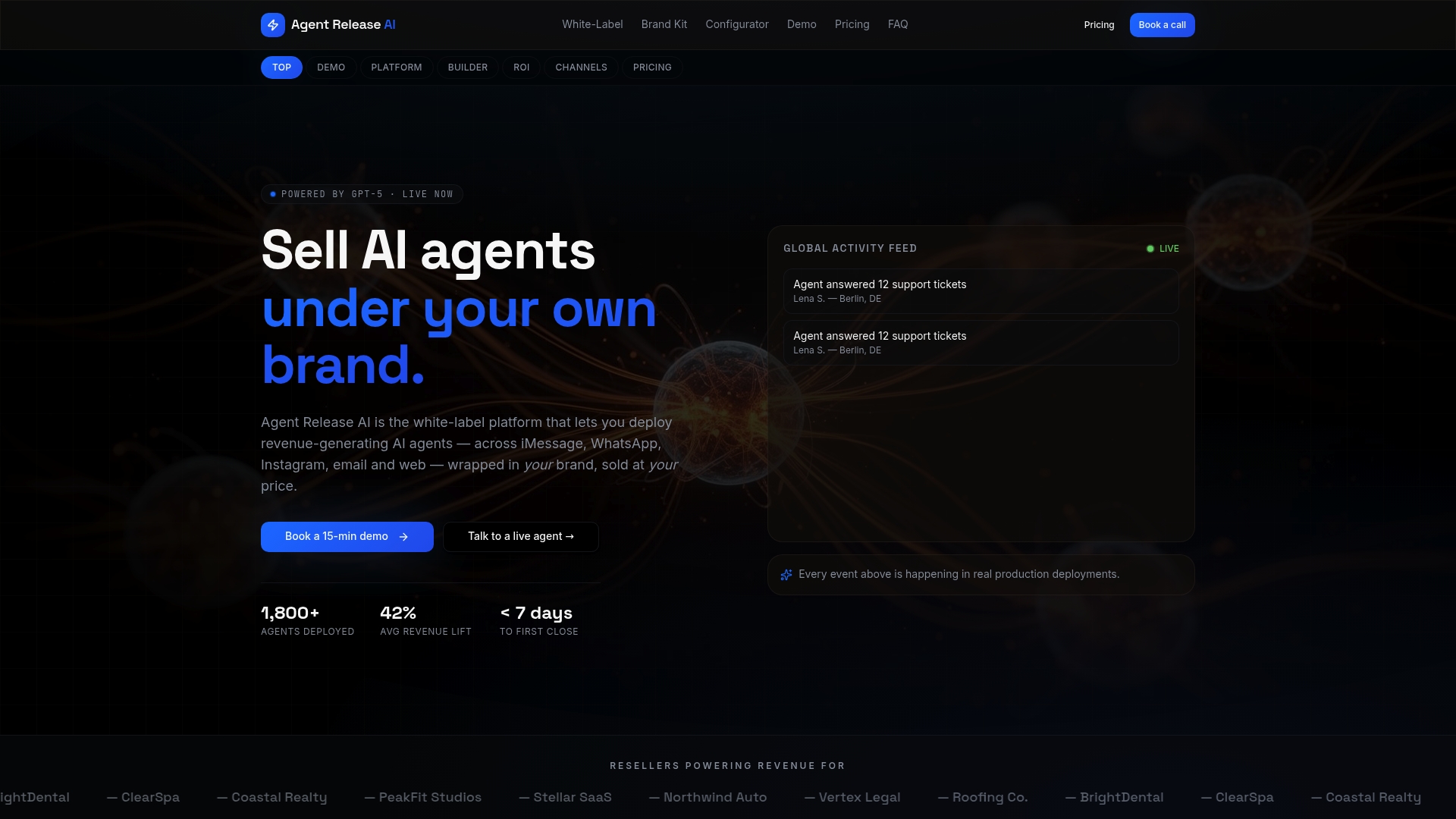
If you’re weighing per-message SaaS against a flat-rate alternative, check our pricing page or explore the White-Label Program built specifically for resellers. Book a call to see how fast your first client deployment can go live.
FAQ
How much does a chatbot cost in 2026?
Most businesses land between $100 and $2,500 a month on a SaaS subscription, depending on tier, AI usage and channel count. Enterprise deployments with SLAs and multi-channel scale typically start above $2,500 a month, while custom builds range from roughly $8,000 for a proof-of-concept to $150,000 or more for a multi-workflow enterprise project.
Is it cheaper to build or buy a chatbot?
Buying a subscription is cheaper until your sustained monthly spend passes roughly $2,000 to $3,000, at which point a custom build often becomes more cost-effective over two to three years because the one-time cost amortises while a subscription keeps compounding. Below that threshold, a SaaS or white-label subscription almost always wins on total cost.
What does Agent Release AI cost?
Agent Release AI is priced at a flat $497 a month, with unlimited tenant creation and no per-message or setup fees. A separate White-Label Program is available for agencies and resellers, with pricing available on request.
Do I pay GST on chatbot software subscriptions in Australia?
If you’re GST-registered, GST charged on a genuine business software subscription is generally recoverable as an input tax credit, provided the vendor issues a compliant tax invoice showing an ABN, as outlined in guidance on ChatGPT Business pricing for Australian buyers. Billing direct through a vendor’s website rather than an app store also tends to avoid extra platform markups.
What’s the difference between per-resolution and flat-rate chatbot pricing?
Per-resolution pricing charges a fee for every conversation the bot resolves without a human, which stays cheap at low volume but grows expensive once your conversation count passes a certain threshold. Flat-rate pricing caps your monthly cost regardless of volume up to a usage ceiling, making it easier to forecast once your conversation count is reasonably predictable.
Sources
- Australian AI Financial Services: Your ASIC 2026 Playbook — Enterprise DNA
- ChatGPT Pricing in Australia 2026 — AUD Costs for Free, Plus & Business