October 15, 2026
SMS Chatbot Use Cases for Australian Businesses: AI Needs Consent
Explore SMS chatbot use cases for support, bookings, cart recovery, and surveys, plus Australian consent rules, pilot KPIs, and white label options.

SMS Chatbot Use Cases for Australian Businesses: AI Needs Consent
The SMS chatbot use cases with the clearest payoff are customer service, appointment reminders, promotions and cart recovery, order updates, and surveys, with payments and collections also relevant in some cases. AI can make these interactions more personal and easier to scale. Consent, a clear sender ID and a working unsubscribe are not optional extras. They decide whether any of it is legal.
TL;DR:
- Text Request found around 76% of businesses text for customer service, while about 70% text for appointments and 84.8% of consumers want appointment texts.
- Start with appointment reminders or order updates, connect the bot to live calendar or order systems, and reserve promotions for stricter consent and frequency controls.
- ACMA found 40–44% of SMEs do not always follow unsubscribe rules, so automate opt out handling and identify your business in marketing texts.
- Use your own sales records and a control group to measure each flow; scale only when results beat costs and opt outs stay low.
Table of Contents
- 1. Which SMS chatbot use cases should you look at first?
- 2. How do SMS chatbots improve customer service?
- 3. How do SMS chatbots handle appointment scheduling and reminders?
- 4. How do promotions and cart recovery work over SMS?
- 5. How do order updates and delivery notifications reduce support load?
- 6. How do SMS surveys and review requests get more responses?
- 7. What do you need to get right on consent, sender ID and unsubscribes?
- 8. Which KPIs show whether an SMS chatbot is working?
- 9. What does a week-one pilot plan look like?
- 10. How do SMS chatbot use cases differ by industry?
- 11. How do SMS chatbots work alongside WhatsApp, email and other channels?
- 12. What security and privacy rules apply to SMS chatbots?
- 13. Why does a white-label, AI-first platform suit agencies and resellers?
- 14. Want to launch SMS AI agents under your own brand?
- FAQ
- Sources
1. Which SMS chatbot use cases should you look at first?
Scan this list, then jump to the use case closest to your business.
- Customer service: two-way answers and triage. Trigger: an inbound “Where’s my invoice?” text. AI matches intent and replies or hands over.
- Appointment scheduling and reminders: fewer no-shows. Trigger: a booking confirmed in your calendar.
- Promotions and cart recovery: timely, relevant offers. Trigger: an abandoned cart or a segment-based flash sale.
- Order and delivery updates: fewer “where is my order?” contacts. Trigger: a status change in your order system.
- Surveys and feedback: a quick way to collect customer feedback. Trigger: a completed job or delivery.
- Payments and collections: gentle nudges with a reply path. Trigger: an invoice nearing its due date.
AI adds the most value in intent detection, personalised wording and routing. Basic keyword bots cope with a fixed menu. An AI-powered text message chatbot copes with the messy way people actually write.
2. How do SMS chatbots improve customer service?
Customer service is the most common business texting use case. Text Request’s 2025 survey found around 76% of businesses text for customer service, and that texting is often the most effective channel for getting a quick response.
A typical flow looks like this:
- A customer texts a question.
- AI detects intent (billing, delivery, booking change, product question).
- The bot answers from your knowledge base or escalates to a person with the full thread attached.
- A ticket lands in your CRM or helpdesk automatically.
Where AI earns its keep:
- Intent detection: it reads “my parcel’s a no-show” and “package never arrived” as the same problem.
- Suggested replies: agents approve or edit a drafted answer instead of typing from scratch.
- Routing: urgent or high-value conversations jump the queue.
- Escalation rules: anything involving anger, refunds above a set amount or legal wording goes straight to a human.
Pro Tip: Write your escalation rules before your answers. Deciding what the bot must never handle alone keeps customers safe and keeps your team’s trust in the system.
The time saving comes from removing repeat questions, not from replacing staff. Your team spends its hours on the conversations that need judgement.
3. How do SMS chatbots handle appointment scheduling and reminders?
Appointment texts are one of the easiest wins. According to the same Text Request report, about 70% of companies text for appointments, and 84.8% of consumers want appointment texts. Demand is already there.
Three flows cover most needs:
- Booking by SMS: the customer texts “book”, the bot offers two or three slots as suggested replies, and the calendar updates on confirmation.
- Confirm or reschedule: a reminder asks for a one-word reply. “1” confirms, “2” offers new times.
- Reminder cadence: a confirmation straight after booking, a reminder the day before, and a short nudge a few hours ahead.
Connect the bot to your booking or calendar system so slots are real, not guessed. Two-way sync matters: a cancelled slot should reopen instantly so someone else can take it. Reminders about an existing booking are operational messages, which keeps compliance simpler than marketing.
For a step-by-step build, see our guide to launching SMS appointment reminders in one week. A sibling article from Plexo shows booking and reminder automations that work well alongside SMS.
4. How do promotions and cart recovery work over SMS?
Promotional texts convert when they are relevant and rare. They drive opt-outs when they are neither.
Flows worth building:
- Segmented flash offers: a time-limited deal sent only to customers who bought a related product.
- Voucher delivery: a code sent on request, with a reply keyword to claim it.
- Cart reminders: one nudge a few hours after abandonment, with a single quick call to action.
AI helps by choosing the right offer for the right person, writing in a tone that fits the customer’s past replies, and holding back when someone has gone quiet. A chatbot can also answer “does this ship by Friday?” inside the thread, which a one-way blast can’t.
Set guardrails. Cap frequency per customer, require a minimum amount of known context before personalising (a first name alone isn’t enough), and always include sender identity and an opt-out. Measure uplift by holding back a small control group that receives nothing, then comparing revenue per recipient. Marketing texts need higher personalisation and tighter frequency control than operational ones, as Sinch’s customer communications research notes.
5. How do order updates and delivery notifications reduce support load?
Order updates are operational texts, and customers expect them. Typical messages:
- Order confirmed, with an estimated date.
- Dispatched, with a tracking link.
- Out for delivery today.
- Delivered, with a prompt to report problems.
The value is in the exception. When a delivery fails, the text offers reply options: reschedule, leave in a safe place, or report an issue. Choosing “report an issue” can open a ticket and ask for a photo as proof, all without a phone call.
Two-way threads cut the “where is my order?” contacts that otherwise land on your support line, and they shorten resolution because the customer’s details arrive with the first message. Sinch’s sector findings point to higher AI chatbot adoption in retail, healthcare and finance for exactly these order updates, support and shipping notices.
Integration is straightforward in principle: your order management or logistics system fires an event on each status change, and the bot sends the matching message and listens for replies. Keep the wording short, put the tracking link first, and never bury the reply options.
6. How do SMS surveys and review requests get more responses?
A short text can be easier to answer than a long form because it asks for a quick response. Good patterns:
- Timing: send within a few hours of the visit or delivery, while it’s fresh.
- Question design: ask a simple question, such as “How was your visit?” Follow up based on whether the answer is positive or negative.
- Review prompts: after a positive score, send the review link. After a negative score, ask what went wrong and alert a manager.
AI summarises free-text replies into themes and sentiment, so you see “late arrivals” rising before it becomes a pattern in your reviews. Negative feedback flags itself for fast human follow-up.
On incentives, be careful. Offering a reward for any review, or only for positive ones, can breach platform rules and consumer law. Thank everyone who replies, or run a draw open to all respondents, rather than paying for a particular rating.
7. What do you need to get right on consent, sender ID and unsubscribes?
Start by separating operational messages (reminders, order updates) from marketing messages (offers, promotions). Marketing messages carry stricter consent obligations. ACMA’s guidance is clear that you need consent before sending, and that express consent is best practice even where inferred consent is possible.
Under the Spam Act 2003, as Sinch’s summary of Australian SMS law lays out, a marketing SMS must be sent with consent, identify the sender, include accurate contact details and offer a functional unsubscribe that you honour within 5 working days.
Your technical checklist:
- Store proof of opt-in: the date, the source and the wording shown.
- Identify your business in every marketing message.
- Include a clear opt-out instruction such as “Reply STOP”.
- Test the unsubscribe flow end to end before launch.
- Honour opt-outs well inside the 5-working-day limit, ideally instantly.
- Connect the bot to your CRM and booking tools, and enable human handover.
ACMA research on small and medium-sized businesses found many SMEs misunderstand the unsubscribe rules, with 40–44% not always following them for SMS and direct messages. SMS unsubscribes are also more often handled by hand than email ones. The fix is simple: automate opt-out handling inside the chatbot so it never waits on a person.
For a detailed pre-send routine, Moor Marketing’s compliance checklist is a practical companion.
8. Which KPIs show whether an SMS chatbot is working?
Track a small set of numbers and review them weekly at first.
- Delivery rate: messages that arrive, which flags number or carrier problems.
- Opt-out rate: the clearest signal of messages that annoy people.
- Response rate: replies per message sent, key for service and survey flows.
- Conversion or click-through rate: purchases, bookings or link taps from a flow.
- No-show reduction: missed appointments before versus after reminders.
- Cost per positive outcome: total flow cost divided by bookings kept, orders recovered or issues resolved.
Revenue attribution is where many programmes go vague. We recommend server-side attribution, where your own systems record the sale and match it to the conversation, rather than relying on link clicks that miss in-thread purchases. Tag each flow (reminder, cart, survey) so results roll up cleanly. Review monthly once the numbers settle, and scale a flow only when its outcome beats its cost and its opt-out rate stays low.
9. What does a week-one pilot plan look like?
Pick one use case and prove it before you build more.
- Define one KPI, such as no-shows or recovered carts.
- Capture consent and store proof of it.
- Build one or two flows only.
- Test the unsubscribe and sender ID on real phones.
- Connect your CRM or calendar.
- Set monitoring: daily checks on replies, failures and opt-outs.
Run the pilot long enough to gather sufficient volume for a meaningful result. Review whether replies make sense and opt-outs stay low. Compare against your pre-pilot baseline.
Pro Tip: Test tone and personalisation on staff and friendly customers first, and send AI-drafted replies for human approval until you trust them.
Our guide to shipping a chatbot in under a week walks through the conversation design for this stage.
10. How do SMS chatbot use cases differ by industry?
The same flows adapt differently by sector. Sinch’s research notes AI chatbot adoption in healthcare, finance and retail.
- Healthcare and allied health: appointment confirmations, pre-visit instructions and recall reminders. Keep clinical detail out of texts and send people to a secure link.
- Finance and accounting: payment nudges, document requests and deadline reminders. Verify identity before discussing balances.
- Retail and e-commerce: cart recovery, back-in-stock alerts and delivery updates, plus product questions answered in thread.
- Trades and home services: quote follow-ups, arrival windows (“Dave is 20 minutes away”) and post-job review requests.
- Hospitality and fitness: bookings, waitlist offers and class reminders, with last-minute slots filled by text.
- Logistics: exception handling, redelivery choices and proof-of-delivery requests.
- Real estate: open-home reminders and instant replies to enquiries, with hot leads passed straight to an agent.
In each case, start with the operational flow that your customers already expect, then layer on marketing once consent and trust are in place.
11. How do SMS chatbots work alongside WhatsApp, email and other channels?
SMS rarely works best alone. A customer might book by text, receive an invoice by email and ask a follow-up on WhatsApp. If each channel keeps its own memory, they repeat themselves, and the experience falls apart.
Good cross-channel design rests on a few ideas:
- One customer record: every message, whatever the channel, attaches to the same profile.
- Channel by purpose: SMS for urgent, short and time-sensitive messages. Email for receipts and longer detail. WhatsApp or Messenger for richer conversations where the customer already prefers them.
- Respect preferences: if someone opts out of SMS, they may still welcome email. Treat consent per channel, never as one blanket yes.
- Handover without friction: when a text thread needs a longer reply, the bot can offer to continue by email and carry the context across.
Richer formats such as RCS buttons and image carousels add an incremental option beyond plain SMS, as the Sinch report notes, but plain SMS remains a widely used messaging channel.
A multi-channel inbox helps your team see all of this in one place. Our walkthrough on launching a messenger automation flow in a day shows how a second channel fits in without starting over.
12. What security and privacy rules apply to SMS chatbots?
Treat SMS cautiously and avoid sending sensitive information in messages. Never send full card numbers, passwords or sensitive health or financial details by text. Send a short message with a secure link instead, and verify the person before sharing anything personal.

On privacy, the OAIC’s direct marketing guidance explains that organisations sending commercial electronic messages such as SMS must comply with the Spam Act and the applicable privacy principles. That includes how you collect personal information and when you disclose it to third parties for marketing. Check what your chatbot vendor does with message data, and whether it is used to train models.
Enforcement is real. ACMA’s spam investigations have led to infringement notices and enforceable undertakings against brands that sent marketing SMS without consent or a working unsubscribe.
Practical safeguards:
- Collect opt-in with clear wording and keep the record.
- Limit what the bot can see and say, using role-based access.
- Log conversations and set a retention period.
- Hand sensitive topics to a human.
- Choose a platform with enterprise-grade security and clear data controls.
13. Why does a white-label, AI-first platform suit agencies and resellers?
If you sell SMS chatbot services to clients, the platform you build on shapes your margins. Our view is that agencies win when they own the relationship and the brand, not when they hand clients a vendor’s logo. A white-label platform with multi-tenant management lets you run many client accounts under your own name, deploy in days rather than months, and prove revenue with server-side attribution, which is the number a client renews on.
Package the work as a recurring service: a setup fee for flows and consent capture, then a monthly retainer for monitoring, tuning and reporting, tiered by channels or conversation volume. Clients pay for outcomes, such as fewer no-shows or recovered carts, not for software seats. For the economics, see our analysis of small business chatbot payback.
— Agent
14. Want to launch SMS AI agents under your own brand?
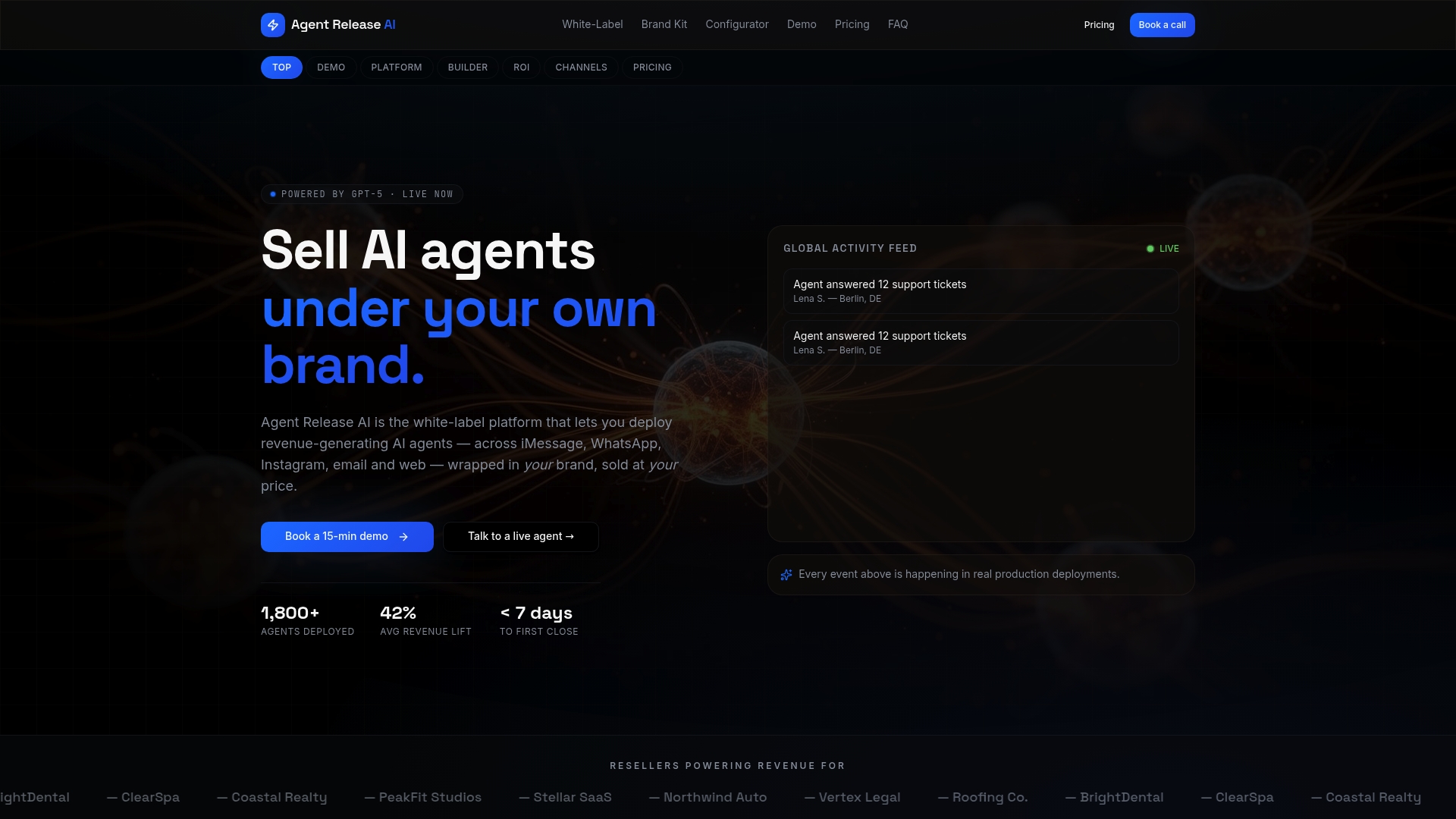
We give agencies, consultants and resellers a white-label platform to launch AI agents on SMS and other messaging channels, branded as yours. Deployment timelines vary, and the platform includes server-side revenue tracking and security features.
- See the Agent Release AI plan, listed at 497 $ per month.
- Explore the White-Label Program for reseller options; current pricing details are on its page.
- Build your setup in the White-Label Configurator.
Start with one use case, pilot it for a few weeks, and book a demo when you’re ready to see it running.
FAQ
Do I need consent to send SMS chatbot messages?
Yes, for marketing messages you need consent before you send. Operational messages such as appointment reminders are treated differently, but you should still collect a clear opt-in and keep a record of it. ACMA’s guidance says express consent is best practice even where inferred consent is possible.
What is the difference between operational and marketing SMS?
Operational texts are updates a customer expects, such as order status or booking reminders. Marketing texts promote offers and need stricter consent, tighter frequency limits and more relevant personalisation. Sinch’s research draws the same line.
How fast must I honour an unsubscribe request?
Within 5 working days under the Spam Act, but instant is better. Automating opt-outs inside your chatbot removes the delay that ACMA found many small businesses struggle with when handling them by hand.
How do I measure the ROI of an SMS chatbot?
Tie each flow to one outcome, such as kept appointments or recovered carts, and divide the flow’s cost by the number of positive outcomes. Server-side attribution gives you the most reliable revenue figures, and a held-back control group shows true uplift.
Which SMS chatbot use case should I start with?
Start with appointment reminders or order updates. They are operational, welcomed by customers and simple to measure, and they build the consent base you need for promotions later.